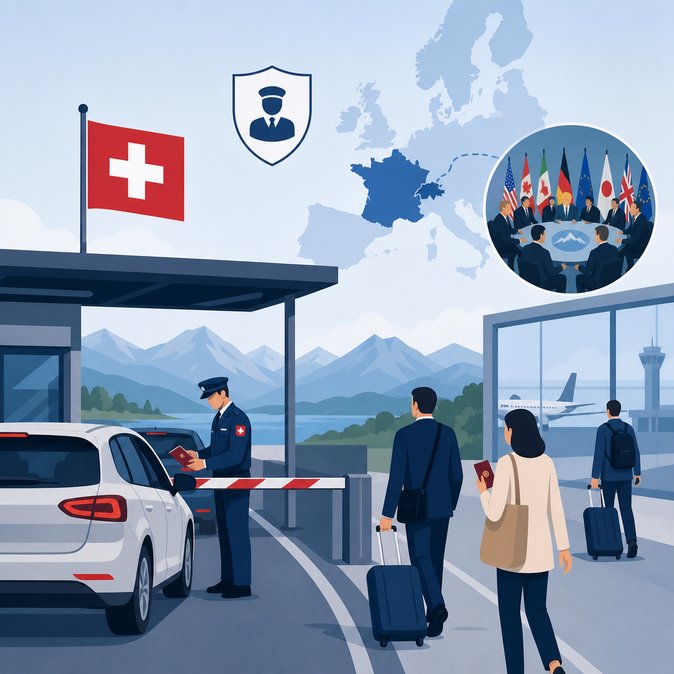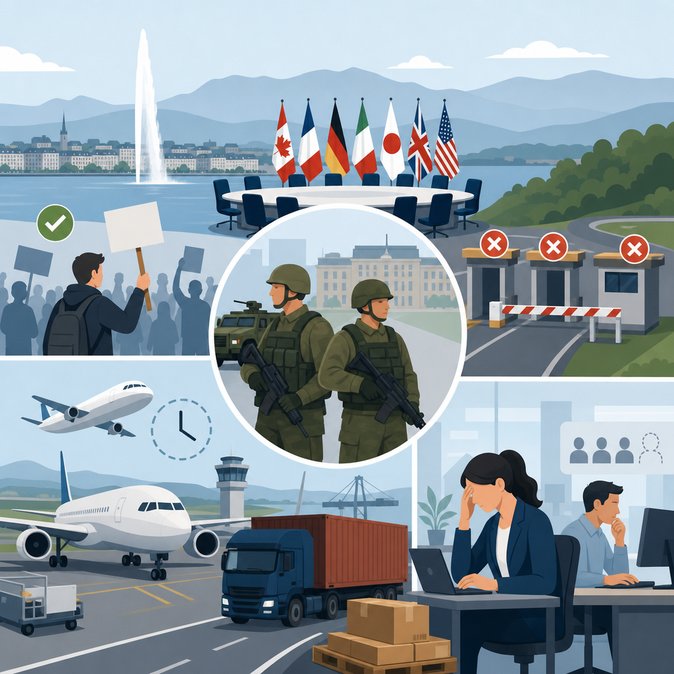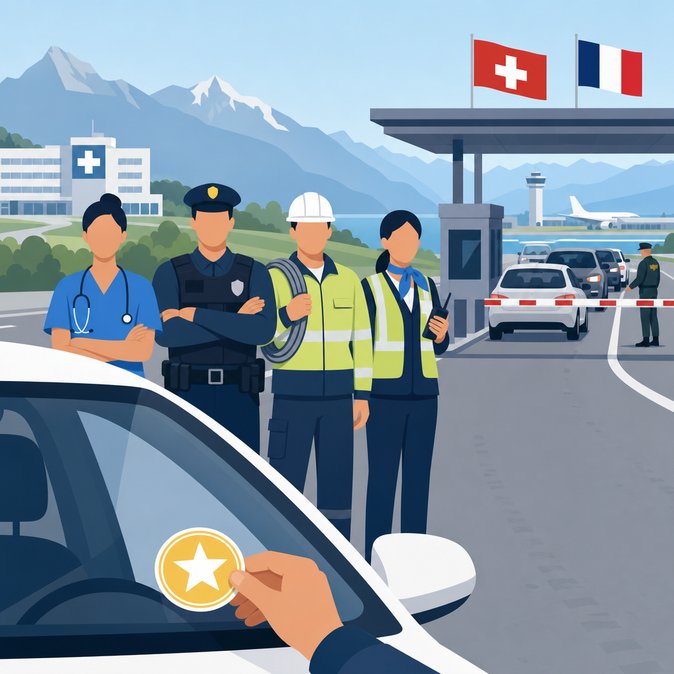
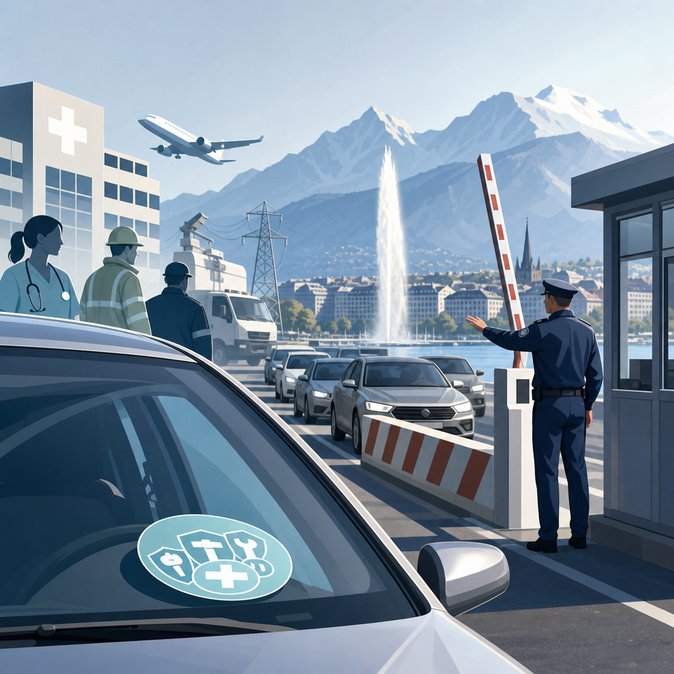
To blunt the economic impact of summit-related controls, the Geneva cantonal government published a detailed scheme on 21 May 2026 under which employers can request special windshield stickers—nicknamed “macarons”—for staff who live in France but perform critical functions in Switzerland. The measure applies from 12 to 18 June, overlapping exactly with the period of reinforced customs checks. Holders of the macaron will be funnelled through dedicated lanes at Bardonnex and Thônex-Vallard, the two main Geneva crossings, and will gain timed-access to three smaller posts opened exclusively for them. Eligible sectors include hospitals, emergency services, energy utilities, public transport (TPG), and Geneva Airport operations. Applicants must satisfy three cumulative criteria: (1) residency in France, (2) an on-site role that cannot be done remotely, and (3) fixed or on-call shifts. Requests, which must be submitted by employers rather than individuals, close at 23:59 on 27 May.
![Geneva Launches Priority ‘Macaron’ Passes for Critical Cross-Border Staff During G7 Week]()
Professionals navigating cross-border compliance can also tap external expertise. VisaHQ, a global visa and travel documentation platform, offers dedicated Swiss resources (https://www.visahq.com/switzerland/) that can help HR teams understand entry requirements, track paperwork, and coordinate staff movements—support that dovetails neatly with the canton’s macaron programme.
Stickers will be distributed in early June and are non-transferable; misuse can trigger prosecution. For mobility and HR teams the macaron offers a lifeline: roughly 70 % of Geneva University Hospital’s nursing staff and a third of airport ground personnel are French residents. Without fast-track access, service continuity—already stretched by record tourist numbers—would be at risk. Companies outside the critical list should prepare alternative staffing plans or remote-work options. The initiative reflects lessons learned from the 2003 G8 summit, when clogged borders cost the canton an estimated CHF 40 million in lost productivity. By pre-identifying essential workers, Geneva hopes to avoid a repeat and present an orderly image to the world’s media. It also illustrates how local authorities, not just federal ones, are shaping mobility policy in real time—an important precedent for HR directors managing decentralised Swiss workforces.
Professionals navigating cross-border compliance can also tap external expertise. VisaHQ, a global visa and travel documentation platform, offers dedicated Swiss resources (https://www.visahq.com/switzerland/) that can help HR teams understand entry requirements, track paperwork, and coordinate staff movements—support that dovetails neatly with the canton’s macaron programme.
Stickers will be distributed in early June and are non-transferable; misuse can trigger prosecution. For mobility and HR teams the macaron offers a lifeline: roughly 70 % of Geneva University Hospital’s nursing staff and a third of airport ground personnel are French residents. Without fast-track access, service continuity—already stretched by record tourist numbers—would be at risk. Companies outside the critical list should prepare alternative staffing plans or remote-work options. The initiative reflects lessons learned from the 2003 G8 summit, when clogged borders cost the canton an estimated CHF 40 million in lost productivity. By pre-identifying essential workers, Geneva hopes to avoid a repeat and present an orderly image to the world’s media. It also illustrates how local authorities, not just federal ones, are shaping mobility policy in real time—an important precedent for HR directors managing decentralised Swiss workforces.