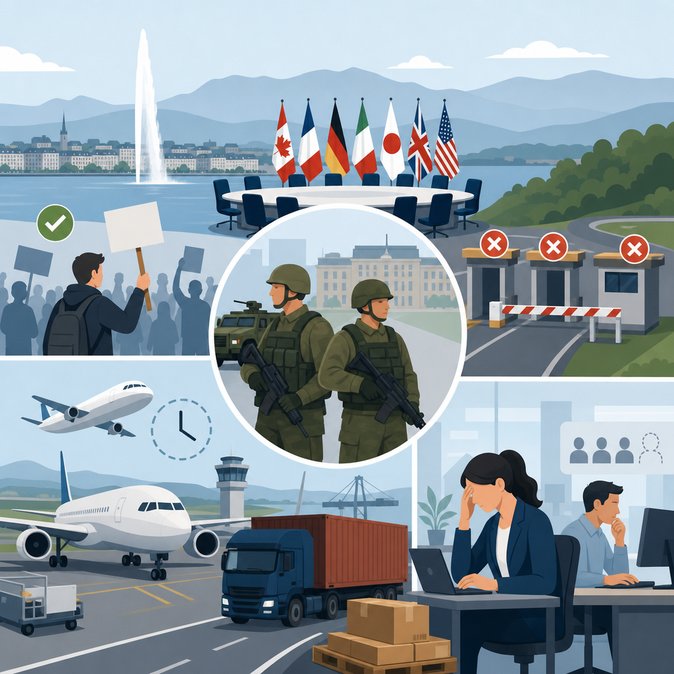
In its 21 May 2026 daily briefing, Swiss public broadcaster SWI Swissinfo reported that Geneva’s cantonal government has authorised a single demonstration on 14 June—one day before the G7 opens in Évian—but warned that police resources are already stretched to the limit. Under the plan, all other unauthorised public events between 12 and 17 June are banned. The Federal Council has green-lit the mobilisation of up to 5 000 soldiers to reinforce cantonal officers, some of whom are facing 12-hour shifts over ten consecutive days. Geneva’s public prosecutor says arrest-processing capacity will need to double or triple, a reminder that even peaceful protests can create logistical headaches.
![Geneva Clears Protest, Confirms Troop Back-Up and Border Closures for G7; Mobility Managers Face Staffing Crunch]()
Amid such uncertainty, companies and travellers scrambling for last-minute arrangements can lean on VisaHQ’s Switzerland portal (https://www.visahq.com/switzerland/) for swift visa checks, document procurement and expert guidance—helping staff, delegates and VIPs reroute through alternative Swiss or Schengen gateways without adding paperwork headaches to an already complex week.
Mobility implications are immediate: from 12 June only seven of 35 local border points will remain open; secondary crossings will be closed or time-restricted, further complicating commutes for the 30 000 cross-border staff who keep Geneva’s hotels, restaurants and retail outlets running. Employers relying on temp agencies for event hospitality or retail peak-season cover may find staff unable or unwilling to cross into Switzerland. Relocation managers with VIP moves scheduled for mid-June should either delay inbound shipments or route trucks via Basel or Vallorbe. Business-aviation providers operating out of Geneva (GVA) report that parking slots are already sold out, forcing overflow flights to Bern or Sion and adding costly helicopter shuttles. The episode underlines how security logistics, industrial relations and border management now intersect. With NATO set to meet in Brussels a week later, similar clamp-downs could ripple across the region. Firms should therefore treat the G7 as a dress rehearsal for compounded mobility stress in Europe’s peak summer season.

Amid such uncertainty, companies and travellers scrambling for last-minute arrangements can lean on VisaHQ’s Switzerland portal (https://www.visahq.com/switzerland/) for swift visa checks, document procurement and expert guidance—helping staff, delegates and VIPs reroute through alternative Swiss or Schengen gateways without adding paperwork headaches to an already complex week.
Mobility implications are immediate: from 12 June only seven of 35 local border points will remain open; secondary crossings will be closed or time-restricted, further complicating commutes for the 30 000 cross-border staff who keep Geneva’s hotels, restaurants and retail outlets running. Employers relying on temp agencies for event hospitality or retail peak-season cover may find staff unable or unwilling to cross into Switzerland. Relocation managers with VIP moves scheduled for mid-June should either delay inbound shipments or route trucks via Basel or Vallorbe. Business-aviation providers operating out of Geneva (GVA) report that parking slots are already sold out, forcing overflow flights to Bern or Sion and adding costly helicopter shuttles. The episode underlines how security logistics, industrial relations and border management now intersect. With NATO set to meet in Brussels a week later, similar clamp-downs could ripple across the region. Firms should therefore treat the G7 as a dress rehearsal for compounded mobility stress in Europe’s peak summer season.