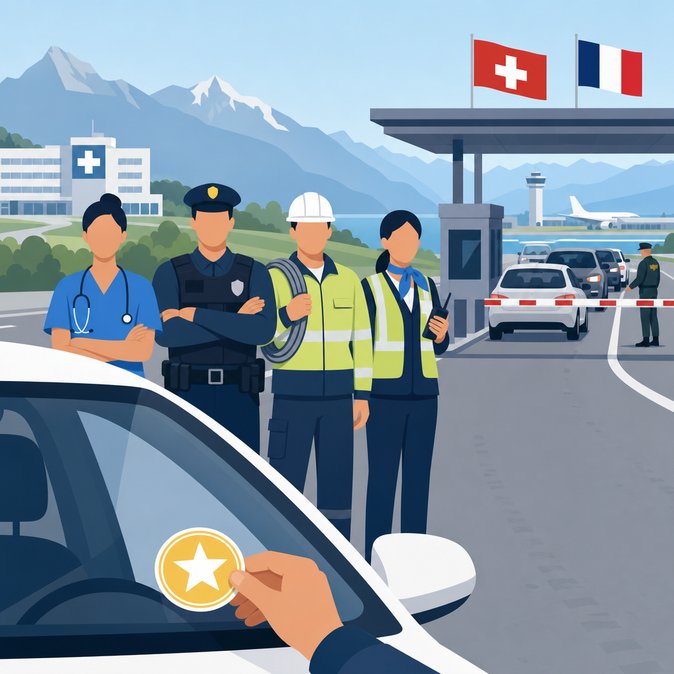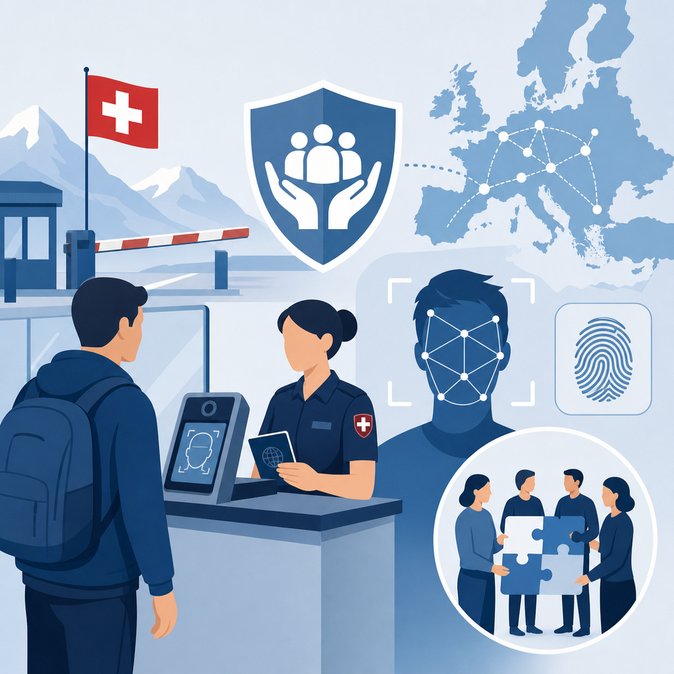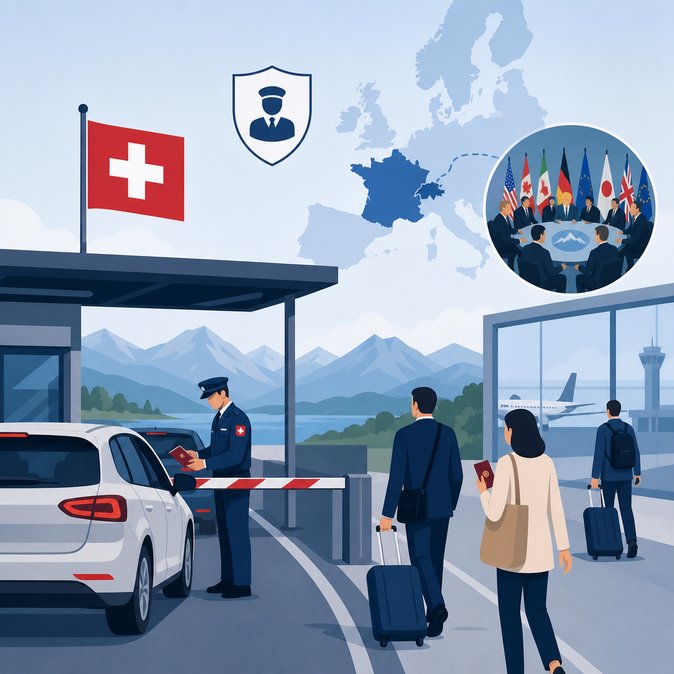
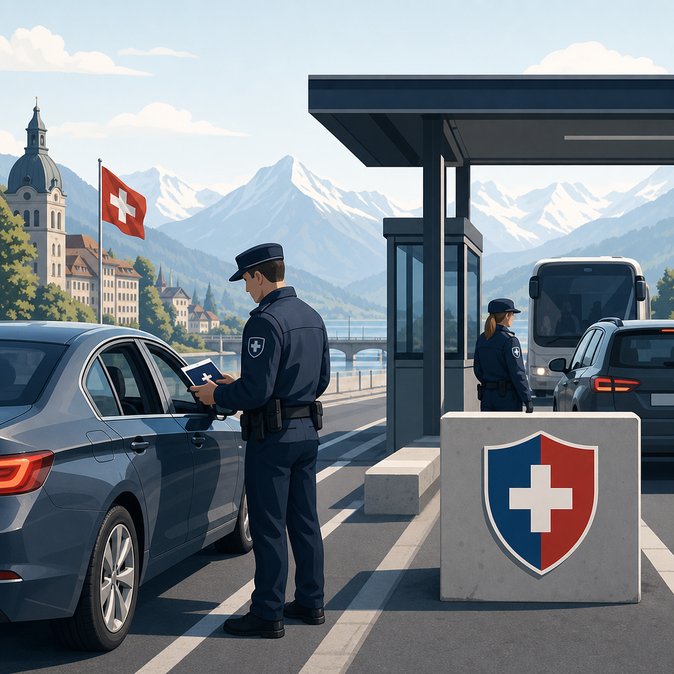
The Swiss Federal Council confirmed on 21 May 2026 that it will reactivate temporary checks at its normally open internal Schengen border with France from 10 to 19 June, ahead of the Group-of-Seven (G7) leaders’ meeting in Évian-les-Bains. Although Switzerland has exercised its Schengen right to re-introduce controls before, this is the first time since the pandemic that the measure targets only one neighbouring country and is driven primarily by summit-related security rather than migration pressures. Évian lies barely ten kilometres from Geneva, where cross-border commuting is part of daily life: about 95 000 frontier workers enter the canton each work-day and Geneva Airport handles more than half a million passengers per week in June. During the ten-day period, customs and the Federal Office for Customs and Border Security (BAZG) will be able to stop travellers “without suspicion” at main and secondary crossings, as well as inside Swiss territory.
![Switzerland to Reinstate French Border Checks for G7 Summit, Business Travellers Warned]()
For added certainty, travellers uncertain about whether they need additional documentation or a visa for Switzerland can quickly verify their individual requirements through VisaHQ, which offers real-time eligibility checks, step-by-step application support and courier services for urgent cases. For more information, visit https://www.visahq.com/switzerland/
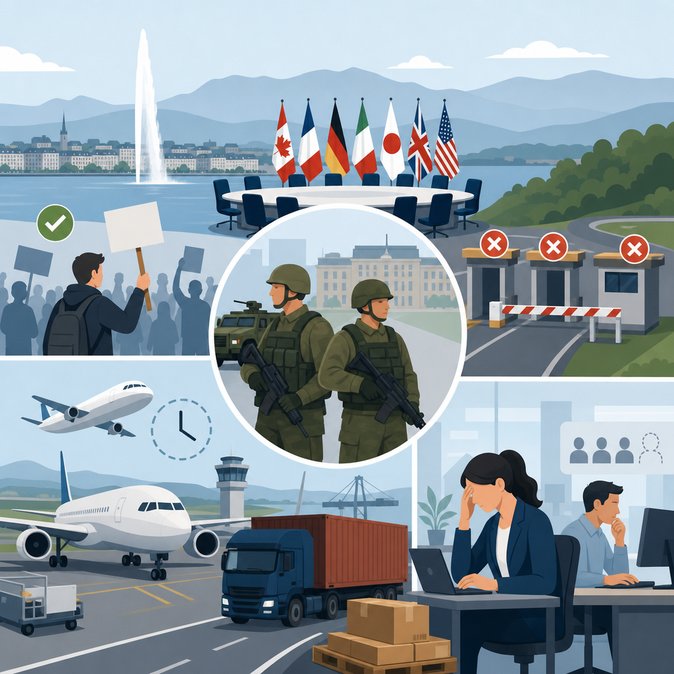
Airlines have been asked to advise passengers to arrive earlier at Geneva and Zürich airports; trucking companies are being urged to build extra time into just-in-time delivery schedules. The Federal Council has also authorised the deployment of up to 5 000 Swiss Army soldiers to reinforce cantonal police if protests spill onto Swiss soil, replicating the model used for the 2021 Biden-Putin summit. For mobility managers the key practical point is contingency planning: cross-border staff may face queues of up to 60 minutes at Bardonnex and Thônex-Vallard, Geneva’s busiest crossings. Employers should issue attendance flexibility guidelines and, where possible, shift meetings to virtual formats or schedule them outside the peak summit window. Travellers transiting Geneva rail hub to alpine resorts should note that only seven of the region’s 35 crossings will remain open 24/7; night trains will be subject to on-board ID checks. Swiss authorities emphasise that EU nationals and other Schengen residents retain the right of entry, but must carry a passport or national ID card. Non-EU business visitors should have both their passport and Swiss/Schengen visa or residence permit ready for inspection. Failure to do so could result in refused entry or fines—even for people accustomed to friction-free Schengen travel. Companies running just-in-time operations, especially in luxury goods and pharma, are advised to use the government’s real-time traffic app and to build in buffer inventory. The temporary measures underscore an emerging European trend: the politicisation of internal Schengen borders in response to security events. Germany, Norway and Slovenia implemented similar controls earlier this spring. If the G7 passes without major incident, Switzerland will lift the checks at 23:59 on 19 June; if unrest flares, the window can be extended in renewable 30-day blocks. Global mobility teams with staff in the Léman region should therefore monitor official communiqués closely and maintain agile travel policies.
For added certainty, travellers uncertain about whether they need additional documentation or a visa for Switzerland can quickly verify their individual requirements through VisaHQ, which offers real-time eligibility checks, step-by-step application support and courier services for urgent cases. For more information, visit https://www.visahq.com/switzerland/
Airlines have been asked to advise passengers to arrive earlier at Geneva and Zürich airports; trucking companies are being urged to build extra time into just-in-time delivery schedules. The Federal Council has also authorised the deployment of up to 5 000 Swiss Army soldiers to reinforce cantonal police if protests spill onto Swiss soil, replicating the model used for the 2021 Biden-Putin summit. For mobility managers the key practical point is contingency planning: cross-border staff may face queues of up to 60 minutes at Bardonnex and Thônex-Vallard, Geneva’s busiest crossings. Employers should issue attendance flexibility guidelines and, where possible, shift meetings to virtual formats or schedule them outside the peak summit window. Travellers transiting Geneva rail hub to alpine resorts should note that only seven of the region’s 35 crossings will remain open 24/7; night trains will be subject to on-board ID checks. Swiss authorities emphasise that EU nationals and other Schengen residents retain the right of entry, but must carry a passport or national ID card. Non-EU business visitors should have both their passport and Swiss/Schengen visa or residence permit ready for inspection. Failure to do so could result in refused entry or fines—even for people accustomed to friction-free Schengen travel. Companies running just-in-time operations, especially in luxury goods and pharma, are advised to use the government’s real-time traffic app and to build in buffer inventory. The temporary measures underscore an emerging European trend: the politicisation of internal Schengen borders in response to security events. Germany, Norway and Slovenia implemented similar controls earlier this spring. If the G7 passes without major incident, Switzerland will lift the checks at 23:59 on 19 June; if unrest flares, the window can be extended in renewable 30-day blocks. Global mobility teams with staff in the Léman region should therefore monitor official communiqués closely and maintain agile travel policies.