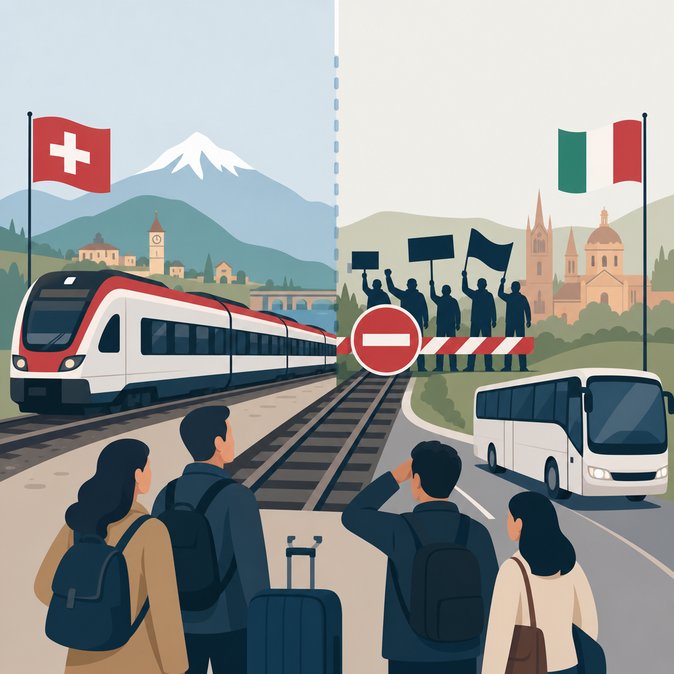
Cross-border commuters in Switzerland’s southern Canton Ticino awoke on 18 May to widespread rail cancellations after Italy’s USB union launched a 24-hour national strike covering Trenitalia, Trenord and Italo personnel. Because TILO trains are jointly operated by Swiss Federal Railways (SBB) and Trenord, five key regional lines that normally continue into Lombardy were truncated at the frontier, MoneyMag.ch reported at 07:12. Services on the RE80 (Locarno–Zurich–Milan), S10 (Bellinzona–Chiasso–Como), S30 (Bellinzona–Luino), S40 (Cadenazzo–Varese–Malpensa) and S50 (Bellinzona–Stabio–Malpensa) all ran normally on the Swiss side but terminated at Chiasso, Stabio or Pino-Tronzano, leaving no direct rail link to Milan or Malpensa Airport for most of the day. To protect air connections, TILO organised non-stop buses between Stabio and Malpensa, though passengers from Lugano or Bellinzona had to backtrack to Stabio first. Under Italian law, limited “fasce di garanzia” ensured skeleton services between 06:00–09:00 and 18:00–21:00, but outside these windows travellers faced an effective shutdown. Around 78,500 Italian cross-border workers who enter Ticino daily were advised to drive to the first Swiss station, work remotely, or take leave.
![Italian 24-hour rail strike halts TILO cross-border services, forces bus shuttles to Malpensa]()
For cross-border staff who suddenly find themselves rerouting through unfamiliar airports or needing updated work authorisations, VisaHQ’s Switzerland portal (https://www.visahq.com/switzerland/) offers a quick, fully online way to secure visas, residence permits and other travel documents. The service’s real-time tracking and corporate bulk-processing options can help both individuals and HR teams minimise disruption the next time strikes, schedule changes or other surprises hit the railways.
Cargo forwarders also shifted urgent shipments onto road, adding pressure to already busy motorway border crossings. For Swiss employers, the disruption highlighted the fragility of reliance on Italian rail labour and underlined the need for contingency planning as further strikes remain likely amid wage and public-service funding disputes in Italy. HR departments were reminded that absences caused by third-party industrial action can require special payroll coding and that travel insurance rarely covers strike-related delays inside Europe. Normal timetables are expected to resume on the morning of 19 May, but observers note that growing labour unrest south of the border could make such shutdowns a recurring headache for Swiss mobility managers through 2026.

For cross-border staff who suddenly find themselves rerouting through unfamiliar airports or needing updated work authorisations, VisaHQ’s Switzerland portal (https://www.visahq.com/switzerland/) offers a quick, fully online way to secure visas, residence permits and other travel documents. The service’s real-time tracking and corporate bulk-processing options can help both individuals and HR teams minimise disruption the next time strikes, schedule changes or other surprises hit the railways.
Cargo forwarders also shifted urgent shipments onto road, adding pressure to already busy motorway border crossings. For Swiss employers, the disruption highlighted the fragility of reliance on Italian rail labour and underlined the need for contingency planning as further strikes remain likely amid wage and public-service funding disputes in Italy. HR departments were reminded that absences caused by third-party industrial action can require special payroll coding and that travel insurance rarely covers strike-related delays inside Europe. Normal timetables are expected to resume on the morning of 19 May, but observers note that growing labour unrest south of the border could make such shutdowns a recurring headache for Swiss mobility managers through 2026.