
Poland processed a record 509,000 temporary-residence applications from non-EU nationals in 2025, but more than 150,000 cases were still waiting for a first-instance decision as of April. On 17 May 2026 the Chancellery of the Prime Minister published draft bill UD-408, which would introduce “milczące załatwienie sprawy”—silent approval—if a provincial governor fails to issue a decision within 60 days after a complete file is lodged. The reform targets applicants from “low-risk, highly developed” third countries whose security vetting raises few red flags.
![Polish government proposes ‘silent approval’ to clear 500,000-case residence-permit backlog]()
Businesses and individual professionals navigating these evolving rules can streamline the process through VisaHQ’s Poland portal (https://www.visahq.com/poland/). The service tracks real-time legislative updates such as UD-408, offers document pre-screening and submission support, and coordinates courier and biometrics appointments, helping applicants avoid costly delays and keep within the prospective 60-day window.
If passed, it means that workers transferred from the United States, Canada, Japan or South Korea, for example, could receive legal stay and work rights automatically when the two-month window closes, unless authorities actively object. Appeals and post-decision security checks would still be possible, and the Interior Ministry could revoke the permit if new threats emerge. Employers’ federations, especially in IT, renewable energy and advanced manufacturing, have lobbied for predictable timelines, arguing that Poland’s new MOS 2.0 e-filing system (launched 27 April) has not yet resolved chronic queues at voivode offices. The Confederation Lewiatan estimates each month of delay costs firms roughly €4,000 in lost productivity per expatriate. Silent approval, they say, would align Poland with fast-track models already used in the Netherlands and Denmark, enhancing the country’s competitiveness for foreign investment. Migrants’-rights groups cautiously welcome the idea but warn that unequal treatment by nationality could breach EU non-discrimination rules. They also point out that applicants covered by silent approval would still have to wait for a physical residence card—something that in Mazowieckie voivodeship currently takes up to 90 days after a decision. Without the card, cross-border business travel is risky because re-entry into Poland can be denied. For global-mobility managers the proposal is encouraging but not yet law. Companies should continue to submit complete digital files through MOS 2.0, track the 60-day clock and budget extra time for card issuance. If the bill passes in the second quarter, HR teams should review posted-worker notifications, A1 certificates and Schengen visa usage to prevent overstays during the transition.

Businesses and individual professionals navigating these evolving rules can streamline the process through VisaHQ’s Poland portal (https://www.visahq.com/poland/). The service tracks real-time legislative updates such as UD-408, offers document pre-screening and submission support, and coordinates courier and biometrics appointments, helping applicants avoid costly delays and keep within the prospective 60-day window.
If passed, it means that workers transferred from the United States, Canada, Japan or South Korea, for example, could receive legal stay and work rights automatically when the two-month window closes, unless authorities actively object. Appeals and post-decision security checks would still be possible, and the Interior Ministry could revoke the permit if new threats emerge. Employers’ federations, especially in IT, renewable energy and advanced manufacturing, have lobbied for predictable timelines, arguing that Poland’s new MOS 2.0 e-filing system (launched 27 April) has not yet resolved chronic queues at voivode offices. The Confederation Lewiatan estimates each month of delay costs firms roughly €4,000 in lost productivity per expatriate. Silent approval, they say, would align Poland with fast-track models already used in the Netherlands and Denmark, enhancing the country’s competitiveness for foreign investment. Migrants’-rights groups cautiously welcome the idea but warn that unequal treatment by nationality could breach EU non-discrimination rules. They also point out that applicants covered by silent approval would still have to wait for a physical residence card—something that in Mazowieckie voivodeship currently takes up to 90 days after a decision. Without the card, cross-border business travel is risky because re-entry into Poland can be denied. For global-mobility managers the proposal is encouraging but not yet law. Companies should continue to submit complete digital files through MOS 2.0, track the 60-day clock and budget extra time for card issuance. If the bill passes in the second quarter, HR teams should review posted-worker notifications, A1 certificates and Schengen visa usage to prevent overstays during the transition.
More From Poland
View all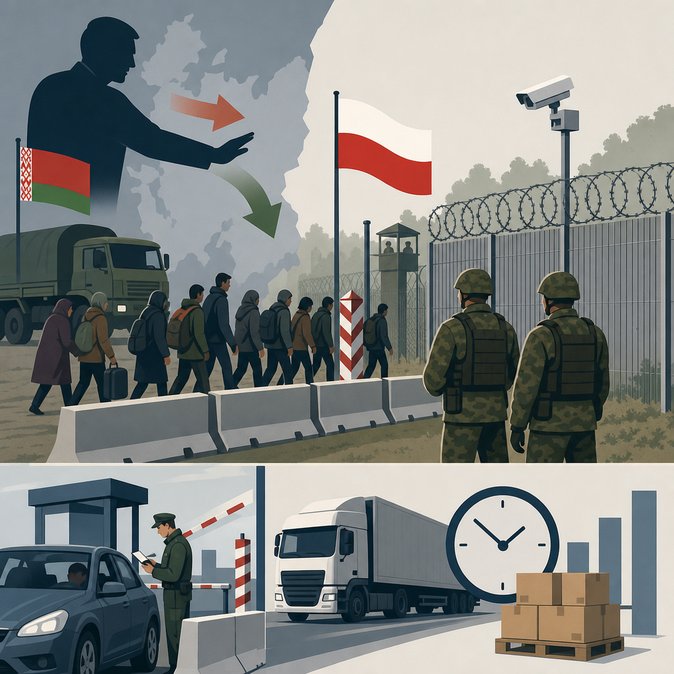
Polish officials warn NATO that Russia and Belarus are ‘weaponising’ migration at the Polish-Belarusian frontier

Live border data show 16-hour truck delays at Shehyni–Medyka crossing on 17 May, straining Polish-Ukrainian supply chains