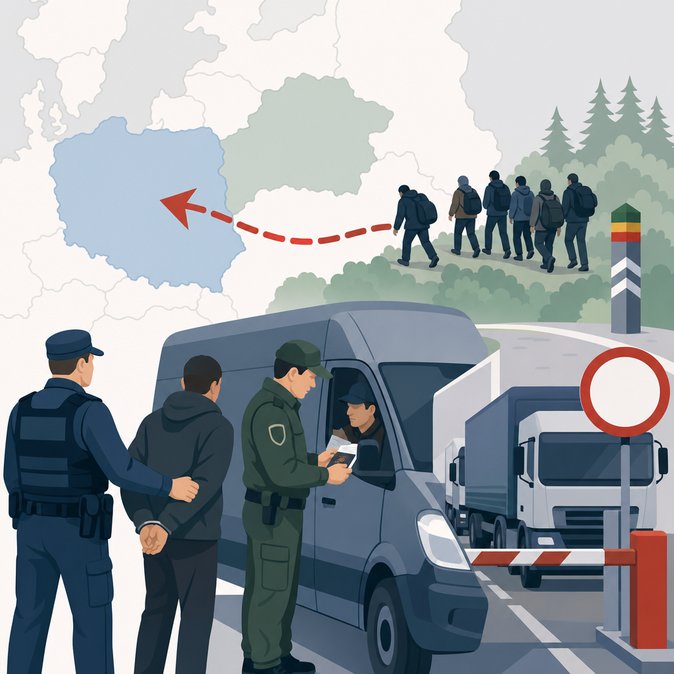
The Polish government on Saturday published an updated regulation that temporarily suspends the right to file in-person asylum claims at crossing points along the 418-kilometre frontier with Belarus. The measure—issued under the March 2025 amendments to the Foreigners Act—entered into force immediately upon its publication in the Journal of Laws and will remain valid for 60 days, unless extended.
![Poland formally limits asylum applications at Belarus border for a further 60 days]()
Organizations and individuals who need help navigating these fast-changing Polish border rules can turn to VisaHQ. The company monitors regulatory updates, assists with visa and residence applications, and offers document pre-screening for humanitarian, business, or tourism travel. For tailored guidance, visit https://www.visahq.com/poland/
An earlier order was due to expire this week; the 31 May 2026 notice prolongs the restriction through late July. Warsaw argues that Minsk continues to ‘instrumentalise migration’ by funnelling Middle-Eastern and African nationals toward EU territory, presenting what Prime Minister Donald Tusk calls a “genuine, ongoing threat” to national security. Under the regulation, Border Guard officers may refuse to accept asylum intents at the green border or official checkpoints such as Kuźnica and Terespol, diverting applicants to Polish consulates abroad. Vulnerable cases can still be admitted on humanitarian grounds following individual assessment. Human-rights NGOs, including the Helsinki Foundation for Human Rights, warn that the blanket measure risks breaching the non-refoulement principle and undermining access to international protection. The interior ministry counters that emergency derogations are foreseen in EU law and insists that Poland processed more than 7,000 asylum requests in 2025 despite the restrictions. For multinational employers, the extension has operational consequences. Ukrainian and Belarusian staff who overstay Schengen visas cannot legalise their status by filing at the border and must instead apply within Poland or depart. Companies moving equipment or project teams through the Koroszczyn–Kozłowicze freight corridor should anticipate tighter document scrutiny and potential delays as Border Guard units adjust work flows to the new regulation.

Organizations and individuals who need help navigating these fast-changing Polish border rules can turn to VisaHQ. The company monitors regulatory updates, assists with visa and residence applications, and offers document pre-screening for humanitarian, business, or tourism travel. For tailored guidance, visit https://www.visahq.com/poland/
An earlier order was due to expire this week; the 31 May 2026 notice prolongs the restriction through late July. Warsaw argues that Minsk continues to ‘instrumentalise migration’ by funnelling Middle-Eastern and African nationals toward EU territory, presenting what Prime Minister Donald Tusk calls a “genuine, ongoing threat” to national security. Under the regulation, Border Guard officers may refuse to accept asylum intents at the green border or official checkpoints such as Kuźnica and Terespol, diverting applicants to Polish consulates abroad. Vulnerable cases can still be admitted on humanitarian grounds following individual assessment. Human-rights NGOs, including the Helsinki Foundation for Human Rights, warn that the blanket measure risks breaching the non-refoulement principle and undermining access to international protection. The interior ministry counters that emergency derogations are foreseen in EU law and insists that Poland processed more than 7,000 asylum requests in 2025 despite the restrictions. For multinational employers, the extension has operational consequences. Ukrainian and Belarusian staff who overstay Schengen visas cannot legalise their status by filing at the border and must instead apply within Poland or depart. Companies moving equipment or project teams through the Koroszczyn–Kozłowicze freight corridor should anticipate tighter document scrutiny and potential delays as Border Guard units adjust work flows to the new regulation.