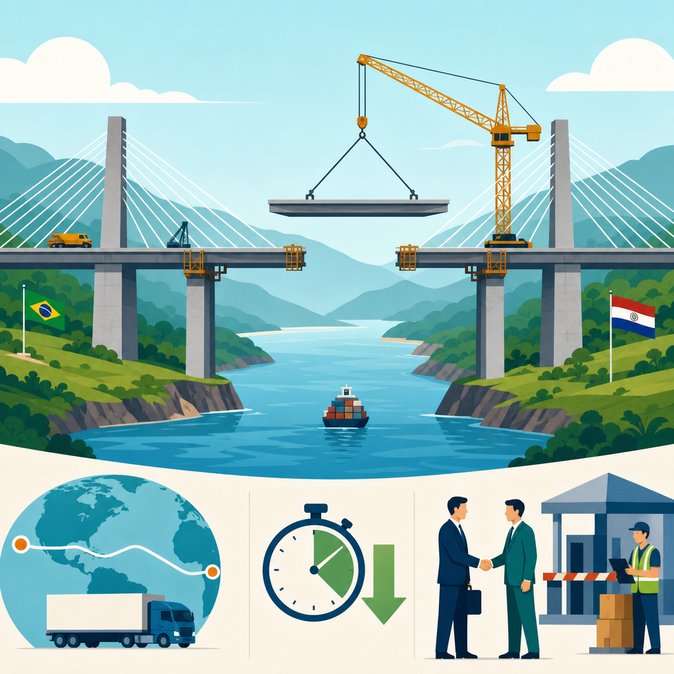
Paraguayan engineers confirmed late on 29 May that only 21 metres of decking remain to unite the two halves of the Bioceanic Bridge over the Paraguay River, a keystone of the Capricorn Bioceanic Corridor linking Porto Murtinho (Mato Grosso do Sul) to Carmelo Peralta in Paraguay. Once complete—now projected for August—the 1.3-kilometre cable-stay structure will slash truck transit times between Brazil’s agricultural heartland and Chilean Pacific ports by up to ten days. The corridor, financed in part by Brazil’s BNDES and Paraguay’s Itaipu resources, is widely seen as South America’s answer to Asia’s east–west freight lanes. For Brazilian soy exporters, the bridge could shave US$25–30 per tonne off logistics costs, according to the Centro Norte-Sul de Logística. The Receita Federal has already deployed a mobile customs unit on the Brazilian riverbank to rehearse paperless clearance procedures that will become permanent once the span opens.
![Bioceanic Bridge Nears ‘Final Kiss’, Promising Faster Atlantic–Pacific Route for Brazilian Exporters]()
For mobility professionals, the project means new duty-station opportunities in isolated border towns and a likely surge in business-visitor traffic as contractors race to build supporting road and warehouse infrastructure. Companies should monitor forthcoming immigration accords: Paraguayan officials have proposed a joint visa-waiver regime for drivers and project technicians to enable same-day crossings during the ramp-up phase. In the meantime, firms and individual travelers can streamline existing visa and travel document requirements through VisaHQ, whose Brazil portal (https://www.visahq.com/brazil/) offers real-time guidance and application support for business, technical, and tourist entries—a useful stop-gap until any bilateral waivers are formally ratified. Environmental groups remain cautious, citing potential impacts on the Pantanal wetlands. Brazilian authorities insist that an electronic toll and weigh-in-motion sensors will fund real-time habitat monitoring—technology that, if successful, could set a template for future cross-border megaprojects.

For mobility professionals, the project means new duty-station opportunities in isolated border towns and a likely surge in business-visitor traffic as contractors race to build supporting road and warehouse infrastructure. Companies should monitor forthcoming immigration accords: Paraguayan officials have proposed a joint visa-waiver regime for drivers and project technicians to enable same-day crossings during the ramp-up phase. In the meantime, firms and individual travelers can streamline existing visa and travel document requirements through VisaHQ, whose Brazil portal (https://www.visahq.com/brazil/) offers real-time guidance and application support for business, technical, and tourist entries—a useful stop-gap until any bilateral waivers are formally ratified. Environmental groups remain cautious, citing potential impacts on the Pantanal wetlands. Brazilian authorities insist that an electronic toll and weigh-in-motion sensors will fund real-time habitat monitoring—technology that, if successful, could set a template for future cross-border megaprojects.