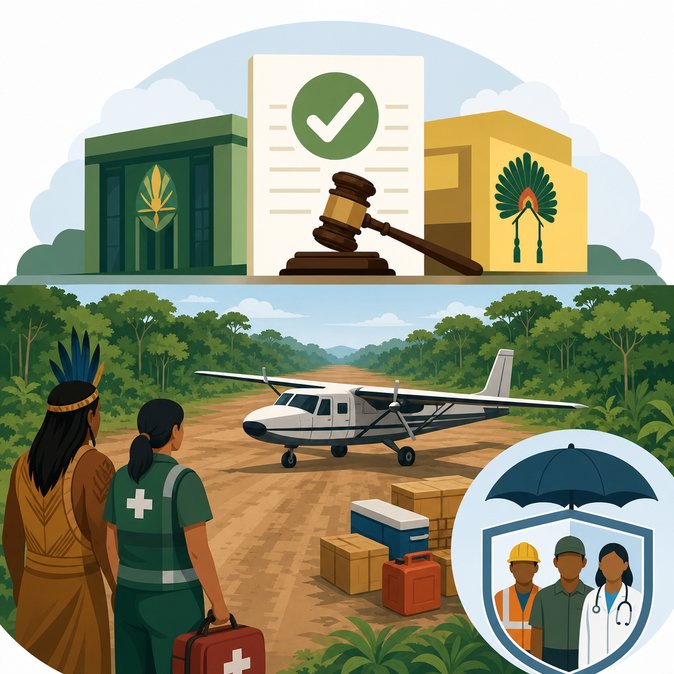
In a unanimous ruling handed down on May 29, Brazil’s Federal Regional Court of the 1st Region (TRF-1) upheld a lower-court decision compelling the federal government and FUNAI to homologate more than a dozen improvised airstrips inside Yanomami and other Indigenous territories in Roraima. The Ministry of Public Prosecution (MPF) first filed the case in 2016 after medical-evacuation flights stopped landing for fear of sanctions from the civil-aviation regulator ANAC; air-taxis said they could no longer risk using runways that lacked basic safety certifications. What followed was a series of public-health emergencies in which patients with malaria, pneumonia and snakebite were ferried for hours by canoe or carried on hammocks instead of being flown out in 40 minutes. Under the ruling, the Union and FUNAI have 60 days to file a concrete workplan and 12 months to obtain ANAC and Air-Space Control Department (DECEA) sign-off for each strip. Failure triggers a R$5,000 daily fine. Importantly, the court also froze the automatic NOTAM closures that ANAC had placed on the runways, meaning medevac operators can keep flying on a provisional basis while paperwork moves forward. The judges rejected the government’s budgetary-constraint defense, citing the constitutional right to health and the fact that the state’s own 2019 audits identified the problem but never acted. For multinationals running extractive or humanitarian projects in the far north, the decision is consequential. Charter companies expect renewed demand for twin-otter and caravan services, and insurance underwriters say they can reopen medevac coverage that was suspended last year. HR teams responsible for expatriates in the jungle belt should review their emergency-response plans: once regularization is complete, evacuations will be faster and premiums could fall by up to 15 %, according to brokers in Manaus.
![Federal Court Orders Brazil to Regularize Amazon Airstrips Serving Indigenous Communities]()
For organizations sending staff in and out of these remote regions, VisaHQ can simplify the paperwork burden that often delays deployments. Through its Brazil portal (https://www.visahq.com/brazil/), the service offers expedited processing for business, work and humanitarian visas, real-time tracking, and dedicated support—helping companies keep rotation schedules on track while the new airstrip rules take effect.
The verdict also illustrates the judiciary’s willingness to police federal inaction on critical mobility infrastructure. Lawyers note that similar suits are pending over river ports in Acre and helicopter pads in Pará; yesterday’s ruling may become the template. In the short term, health authorities are racing to pre-position fuel and medical supplies in anticipation of a spike in dry-season evacuations that historically start in June. Companies relying on those air corridors would be wise to coordinate with Indigenous district hospitals and confirm that their flight manifests are logged with the new task-force desk the court ordered FUNAI to create.

For organizations sending staff in and out of these remote regions, VisaHQ can simplify the paperwork burden that often delays deployments. Through its Brazil portal (https://www.visahq.com/brazil/), the service offers expedited processing for business, work and humanitarian visas, real-time tracking, and dedicated support—helping companies keep rotation schedules on track while the new airstrip rules take effect.
The verdict also illustrates the judiciary’s willingness to police federal inaction on critical mobility infrastructure. Lawyers note that similar suits are pending over river ports in Acre and helicopter pads in Pará; yesterday’s ruling may become the template. In the short term, health authorities are racing to pre-position fuel and medical supplies in anticipation of a spike in dry-season evacuations that historically start in June. Companies relying on those air corridors would be wise to coordinate with Indigenous district hospitals and confirm that their flight manifests are logged with the new task-force desk the court ordered FUNAI to create.