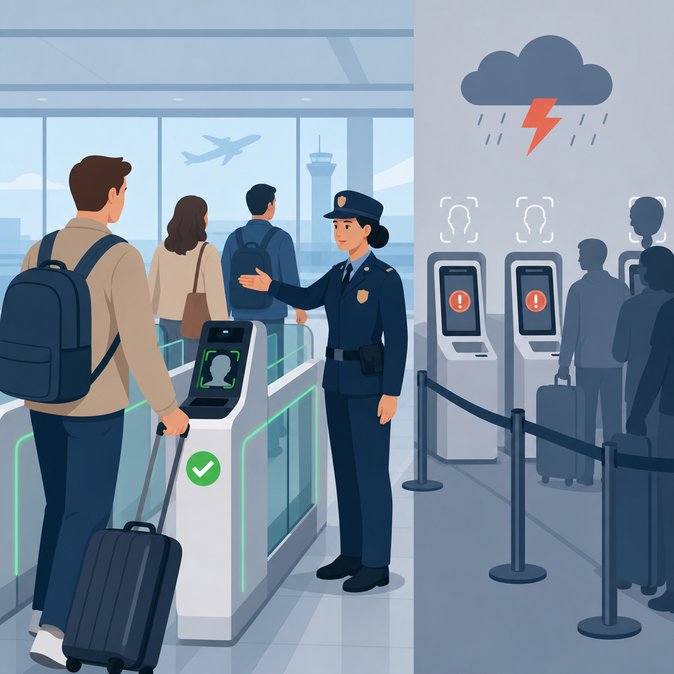
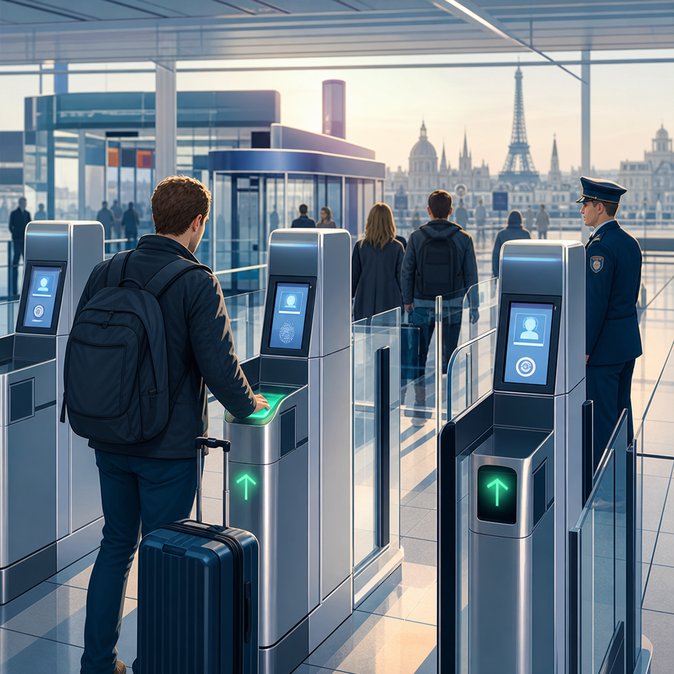
In a welcome U-turn for non-EU residents, France’s border-police confirmed on 29 May that British and American citizens who hold French residency cards can again use fast-track PARAFE e-gates at airports, seaports and Eurotunnel terminals. The decision, quietly circulated to front-line officers overnight, also allows short-stay UK and US visitors to be directed to e-gates when passenger volumes surge—even though they must still undergo the new EU Entry/Exit System (EES) registration. The move follows weeks of chaos as EES went “live” on 10 April. Self-service EES kiosks designed to capture fingerprints and facial images remain out of action at most French border points because of software glitches. As a stop-gap, passport data are being uploaded directly from the PARAFE gates and—crucially—the collection of biometrics is being suspended in rolling six-hour blocks whenever queues exceed set thresholds, a loophole the EU will tolerate only until September. Ryanair and several airport operators have demanded a full summer suspension, warning of four-hour passport lines if the kiosks are not fixed. For business travellers the restored e-gate access can shave 20-40 minutes off arrival formalities at Paris-Charles-de-Gaulle, Orly and Nice, where peak-hour queues recently stretched into air-bridges. The policy also resolves an awkward paradox whereby holders of France’s Brexit Withdrawal Agreement (WA) cards—technically long-term EU residents—were being forced into ‘other passports’ lanes behind first-time tourists. Several travellers told The Connexion they were waved through e-gates last weekend simply by flashing both passport and residency card.
![PARAFE E-Gates Reopened to UK and US Residents as France Struggles with EES Roll-out]()
Travellers who still need help sorting out the right paperwork before heading to France can turn to VisaHQ’s dedicated portal (https://www.visahq.com/france/) for clear, up-to-date guidance on visas, residency documents and other entry formalities, with optional expedited processing that keeps you a step ahead of the airport queues.
Yet the fix is only partial. Until the biometric element of EES is stable, each airport is improvising: Bordeaux insists that visitors first attempt kiosk pre-registration; Nice is letting most UK and US passengers straight through PARAFE; at Lyon, some residency-card holders are still diverted to staffed booths. Global-mobility teams should brief travellers to carry printed boarding passes (needed for kiosk fallback) and allow extra time at regional airports where staffing is thin. Longer term, France faces an EU infringement risk if it cannot demonstrate full compliance by Q4. Industry insiders say contractor Thales will roll out a major software patch in July and begin round-the-clock test cycles in August, just in time for the post-Olympic travel surge. Failure would push more pressure onto the next big milestone: the ETIAS travel-authorisation system for visa-waiver nationals, now pencilled in for late 2026.
Travellers who still need help sorting out the right paperwork before heading to France can turn to VisaHQ’s dedicated portal (https://www.visahq.com/france/) for clear, up-to-date guidance on visas, residency documents and other entry formalities, with optional expedited processing that keeps you a step ahead of the airport queues.
Yet the fix is only partial. Until the biometric element of EES is stable, each airport is improvising: Bordeaux insists that visitors first attempt kiosk pre-registration; Nice is letting most UK and US passengers straight through PARAFE; at Lyon, some residency-card holders are still diverted to staffed booths. Global-mobility teams should brief travellers to carry printed boarding passes (needed for kiosk fallback) and allow extra time at regional airports where staffing is thin. Longer term, France faces an EU infringement risk if it cannot demonstrate full compliance by Q4. Industry insiders say contractor Thales will roll out a major software patch in July and begin round-the-clock test cycles in August, just in time for the post-Olympic travel surge. Failure would push more pressure onto the next big milestone: the ETIAS travel-authorisation system for visa-waiver nationals, now pencilled in for late 2026.