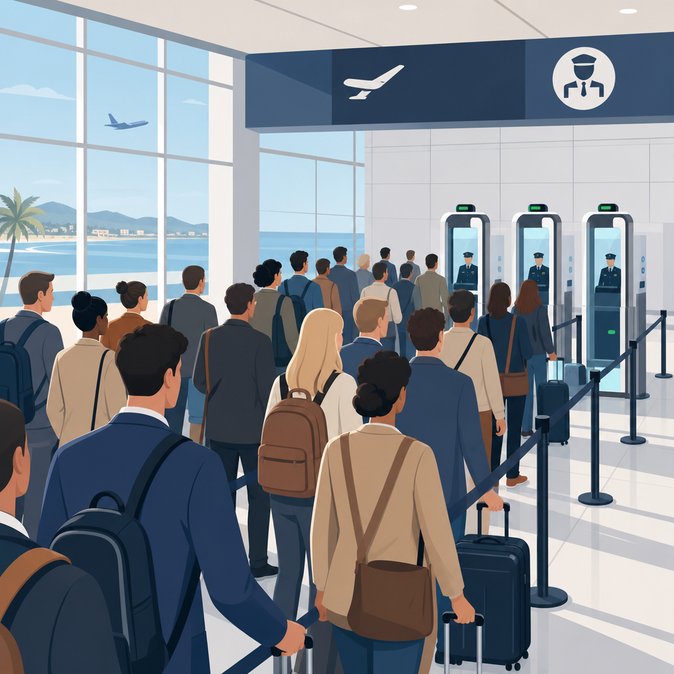
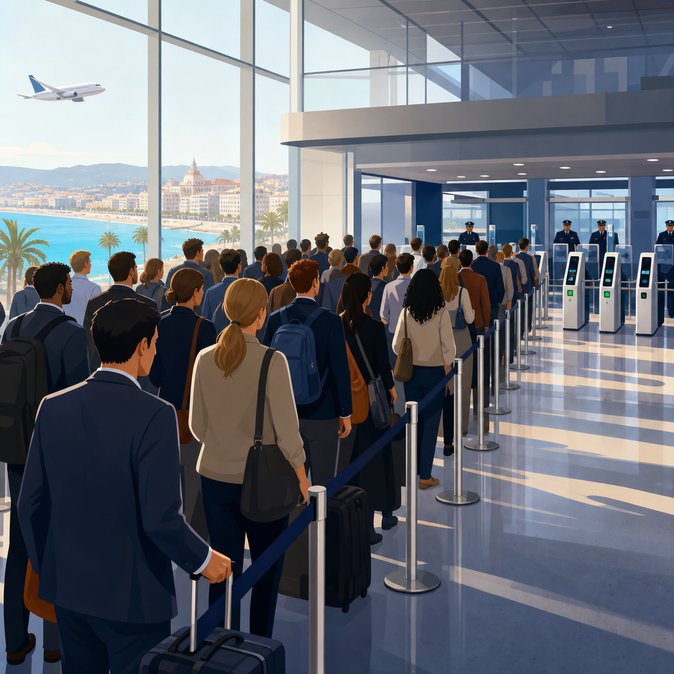
Holiday-makers and frequent flyers passing through Nice-Côte-d’Azur’s Terminal 1 on Wednesday morning were met with serpentine lines that snaked an estimated 120 m across the departures hall. A video obtained by English-language daily The Connexion shows stressed passengers being funnelled into two lanes: one for holders of biometric passports eligible for France’s PARAFE e-gates and another for travellers who must present documents to a border guard.
![Nice Airport Sees 120-Metre Passport-Control Queues as Staffing Squeeze Bites]()
Travellers hoping to avoid unpleasant surprises at the border can also turn to VisaHQ, whose online platform (https://www.visahq.com/france/) helps users check entry requirements, secure visas, and pre-screen documents before arrival in France. By clarifying whether you qualify for the fast-track e-gates or need additional paperwork, the service can shave precious minutes off the airport experience and reduce the risk of delays.
The airport—France’s third-busiest after Paris-Charles-de-Gaulle and Orly—confirmed to the paper that the bottleneck stemmed from “insufficient numbers of border-police officers” coinciding with a cluster of long-haul departures to London and the United States. Only three of the four PARAFE gates were operational, and several machines rejected passports on the first scan, forcing users to re-queue. Importantly, the incident was **not** linked to the EU’s new Entry/Exit System (EES); the biometric kiosks that will eventually feed EES are still pending installation at Nice. Nevertheless, the scene offers a real-world preview of what could happen this summer if manpower levels do not keep pace with rising international volumes. Airport capacity was recently expanded to 18 million passengers a year, but border-police headcount has not grown at the same rate. For corporate-travel teams the takeaway is to advise staff to arrive at least two hours before a Schengen-external flight from Nice—even if they plan to use the e-gates—and to carry evidence of residency status, which can speed redirection to a shorter lane. Employers moving talent to the French Riviera should also budget for potential missed connections when scheduling onward meetings. The airport authority says additional officers will be deployed over upcoming holiday weekends, yet peak-day disruptions remain likely until full EES integration and kiosk automation come online.
Travellers hoping to avoid unpleasant surprises at the border can also turn to VisaHQ, whose online platform (https://www.visahq.com/france/) helps users check entry requirements, secure visas, and pre-screen documents before arrival in France. By clarifying whether you qualify for the fast-track e-gates or need additional paperwork, the service can shave precious minutes off the airport experience and reduce the risk of delays.
The airport—France’s third-busiest after Paris-Charles-de-Gaulle and Orly—confirmed to the paper that the bottleneck stemmed from “insufficient numbers of border-police officers” coinciding with a cluster of long-haul departures to London and the United States. Only three of the four PARAFE gates were operational, and several machines rejected passports on the first scan, forcing users to re-queue. Importantly, the incident was **not** linked to the EU’s new Entry/Exit System (EES); the biometric kiosks that will eventually feed EES are still pending installation at Nice. Nevertheless, the scene offers a real-world preview of what could happen this summer if manpower levels do not keep pace with rising international volumes. Airport capacity was recently expanded to 18 million passengers a year, but border-police headcount has not grown at the same rate. For corporate-travel teams the takeaway is to advise staff to arrive at least two hours before a Schengen-external flight from Nice—even if they plan to use the e-gates—and to carry evidence of residency status, which can speed redirection to a shorter lane. Employers moving talent to the French Riviera should also budget for potential missed connections when scheduling onward meetings. The airport authority says additional officers will be deployed over upcoming holiday weekends, yet peak-day disruptions remain likely until full EES integration and kiosk automation come online.