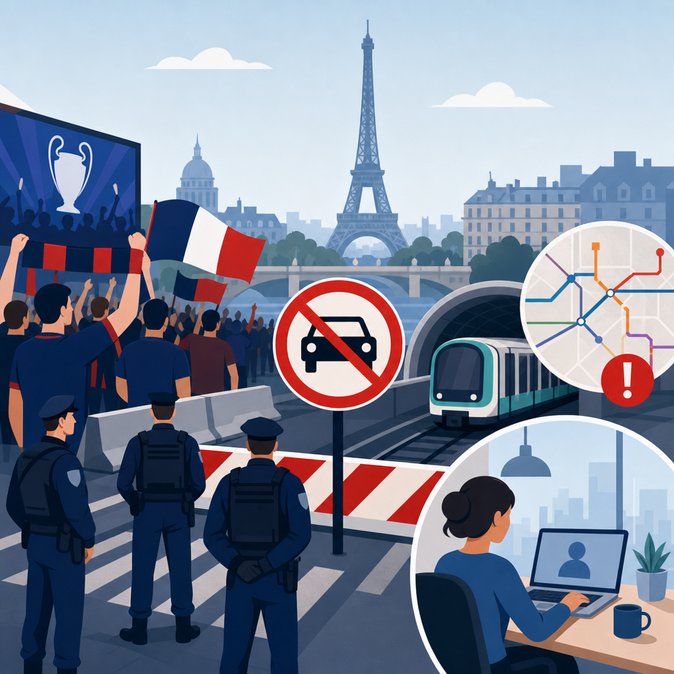
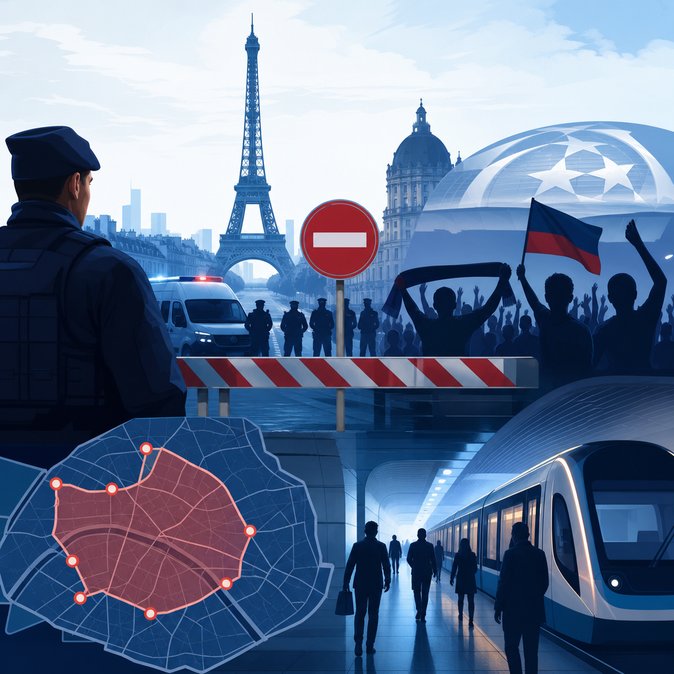
Paris is bracing for a complicated weekend as Paris-Saint-Germain contest the UEFA Champions League final on Saturday, 30 May, in Budapest. Although the match will be played abroad, the city’s authorities expect tens of thousands of fans to pack the capital’s streets and fan-zones, triggering a security operation on a scale normally reserved for presidential visits. The Préfecture de Police has announced a ring-fence security perimeter that stretches from the Arc de Triomphe and the upper Champs-Élysées to the Trocadéro and parts of the Périphérique ring-road. From 17:00 on 30 May until 05:00 the next morning, all private traffic—including ride-hailing services and corporate shuttles—will be banned inside the zone. Metro lines 1, 2, 6, 8, 9, 12 and 13, as well as RER A, will skip the affected stops, and Charles-de-Gaulle–Étoile station will close entirely. City buses will also be diverted. Some 8,000 extra police officers—almost 50 % more than during last year’s final—will be on duty.
![Paris Locks Down Transport Network Ahead of 30 May Champions League Final]()
If any travellers still need to finalise entry paperwork, VisaHQ can streamline the process. The company’s France portal (https://www.visahq.com/france/) offers rapid visa processing, health-declaration assistance and up-to-date entry guidance, helping visitors avoid last-minute surprises while the city’s security measures are at their peak.
Business travellers arriving at Paris-Charles-de-Gaulle or Orly on Friday evening could find the usual 45-minute taxi ride to western Paris ballooning past two hours as traffic is funnelled onto the outer boulevards. Hotels on the Right Bank have advised corporate guests to complete check-in by mid-afternoon and to keep company vehicles in guarded underground car parks to avoid vandalism. Corporations with offices near the Champs-Élysées have issued work-from-home guidance for Monday in case post-match clean-up overruns. The high-profile final comes amid a pattern of football-related unrest: riots after PSG’s 2025 victory resulted in more than 500 arrests, 264 vehicles burned and millions of euros in insurance claims. Earlier this month, celebrations after the semi-final win over Bayern Munich saw 127 arrests in the capital alone. Police intelligence units warn that fireworks and aggressive harassment of passing vehicles are likely if PSG win—and possibly even if they lose. For global-mobility managers the key message is contingency: travellers should avoid western and central Paris from Saturday afternoon, use hotels east of the Seine, and monitor staff movements through travel-risk platforms. Companies with Saturday evening departures from CDG should allow an extra hour for road transfers or book the RER B train before 19:00, when west-side stations begin to close. Event organisers have been reminded that any company function involving more than 5,000 people now requires a formal security plan under France’s Vigipirate regime. Looking ahead, security analysts see the operation as a dress rehearsal for crowd-management during the Paris Olympics (July-August 2026). The government is expected to review Saturday night’s performance before finalising Olympic traffic-restriction maps, meaning lessons learned this weekend could directly influence how visitors move around the capital in two months’ time.
If any travellers still need to finalise entry paperwork, VisaHQ can streamline the process. The company’s France portal (https://www.visahq.com/france/) offers rapid visa processing, health-declaration assistance and up-to-date entry guidance, helping visitors avoid last-minute surprises while the city’s security measures are at their peak.
Business travellers arriving at Paris-Charles-de-Gaulle or Orly on Friday evening could find the usual 45-minute taxi ride to western Paris ballooning past two hours as traffic is funnelled onto the outer boulevards. Hotels on the Right Bank have advised corporate guests to complete check-in by mid-afternoon and to keep company vehicles in guarded underground car parks to avoid vandalism. Corporations with offices near the Champs-Élysées have issued work-from-home guidance for Monday in case post-match clean-up overruns. The high-profile final comes amid a pattern of football-related unrest: riots after PSG’s 2025 victory resulted in more than 500 arrests, 264 vehicles burned and millions of euros in insurance claims. Earlier this month, celebrations after the semi-final win over Bayern Munich saw 127 arrests in the capital alone. Police intelligence units warn that fireworks and aggressive harassment of passing vehicles are likely if PSG win—and possibly even if they lose. For global-mobility managers the key message is contingency: travellers should avoid western and central Paris from Saturday afternoon, use hotels east of the Seine, and monitor staff movements through travel-risk platforms. Companies with Saturday evening departures from CDG should allow an extra hour for road transfers or book the RER B train before 19:00, when west-side stations begin to close. Event organisers have been reminded that any company function involving more than 5,000 people now requires a formal security plan under France’s Vigipirate regime. Looking ahead, security analysts see the operation as a dress rehearsal for crowd-management during the Paris Olympics (July-August 2026). The government is expected to review Saturday night’s performance before finalising Olympic traffic-restriction maps, meaning lessons learned this weekend could directly influence how visitors move around the capital in two months’ time.