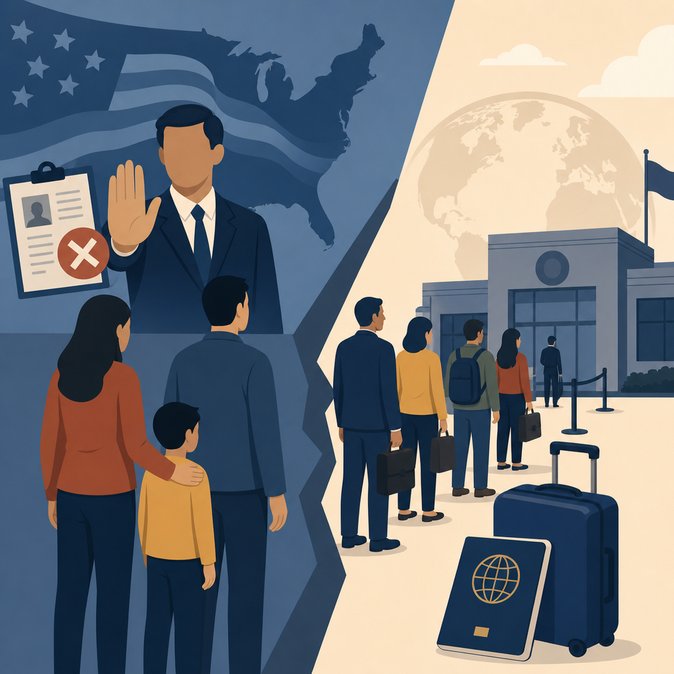
Citing an escalating Ebola outbreak in central and east Africa, the Centers for Disease Control and Prevention (CDC) and the Department of Homeland Security (DHS) on 22 May 2026 temporarily prohibited lawful permanent residents (LPRs) from entering the United States if they have been in the Democratic Republic of Congo, Uganda or South Sudan within the previous 21 days. The order extends a ban that already applied to foreign nationals without U.S. passports and is the first time in recent history that green-card holders have been swept into a communicable-disease entry bar. To enforce the measure, DHS directed airlines to re-route affected passengers to Washington Dulles International Airport, where enhanced health screening is now centralized. Travelers flagged under the rule undergo temperature checks, symptom questionnaires and, if warranted, quarantine at federally managed facilities near the airport. Airlines were given 48 hours to update reservation systems and contact customers to modify itineraries.
![Ebola precautions expanded: U.S. bars green-card holders who recently visited DRC, Uganda or South Sudan]()
For organizations scrambling to interpret such fast-moving entry rules, VisaHQ offers a one-stop online dashboard that tracks real-time U.S. travel advisories, health requirements and visa policies; its platform can push automated alerts to corporate mobility teams, prepare waiver documentation when available and even coordinate emergency itinerary changes (https://www.visahq.com/united-states/).
Public-health officials insist the step is temporary and proportionate, noting that the World Health Organization on the same day raised the risk level of the Bundibugyo Ebola strain to “very high.” Yet immigration advocates argue the policy sets a precedent for discriminating against LPRs, who normally enjoy near-unrestricted re-entry rights. From a mobility standpoint, U.S. companies with operations or project sites in the three countries must postpone travel for U.S. green-card employees and assess evacuation or remote-work options. The order does not affect U.S. citizens, but it has indirect consequences for mixed-status families and for global supply-chain managers relying on dual-citizen or LPR engineers in mining, energy and infrastructure projects across central Africa. Insurers are reassessing coverage for business-travel medical evacuation, while airline industry groups warn of network disruptions as carriers adjust to the single-airport funnel. Employers should create a real-time roster of staff who have traveled to, or plan to travel through, the region; brief LPR employees on the re-entry bar; and liaise with travel-risk vendors to monitor the DHS notice of arrival-restriction expiration, currently set for review in 30 days.

For organizations scrambling to interpret such fast-moving entry rules, VisaHQ offers a one-stop online dashboard that tracks real-time U.S. travel advisories, health requirements and visa policies; its platform can push automated alerts to corporate mobility teams, prepare waiver documentation when available and even coordinate emergency itinerary changes (https://www.visahq.com/united-states/).
Public-health officials insist the step is temporary and proportionate, noting that the World Health Organization on the same day raised the risk level of the Bundibugyo Ebola strain to “very high.” Yet immigration advocates argue the policy sets a precedent for discriminating against LPRs, who normally enjoy near-unrestricted re-entry rights. From a mobility standpoint, U.S. companies with operations or project sites in the three countries must postpone travel for U.S. green-card employees and assess evacuation or remote-work options. The order does not affect U.S. citizens, but it has indirect consequences for mixed-status families and for global supply-chain managers relying on dual-citizen or LPR engineers in mining, energy and infrastructure projects across central Africa. Insurers are reassessing coverage for business-travel medical evacuation, while airline industry groups warn of network disruptions as carriers adjust to the single-airport funnel. Employers should create a real-time roster of staff who have traveled to, or plan to travel through, the region; brief LPR employees on the re-entry bar; and liaise with travel-risk vendors to monitor the DHS notice of arrival-restriction expiration, currently set for review in 30 days.