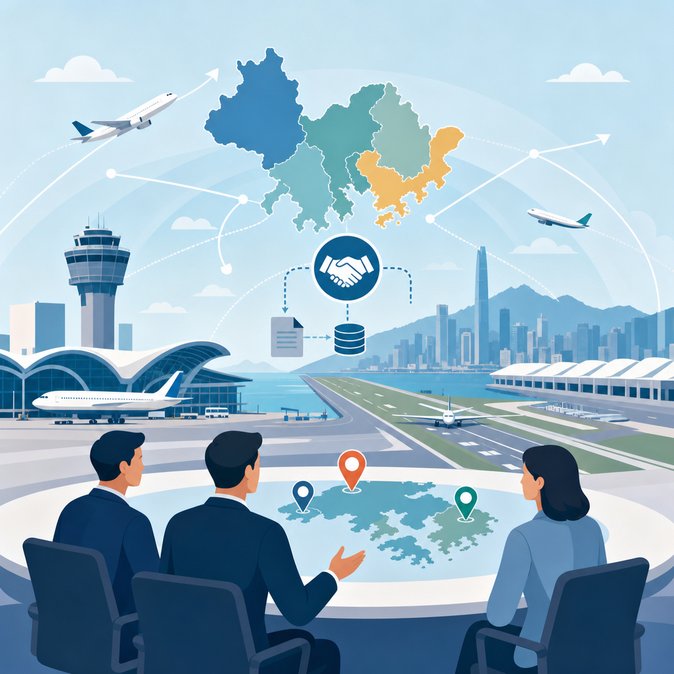
Senior aviation regulators from Mainland China, Hong Kong and Macao met in Xi’an on 21 May for the annual high-level Air Traffic Management (ATM) conference, agreeing on a phased roadmap to optimise airspace in the Guangdong-Hong Kong-Macao Greater Bay Area (GBA). The Director-General of Hong Kong’s Civil Aviation Department, Victor Liu, said the new measures would ‘cement Hong Kong’s status as an international aviation hub’ as regional traffic rebounds past pre-pandemic levels.
![Tripartite air-traffic management plan boosts Greater Bay Area flight efficiency]()
With cross-border traffic accelerating, many corporate passengers and flight crews will need updated entry documents. VisaHQ’s Hong Kong portal (https://www.visahq.com/hong-kong/) offers a one-stop solution for securing China, Hong Kong or Macao visas, providing digital application tools, real-time status tracking and expert support that keeps travel plans aligned with the region’s faster, more predictable flight schedules.
Key outcomes include adoption of a joint airspace-simulation model that identifies bottlenecks affecting the Pearl River Delta’s tightly packed airports. The model supports new arrival and departure procedures that could add up to eight extra movements per hour at Hong Kong International Airport without compromising safety. Regulators also agreed to inter-connect their Air Traffic Flow Management (ATFM) systems, enabling real-time data-sharing on slots, weather and flow constraints. For airlines, this promises more predictable schedules and reduced holding patterns—critical gains as carriers rebuild long-haul capacity and reconnect corporate routes. Notably, the working group approved a contingency protocol to share terrestrial navigation signals across the GBA. In the event of satellite-navigation interference, aircraft equipped to receive ground-based signals from neighbouring jurisdictions would still have seamless navigation coverage. This resilience is increasingly important as geopolitical tensions raise concerns about GNSS spoofing and jamming. For mobility managers, smoother ATFM in South China translates into higher on-time performance for flights that feed regional headquarters and manufacturing sites. Organisations with time-sensitive cargo—pharmaceuticals, semiconductors or just-in-time components—stand to benefit from shorter gate-to-gate times and fewer diversions. The agreement also aligns with Hong Kong’s ambition to open a third runway later this year, signalling that upstream airspace reforms will keep pace with infrastructure expansion. The tripartite working group will reconvene in the fourth quarter to review implementation metrics and discuss integrating emerging concepts such as Urban Air Mobility corridors. Airlines and corporate travel teams are encouraged to engage with industry consultations to ensure business-travel needs are reflected in future airspace design.

With cross-border traffic accelerating, many corporate passengers and flight crews will need updated entry documents. VisaHQ’s Hong Kong portal (https://www.visahq.com/hong-kong/) offers a one-stop solution for securing China, Hong Kong or Macao visas, providing digital application tools, real-time status tracking and expert support that keeps travel plans aligned with the region’s faster, more predictable flight schedules.
Key outcomes include adoption of a joint airspace-simulation model that identifies bottlenecks affecting the Pearl River Delta’s tightly packed airports. The model supports new arrival and departure procedures that could add up to eight extra movements per hour at Hong Kong International Airport without compromising safety. Regulators also agreed to inter-connect their Air Traffic Flow Management (ATFM) systems, enabling real-time data-sharing on slots, weather and flow constraints. For airlines, this promises more predictable schedules and reduced holding patterns—critical gains as carriers rebuild long-haul capacity and reconnect corporate routes. Notably, the working group approved a contingency protocol to share terrestrial navigation signals across the GBA. In the event of satellite-navigation interference, aircraft equipped to receive ground-based signals from neighbouring jurisdictions would still have seamless navigation coverage. This resilience is increasingly important as geopolitical tensions raise concerns about GNSS spoofing and jamming. For mobility managers, smoother ATFM in South China translates into higher on-time performance for flights that feed regional headquarters and manufacturing sites. Organisations with time-sensitive cargo—pharmaceuticals, semiconductors or just-in-time components—stand to benefit from shorter gate-to-gate times and fewer diversions. The agreement also aligns with Hong Kong’s ambition to open a third runway later this year, signalling that upstream airspace reforms will keep pace with infrastructure expansion. The tripartite working group will reconvene in the fourth quarter to review implementation metrics and discuss integrating emerging concepts such as Urban Air Mobility corridors. Airlines and corporate travel teams are encouraged to engage with industry consultations to ensure business-travel needs are reflected in future airspace design.