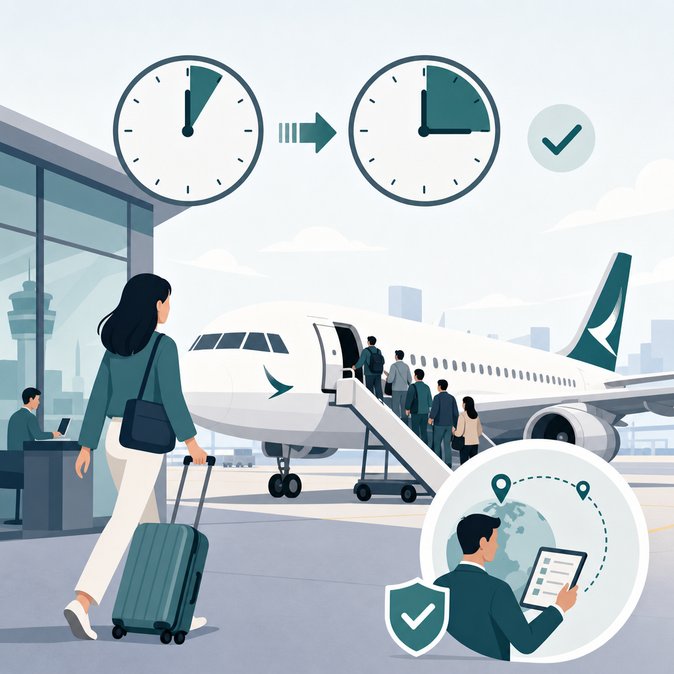
Cathay Pacific will tighten its ground-handling timetable next month in a move the airline says is designed to improve punctuality and travel-time certainty for corporate flyers. In an operations notice highlighted by Asian Aviation on 18 May, the carrier confirmed that from 1 June 2026 all boarding gates will close 15 minutes before the scheduled departure time—five minutes earlier than today.
![Cathay Pacific brings gate closing forward to 15 minutes before departure from 1 June]()
For those corporate travellers who now have even tighter airport timelines, VisaHQ can remove one more stress factor by handling visa formalities in advance. Its online platform processes entry documents for Hong Kong and many other destinations quickly and transparently, letting passengers focus on making the new gate deadlines; see https://www.visahq.com/hong-kong/ for details.
At the same time, boarding for flights departing Hong Kong International Airport will begin five minutes earlier. The adjustment, though seemingly minor, is significant for organisations that rely on Cathay’s regional shuttles and long-haul connections. A five-minute buffer often makes the difference between an on-time push-back and a slot delay that cascades into missed onward meetings or tight interline connections in Hong Kong’s wave-bank schedule. Cathay says the change follows data analytics showing that earlier cabin-door closure translates into an average three-minute improvement in off-blocks time and a four-minute reduction in tarmac waits for arriving aircraft that need the gate. For premium-class and Marco Polo Club travellers, the airline will step up lounge departure screen alerts and roll out push notifications in the Cathay app so that the condensed boarding window does not catch passengers off guard. Travel-management companies (TMCs) are advising corporate clients to update traveller communications and airport meet-and-assist instructions, particularly for first-time visitors unfamiliar with the long walks between some midfield concourse lounges and gates. Employers may also need to refresh travel policies that specify permitted check-in cut-off times or mandate minimum lay-over buffers at HKIA. More broadly, the policy supports Hong Kong’s campaign to restore its pre-pandemic reputation for world-class efficiency. If on-time performance improves—as airline simulations suggest—other home-based carriers may follow suit, progressively reducing schedule padding and freeing up valuable slot capacity for additional frequencies.

For those corporate travellers who now have even tighter airport timelines, VisaHQ can remove one more stress factor by handling visa formalities in advance. Its online platform processes entry documents for Hong Kong and many other destinations quickly and transparently, letting passengers focus on making the new gate deadlines; see https://www.visahq.com/hong-kong/ for details.
At the same time, boarding for flights departing Hong Kong International Airport will begin five minutes earlier. The adjustment, though seemingly minor, is significant for organisations that rely on Cathay’s regional shuttles and long-haul connections. A five-minute buffer often makes the difference between an on-time push-back and a slot delay that cascades into missed onward meetings or tight interline connections in Hong Kong’s wave-bank schedule. Cathay says the change follows data analytics showing that earlier cabin-door closure translates into an average three-minute improvement in off-blocks time and a four-minute reduction in tarmac waits for arriving aircraft that need the gate. For premium-class and Marco Polo Club travellers, the airline will step up lounge departure screen alerts and roll out push notifications in the Cathay app so that the condensed boarding window does not catch passengers off guard. Travel-management companies (TMCs) are advising corporate clients to update traveller communications and airport meet-and-assist instructions, particularly for first-time visitors unfamiliar with the long walks between some midfield concourse lounges and gates. Employers may also need to refresh travel policies that specify permitted check-in cut-off times or mandate minimum lay-over buffers at HKIA. More broadly, the policy supports Hong Kong’s campaign to restore its pre-pandemic reputation for world-class efficiency. If on-time performance improves—as airline simulations suggest—other home-based carriers may follow suit, progressively reducing schedule padding and freeing up valuable slot capacity for additional frequencies.