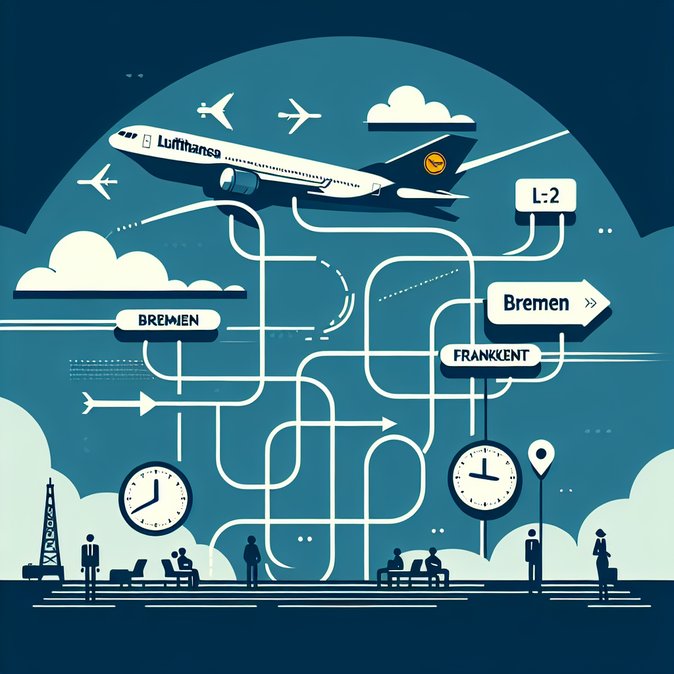
Lufthansa confirmed on Sunday, 10 May 2026, that it will discontinue its Bremen–Frankfurt service from 1 July. The route currently offers roughly 35 weekly rotations and carries more than 5,000 passengers a week. Because most travellers use the short hop to connect onto intercontinental flights at Frankfurt, the decision instantly severs Bremen’s most important link to the global network. Local authorities reacted with unusual unity. Bremen’s Senate called the cut a “severe blow to the region’s international competitiveness” and vowed to enlist the Federal Ministry of Transport to press Lufthansa for a reversal. The city has invested heavily in airport upgrades and had hoped to market itself as a mid-size hub for aerospace suppliers and offshore-wind companies that rely on same-day long-haul connections via Frankfurt.
![Lufthansa to Axe Bremen–Frankfurt Shuttle, Cutting North-South Germany’s Global Gateway]()
For travelers suddenly rerouting through non-Schengen hubs, the paperwork question crops up quickly. VisaHQ (https://www.visahq.com/germany/) specializes in clarifying transit-visa requirements for more than 200 destinations and can arrange electronic authorizations or full embassy submissions on short notice—useful if a Bremen-based engineer now needs to connect via Doha or Chicago instead of Frankfurt. The service also tracks real-time entry rules for accompanying equipment and cargo, helping companies adjust to the new routings with minimal administrative friction.
For corporate mobility managers the impact is immediate: travellers will either have to route via Hamburg (adding up to two hours by rail) or fly via Munich, Amsterdam, or Copenhagen, lengthening total journey times and increasing overnight stays. Early calculations from the Bremen Chamber of Commerce suggest local exporters could face €4–6 million a year in additional travel and freight costs once the feeder disappears. Bremen also loses a symbolic lifeline: many expatriates, international scientists at the University of Bremen, and NATO personnel stationed in the region use the shuttle to maintain family ties abroad. Without it, talent attraction—already strained by Germany’s housing shortage—becomes harder. The episode underlines how airline route decisions, even on short domestic sectors, can ripple through Germany’s wider mobility ecosystem and should be monitored just as closely as formal visa or border measures.

For travelers suddenly rerouting through non-Schengen hubs, the paperwork question crops up quickly. VisaHQ (https://www.visahq.com/germany/) specializes in clarifying transit-visa requirements for more than 200 destinations and can arrange electronic authorizations or full embassy submissions on short notice—useful if a Bremen-based engineer now needs to connect via Doha or Chicago instead of Frankfurt. The service also tracks real-time entry rules for accompanying equipment and cargo, helping companies adjust to the new routings with minimal administrative friction.
For corporate mobility managers the impact is immediate: travellers will either have to route via Hamburg (adding up to two hours by rail) or fly via Munich, Amsterdam, or Copenhagen, lengthening total journey times and increasing overnight stays. Early calculations from the Bremen Chamber of Commerce suggest local exporters could face €4–6 million a year in additional travel and freight costs once the feeder disappears. Bremen also loses a symbolic lifeline: many expatriates, international scientists at the University of Bremen, and NATO personnel stationed in the region use the shuttle to maintain family ties abroad. Without it, talent attraction—already strained by Germany’s housing shortage—becomes harder. The episode underlines how airline route decisions, even on short domestic sectors, can ripple through Germany’s wider mobility ecosystem and should be monitored just as closely as formal visa or border measures.