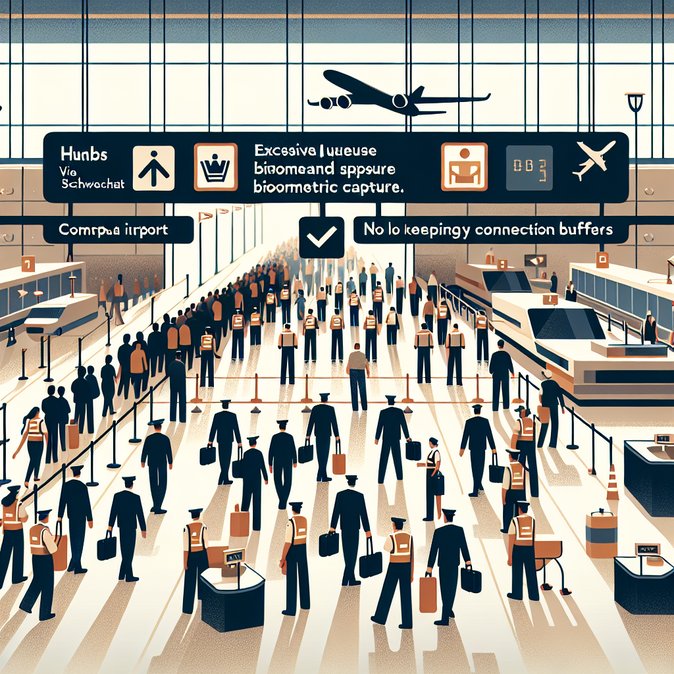
Barely three weeks after the European Union’s biometric Entry/Exit System (EES) became fully operational on 10 April, the European Commission has bowed to mounting pressure from airports, airlines and several member-states by activating a so-called “built-in flexibility” clause. In a statement released on 2 May, Brussels confirmed that border-police units may temporarily pause the capture of fingerprints or facial images when queue times exceed locally set thresholds, while still recording passport data electronically. For Austria, where Vienna-Schwechat is one of six airports handling third-country traffic, the move could not have come at a better time. Over the extended Easter holidays the airport processed up to 44,000 non-EU passengers a day; managers told local media that first-time biometric enrolments were pushing wait times for some long-haul arrivals beyond 40 minutes. With the Ascension-Day, Pentecost and Eurovision travel peaks imminent, Austrian Airlines had already begun advising transfer passengers to allow a minimum 90-minute connection window.
![EU grants ‘built-in flexibility’ to new Entry/Exit System after airports from Vienna to Paris report long queues]()
In this context, travellers can take some of the pressure off the border by pre-checking their documentation through VisaHQ. The company’s Austria portal (https://www.visahq.com/austria/) aggregates up-to-the-minute guidance on EES, future ETIAS rules and traditional visa options, and its digital application tools allow passengers and travel managers to complete required forms in advance, shortening airport dwell time and reducing the risk of delay.
The ability to switch to “demographic-only” processing during surges should help the hub keep its minimum-connect times intact and avoid costly missed-connection re-bookings for corporate travellers. The EES replaces manual passport stamping with automated registration of every entry and exit by non-EU visitors, storing both biographic and biometric data for three years. Austrian border authorities estimate that the system has logged more than 2.4 million crossings in Austria alone since October’s soft launch. While the technology promises stronger external-border security and more accurate 90/180-day calculations, the enrolment of first-time travellers has proved slower than the EU’s 70-second KPI, averaging closer to four minutes in real-world conditions. Industry groups ACI Europe, Airlines for Europe (A4E) and IATA welcome the concession but warn it is only a stop-gap. They are urging governments to invest in additional e-gates and staff and to accelerate public-information campaigns so that passengers complete pre-departure steps—such as downloading QR codes from airline apps—before reaching the border. Travel managers should brief employees that the flexibility clause is triggered locally and dynamically: arriving at peak times may still entail full biometric capture, whilst early-morning or late-evening flights could sail through in under a minute. Looking further ahead, Austria and its Schengen partners must integrate EES with the European Travel Information and Authorisation System (ETIAS), now scheduled for late 2026. Experts caution that unless lessons from this year’s rollout are acted upon, a second wave of congestion could hit just as ETIAS becomes mandatory for visa-exempt travellers from key trade partners such as the United States, Canada and the United Kingdom.

In this context, travellers can take some of the pressure off the border by pre-checking their documentation through VisaHQ. The company’s Austria portal (https://www.visahq.com/austria/) aggregates up-to-the-minute guidance on EES, future ETIAS rules and traditional visa options, and its digital application tools allow passengers and travel managers to complete required forms in advance, shortening airport dwell time and reducing the risk of delay.
The ability to switch to “demographic-only” processing during surges should help the hub keep its minimum-connect times intact and avoid costly missed-connection re-bookings for corporate travellers. The EES replaces manual passport stamping with automated registration of every entry and exit by non-EU visitors, storing both biographic and biometric data for three years. Austrian border authorities estimate that the system has logged more than 2.4 million crossings in Austria alone since October’s soft launch. While the technology promises stronger external-border security and more accurate 90/180-day calculations, the enrolment of first-time travellers has proved slower than the EU’s 70-second KPI, averaging closer to four minutes in real-world conditions. Industry groups ACI Europe, Airlines for Europe (A4E) and IATA welcome the concession but warn it is only a stop-gap. They are urging governments to invest in additional e-gates and staff and to accelerate public-information campaigns so that passengers complete pre-departure steps—such as downloading QR codes from airline apps—before reaching the border. Travel managers should brief employees that the flexibility clause is triggered locally and dynamically: arriving at peak times may still entail full biometric capture, whilst early-morning or late-evening flights could sail through in under a minute. Looking further ahead, Austria and its Schengen partners must integrate EES with the European Travel Information and Authorisation System (ETIAS), now scheduled for late 2026. Experts caution that unless lessons from this year’s rollout are acted upon, a second wave of congestion could hit just as ETIAS becomes mandatory for visa-exempt travellers from key trade partners such as the United States, Canada and the United Kingdom.
More From Austria
View all
Drones, sniper teams and a robot-dog: Austria unveils high-tech security plan for Eurovision Song Contest week

EU relaxes Entry/Exit System rules as Vienna and other Schengen airports struggle with queues