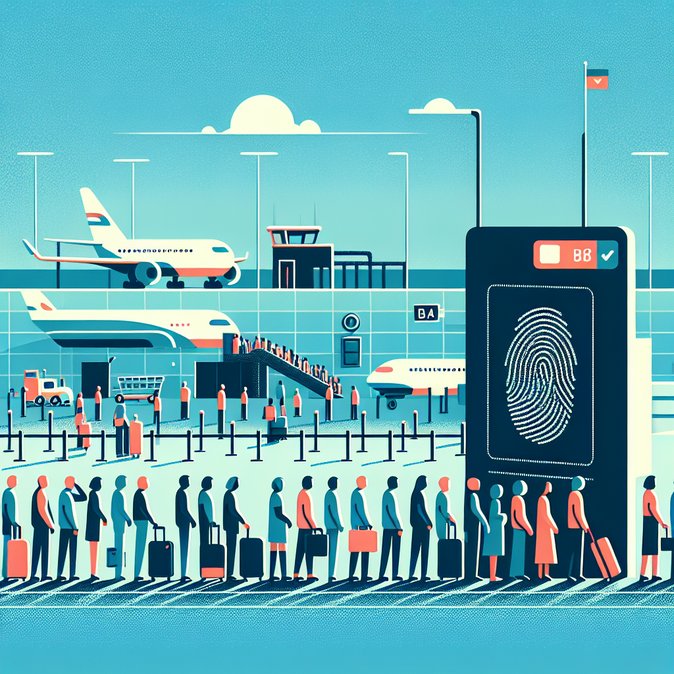
Only three weeks after the European Union’s new Entry/Exit System (EES) became mandatory, the European Commission has granted member states – including Austria – permission to apply “built-in flexibility” in the biometric border-check regime. The move, announced in Brussels on 2 May, is a response to mounting complaints from airlines, airport operators and travellers about hour-long lines and missed connections at major hubs such as Vienna-Schwechat, Frankfurt and Paris-Charles-de-Gaulle. Under the adjustment, border authorities may temporarily switch off the most time-consuming elements of the process – notably the capture of four fingerprints – at peak periods. Core data such as facial image, passport chip read-out and travel history must still be recorded, but Austria’s police can now revert to a “minimum data set” if departure halls start to overflow. According to Commission spokesman Markus Lampert, average processing time is 70 seconds, yet that figure balloons when large volumes of first-time third-country travelers arrive at once. Since October 2025 the system has logged more than 61 million crossings – 2.4 million of them in Austria alone.
![EU relaxes Entry/Exit System rules as Vienna and other Schengen airports struggle with queues]()
If you need tailored guidance on navigating Austria’s evolving border formalities, VisaHQ offers up-to-date visa, passport and travel-authorisation support for individuals and corporate mobility teams alike. Their Austria page (https://www.visahq.com/austria/) aggregates the latest EES and forthcoming ETIAS requirements and can streamline paperwork so travelers spend less time in line and more time on business.
Vienna International Airport welcomed the decision, noting that its 112 self-service kiosks and 244 camera gates have functioned reliably but that “exceptional wave peaks” after Easter produced queues of up to 40 minutes for non-EU passengers. Austrian Airlines and the Vienna Airport Association had warned that without relief measures business-class traffic could migrate to non-Schengen hubs. The Interior Ministry emphasised that the flexibility clause does not undermine security: “All travellers remain subject to automated watch-list checks, and fingerprints will still be captured the first time they enter when volumes stabilise.” For globally mobile staff the practical advice is clear: allow extra time when arriving at any Austrian airport, make the first EES enrolment as early in the trip as possible, and remind assignees that the EES record remains valid for three years and one day after the last exit. Companies should also review their posted-worker schedules, because overstaying the 90/180-day short-stay limit will now trigger an automatic alert in the system. Longer term, Austria is pressing the EU to speed up the linked ETIAS travel-authorisation platform so that risk-based profiling occurs upstream, before travellers ever board a flight. Until then, the Commission’s stop-gap should keep Austrian lanes moving ahead of the summer peak – but only if carriers, airports and police coordinate staffing in real time.

If you need tailored guidance on navigating Austria’s evolving border formalities, VisaHQ offers up-to-date visa, passport and travel-authorisation support for individuals and corporate mobility teams alike. Their Austria page (https://www.visahq.com/austria/) aggregates the latest EES and forthcoming ETIAS requirements and can streamline paperwork so travelers spend less time in line and more time on business.
Vienna International Airport welcomed the decision, noting that its 112 self-service kiosks and 244 camera gates have functioned reliably but that “exceptional wave peaks” after Easter produced queues of up to 40 minutes for non-EU passengers. Austrian Airlines and the Vienna Airport Association had warned that without relief measures business-class traffic could migrate to non-Schengen hubs. The Interior Ministry emphasised that the flexibility clause does not undermine security: “All travellers remain subject to automated watch-list checks, and fingerprints will still be captured the first time they enter when volumes stabilise.” For globally mobile staff the practical advice is clear: allow extra time when arriving at any Austrian airport, make the first EES enrolment as early in the trip as possible, and remind assignees that the EES record remains valid for three years and one day after the last exit. Companies should also review their posted-worker schedules, because overstaying the 90/180-day short-stay limit will now trigger an automatic alert in the system. Longer term, Austria is pressing the EU to speed up the linked ETIAS travel-authorisation platform so that risk-based profiling occurs upstream, before travellers ever board a flight. Until then, the Commission’s stop-gap should keep Austrian lanes moving ahead of the summer peak – but only if carriers, airports and police coordinate staffing in real time.
More From Austria
View all
Austrian Foreign Ministry issues updated security advice for Belgium after spike in metro shootings

New StVO rules for e-scooters and e-bikes enter into force, affecting commuters and assignees across Austria