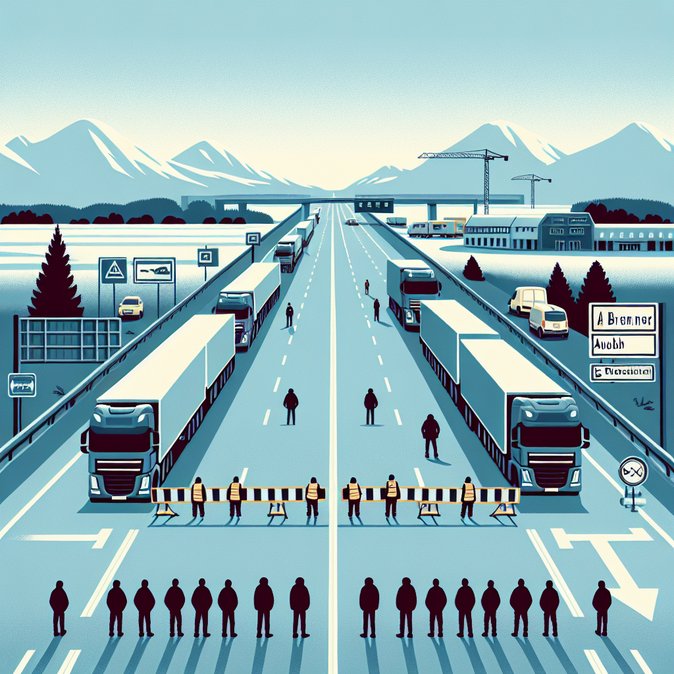
The Tirol provincial government confirmed on 30 April that an environmental demonstration has been authorised to block the A13 Brenner Autobahn and parallel routes between 11:00 and 19:00 on Saturday, 30 May. The decision—first reported by specialist freight daily Transport Online—means a complete stand-still on the main north-south artery linking Germany, Austria and Italy. Roughly 32,000 vehicles, including 7,000 heavy-goods trucks, use the corridor on a typical late-spring Saturday. Under Austrian assembly law, officials cannot prohibit a demonstration unless public safety is at immediate risk.
![Environmental protest to shut Austria’s Brenner corridor for eight hours on 30 May]()
If your rerouted travellers suddenly require updated visas for Austria or neighbouring countries, VisaHQ can accelerate the paperwork. Their online platform handles applications swiftly and securely, helping companies adapt to last-minute itinerary changes caused by events like the Brenner shutdown. Learn more at https://www.visahq.com/austria/
Organisers plan a “human chain” and slow-march to demand stricter modal-shift policies and a moratorium on alpine transit traffic. The shutdown will cover the A13 between the Schönberg toll plaza and the Brenner border, plus the B182 and L38 local alternatives—effectively sealing the Wipptal valley. For corporate mobility planners the stakes are high. The Brenner Pass is the preferred route for just-in-time deliveries from Austrian plants to customers in northern Italy and vice versa. ÖBB Rail Cargo Group says all piggy-back “Rolling Highway” trains will be cancelled that day, forcing logistics companies either to advance shipments by 48 hours or divert via the Tauern or Gotthard corridors—both of which add cost and transit time. Business travellers face knock-on effects as well. PostBus has announced that its Innsbruck-Bolzano regional coaches will terminate at Matrei, while railway operator ÖBB warns of overcrowding on the Nightjet service to Venice as road passengers switch to rail. Airlines could also see higher passenger loads on Vienna–Verona flights that weekend. Mobility managers should alert assignees with end-of-month relocations, resequence household-goods trucking schedules and confirm that time-critical components are either shipped well in advance or routed via alternative passes. The Tirol police are urging motorists to avoid the region entirely during the closure, as local roads cannot absorb overflow traffic.

If your rerouted travellers suddenly require updated visas for Austria or neighbouring countries, VisaHQ can accelerate the paperwork. Their online platform handles applications swiftly and securely, helping companies adapt to last-minute itinerary changes caused by events like the Brenner shutdown. Learn more at https://www.visahq.com/austria/
Organisers plan a “human chain” and slow-march to demand stricter modal-shift policies and a moratorium on alpine transit traffic. The shutdown will cover the A13 between the Schönberg toll plaza and the Brenner border, plus the B182 and L38 local alternatives—effectively sealing the Wipptal valley. For corporate mobility planners the stakes are high. The Brenner Pass is the preferred route for just-in-time deliveries from Austrian plants to customers in northern Italy and vice versa. ÖBB Rail Cargo Group says all piggy-back “Rolling Highway” trains will be cancelled that day, forcing logistics companies either to advance shipments by 48 hours or divert via the Tauern or Gotthard corridors—both of which add cost and transit time. Business travellers face knock-on effects as well. PostBus has announced that its Innsbruck-Bolzano regional coaches will terminate at Matrei, while railway operator ÖBB warns of overcrowding on the Nightjet service to Venice as road passengers switch to rail. Airlines could also see higher passenger loads on Vienna–Verona flights that weekend. Mobility managers should alert assignees with end-of-month relocations, resequence household-goods trucking schedules and confirm that time-critical components are either shipped well in advance or routed via alternative passes. The Tirol police are urging motorists to avoid the region entirely during the closure, as local roads cannot absorb overflow traffic.