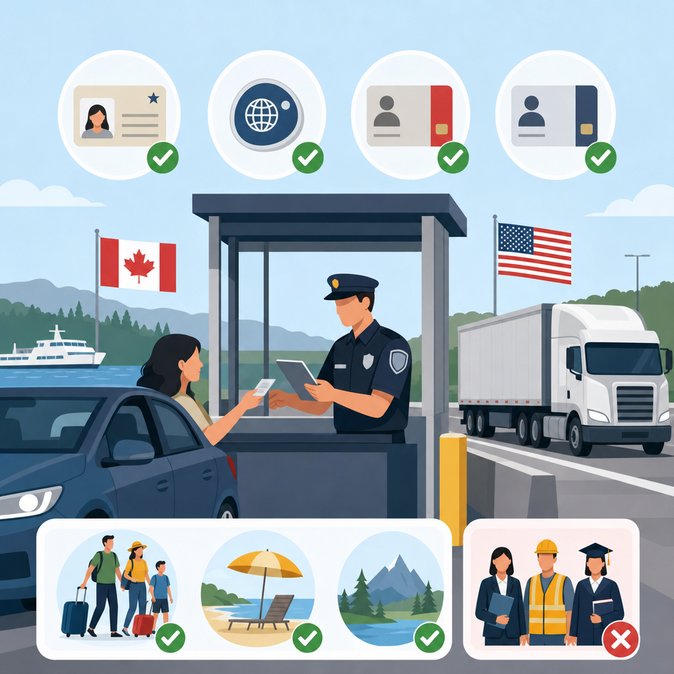
U.S. Customs and Border Protection has reiterated that most Canadian citizens may continue to enter the United States by land or sea without a passport or visa, provided they carry alternative secure documents such as an enhanced driver’s licence, an enhanced provincial ID card, or membership cards for trusted-traveler programs like NEXUS, SENTRI or FAST. The reminder, carried by Spanish-language outlet Cronista US, comes as millions of Canadians finalize summer travel plans and as land-border volumes return to pre-pandemic levels. Under Western Hemisphere Travel Initiative rules, Canadians taking short tourist or business trips of up to six months have long enjoyed simplified documentation requirements.
![CBP Clarifies Canadians Can Cross U.S. Land and Sea Borders With Enhanced IDs—No Passport or Visa Needed for Short Visits]()
If you’re unsure which credential is right for your situation, VisaHQ’s online platform can guide you through the U.S. entry requirements for Canadians, process any necessary visa applications, and keep you updated on policy changes. Their step-by-step tools and live support—available at https://www.visahq.com/united-states/—make it easy to confirm eligibility for travel under the visa-exempt category or to secure the proper work or study visa when one is required.
What is new is CBP’s push to publicize the flexibility amid confusion created by recent fee hikes for I-94 arrival records and by ongoing passport-processing backlogs on both sides of the border. For families driving to U.S. vacation spots, the announcement means that adults with EDLs and children with original birth certificates can still clear primary inspection without the added expense of passports. The policy is especially important for cross-border supply chains: truck drivers enrolled in FAST may present their program card in lieu of a passport, shaving minutes off each port-of-entry transaction and helping carriers stay on schedule. Employers should verify that drivers’ FAST cards remain valid for the duration of any assignment, as suspended cards require in-person re-enrollment interviews that can stretch weeks at congested enrollment centers. CBP does caution that a visa is still required for Canadians who intend to work, study, immigrate, or reside permanently in the United States. Treaty traders (E-1/E-2), intracompany transferees (L-1) and dependents, for example, must obtain the appropriate visa at a U.S. consulate before presenting themselves at the border. Likewise, officers may demand stronger evidence of ties to Canada from frequent border crossers to ensure visits remain temporary. For mobility managers, the takeaway is to align document policies with operational realities: verify that Canadian assignees traveling by land or sea hold the correct credential, educate employees on the six-month admission limit, and anticipate possible secondary inspections if officers suspect misuse of the visitor privilege.

If you’re unsure which credential is right for your situation, VisaHQ’s online platform can guide you through the U.S. entry requirements for Canadians, process any necessary visa applications, and keep you updated on policy changes. Their step-by-step tools and live support—available at https://www.visahq.com/united-states/—make it easy to confirm eligibility for travel under the visa-exempt category or to secure the proper work or study visa when one is required.
What is new is CBP’s push to publicize the flexibility amid confusion created by recent fee hikes for I-94 arrival records and by ongoing passport-processing backlogs on both sides of the border. For families driving to U.S. vacation spots, the announcement means that adults with EDLs and children with original birth certificates can still clear primary inspection without the added expense of passports. The policy is especially important for cross-border supply chains: truck drivers enrolled in FAST may present their program card in lieu of a passport, shaving minutes off each port-of-entry transaction and helping carriers stay on schedule. Employers should verify that drivers’ FAST cards remain valid for the duration of any assignment, as suspended cards require in-person re-enrollment interviews that can stretch weeks at congested enrollment centers. CBP does caution that a visa is still required for Canadians who intend to work, study, immigrate, or reside permanently in the United States. Treaty traders (E-1/E-2), intracompany transferees (L-1) and dependents, for example, must obtain the appropriate visa at a U.S. consulate before presenting themselves at the border. Likewise, officers may demand stronger evidence of ties to Canada from frequent border crossers to ensure visits remain temporary. For mobility managers, the takeaway is to align document policies with operational realities: verify that Canadian assignees traveling by land or sea hold the correct credential, educate employees on the six-month admission limit, and anticipate possible secondary inspections if officers suspect misuse of the visitor privilege.