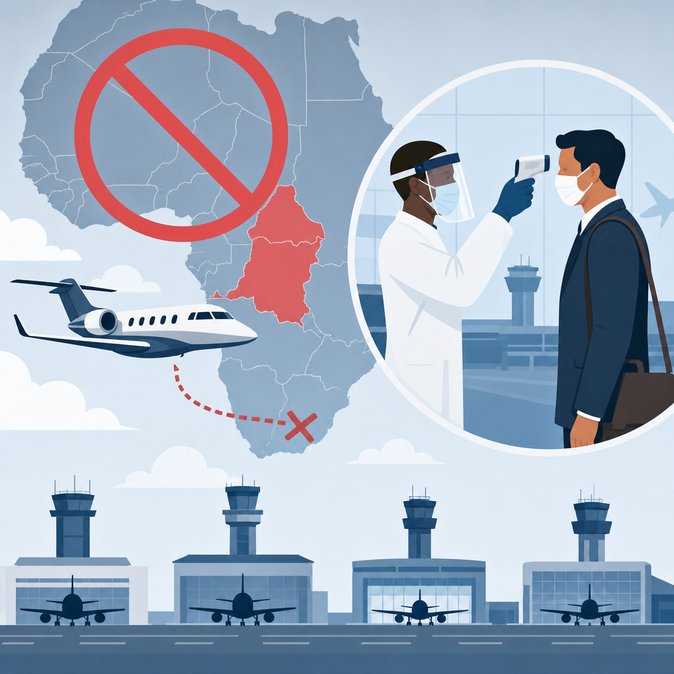
In an emergency public-health move, the U.S. Centers for Disease Control and Prevention (CDC) and DHS have invoked authority under 42 CFR 71.40 to suspend the entry of most non-U.S. citizens who have been in the Democratic Republic of Congo, Uganda or South Sudan within the previous 21 days. Effective immediately, only four ports – Washington Dulles (IAD), Atlanta (ATL), Houston (IAH) and New York JFK – may receive travellers subject to the order, and those arrivals face enhanced screening and potential quarantine. A Carrier Liaison Program bulletin circulated on 26 May and amplified by the National Business Aviation Association (NBAA) on 29 May warns business-jet operators that failure to comply will result in denial of landing rights or costly mid-flight diversions. NBAA cited an incident in which a Gulfstream heading to Houston was forced to return to Nassau after ATC advised that all CBP resources were tied up screening commercial flights. For companies with crews or assignees in central Africa, the order effectively shuts the door on routine routings through secondary U.S. gateways. Cargo-only flights are exempt, but passengers – including lawful permanent residents – must plan for routing through one of the four designated airports. The restriction is set for 30 days but can be extended.
![U.S. restricts entry from Ebola-affected African countries; business aviation urged to reroute]()
VisaHQ can be an invaluable resource for organizations and individual travelers trying to keep pace with these sudden rule changes. Its U.S. portal (https://www.visahq.com/united-states/) aggregates real-time updates on CDC and DHS directives, port-of-entry requirements, and supporting documentation, helping clients quickly adjust itineraries, secure any necessary clearances, and avoid costly disruptions.
Beyond aviation logistics, the policy triggers corporate duty-of-care obligations. Employers should update travel approval systems to flag itineraries originating in DRC, Uganda or South Sudan and confirm that travellers understand routing and screening requirements. Employee health plans should also review evacuation coverage: while U.S. citizens are still permitted to enter, they may face CDC-directed quarantine or monitoring on arrival. The rule arrives as global mobility teams already contend with heightened bio-surveillance measures worldwide – from Europe’s EES kiosks to U.S. biometric exit – underscoring the need for real-time monitoring of health-security rules that can reshape permissible travel overnight.

VisaHQ can be an invaluable resource for organizations and individual travelers trying to keep pace with these sudden rule changes. Its U.S. portal (https://www.visahq.com/united-states/) aggregates real-time updates on CDC and DHS directives, port-of-entry requirements, and supporting documentation, helping clients quickly adjust itineraries, secure any necessary clearances, and avoid costly disruptions.
Beyond aviation logistics, the policy triggers corporate duty-of-care obligations. Employers should update travel approval systems to flag itineraries originating in DRC, Uganda or South Sudan and confirm that travellers understand routing and screening requirements. Employee health plans should also review evacuation coverage: while U.S. citizens are still permitted to enter, they may face CDC-directed quarantine or monitoring on arrival. The rule arrives as global mobility teams already contend with heightened bio-surveillance measures worldwide – from Europe’s EES kiosks to U.S. biometric exit – underscoring the need for real-time monitoring of health-security rules that can reshape permissible travel overnight.