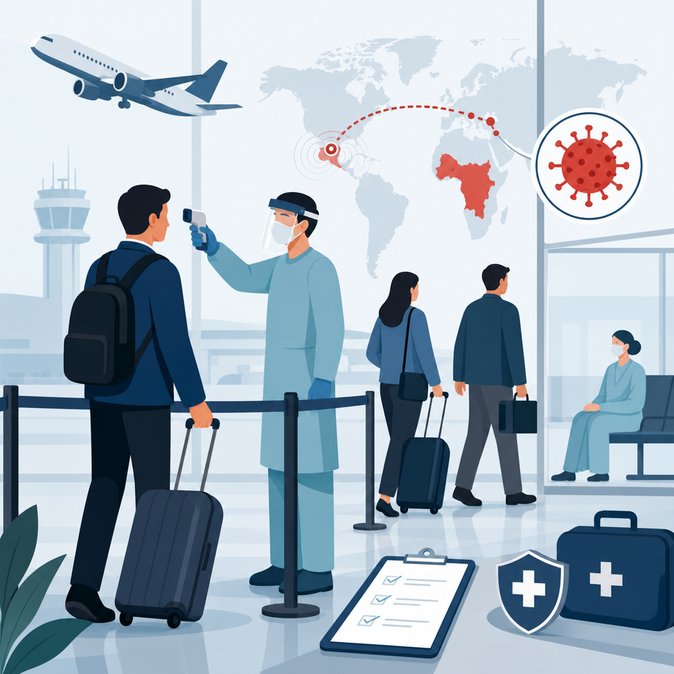
Federal health officials have redeployed Ebola screening teams to key U.S. gateways for the first time since 2014, responding to a fast-growing Bundibugyo-strain outbreak in the Democratic Republic of the Congo, Uganda and South Sudan. The Centers for Disease Control and Prevention and the Department of Homeland Security confirmed on May 30 that Chicago O’Hare, New York JFK and Los Angeles LAX are already screening travelers, with Atlanta and Houston quietly added on May 25 after on-site readiness assessments. Under a Title 42 public-health order, most non-U.S. citizens who have been in the three affected countries within 21 days are barred from entry unless they arrive at one of the designated airports, where they undergo temperature checks, health questionnaires and—if warranted—quarantine. U.S. citizens and lawful permanent residents may still enter but are subject to enhanced screening and post-arrival monitoring.
![U.S. expands Ebola entry screening to eight major airports as Bundibugyo outbreak widens]()
Travelers navigating these sudden rule changes don’t have to go it alone. VisaHQ’s platform (https://www.visahq.com/united-states/) offers up-to-the-minute guidance on country-specific entry bans, health declarations and transit visa requirements, and can expedite the paperwork so employees reach the correct gateway with documents in order.
Airlines have begun re-routing itineraries to comply, prompting schedule changes that particularly affect connecting traffic from Africa and the Middle East. The expanded list mirrors the 2014 playbook but has been activated earlier in the outbreak cycle—a move public-health experts say reflects lessons learned from COVID-19 and the previous Zaire-strain epidemic. However, internal CDC emails obtained by reporters show the agency scrambling for volunteer screeners, raising questions about its capacity to sustain operations during the busy summer travel season. For mobility managers, the practical implications are immediate: employees who have recently visited central Africa should postpone non-essential travel or plan to enter through one of the eight airports. Companies should update travel-health advisories, confirm that evacuation and medical-treatment benefits cover hemorrhagic fevers, and build extra connection time into itineraries for secondary screening. While officials emphasize that the risk to the general U.S. public remains low, the episode underscores the continuing link between global health crises and cross-border mobility. Organizations with operations in Africa are advised to audit duty-of-care protocols and rehearse remote-work contingencies in case the outbreak spreads or additional countries are added to the entry-ban list.

Travelers navigating these sudden rule changes don’t have to go it alone. VisaHQ’s platform (https://www.visahq.com/united-states/) offers up-to-the-minute guidance on country-specific entry bans, health declarations and transit visa requirements, and can expedite the paperwork so employees reach the correct gateway with documents in order.
Airlines have begun re-routing itineraries to comply, prompting schedule changes that particularly affect connecting traffic from Africa and the Middle East. The expanded list mirrors the 2014 playbook but has been activated earlier in the outbreak cycle—a move public-health experts say reflects lessons learned from COVID-19 and the previous Zaire-strain epidemic. However, internal CDC emails obtained by reporters show the agency scrambling for volunteer screeners, raising questions about its capacity to sustain operations during the busy summer travel season. For mobility managers, the practical implications are immediate: employees who have recently visited central Africa should postpone non-essential travel or plan to enter through one of the eight airports. Companies should update travel-health advisories, confirm that evacuation and medical-treatment benefits cover hemorrhagic fevers, and build extra connection time into itineraries for secondary screening. While officials emphasize that the risk to the general U.S. public remains low, the episode underscores the continuing link between global health crises and cross-border mobility. Organizations with operations in Africa are advised to audit duty-of-care protocols and rehearse remote-work contingencies in case the outbreak spreads or additional countries are added to the entry-ban list.