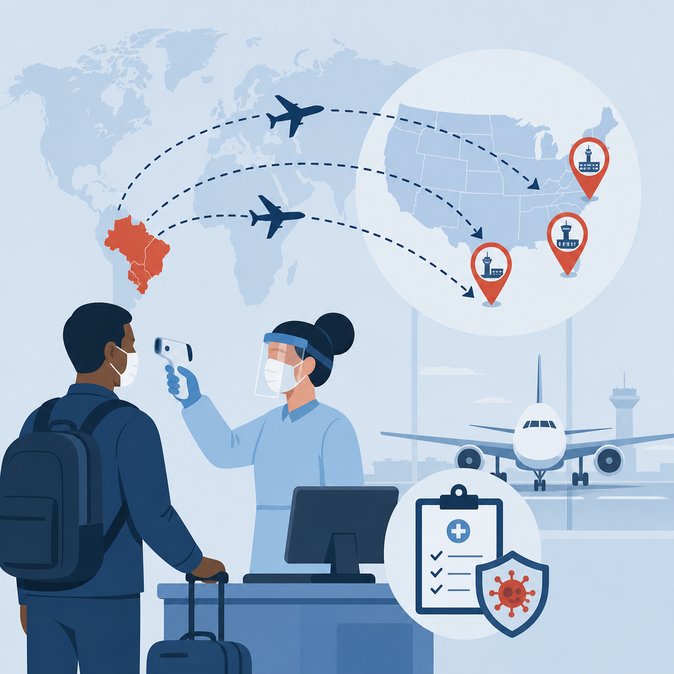
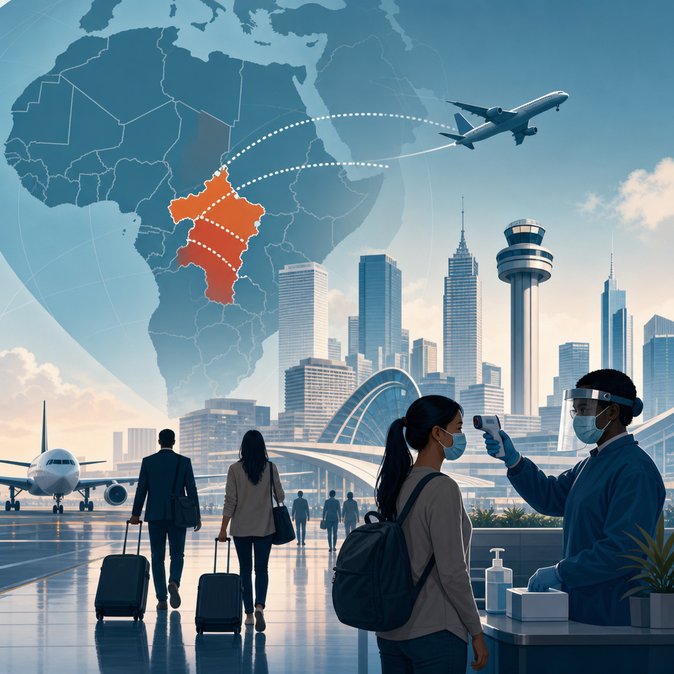
U.S. Customs and Border Protection (CBP) quietly expanded its health-screening program for travelers arriving from Ebola-affected nations on Monday, May 25. An operational notice circulated to airlines confirms that, effective immediately, all commercial flights carrying passengers who have been in the Democratic Republic of the Congo, Uganda, or South Sudan within the previous 21 days must land at one of three designated gateways: Washington Dulles (IAD), Atlanta Hartsfield-Jackson (ATL) or, beginning May 26, Houston George Bush Intercontinental (IAH).
![CBP Adds Atlanta and Houston to Ebola Arrival Screening List]()
Whether you’re a business traveler rerouted through these hubs or an employer coordinating complex itineraries, VisaHQ can simplify the paperwork. The company’s online portal consolidates visa, ESTA, and health documentation guidance for the United States, updating requirements in real time and offering hands-on support when emergencies like Ebola-related screening rules arise. Travelers can start the process or chat with an expert at https://www.visahq.com/united-states/
The move builds on a Department of Homeland Security (DHS) directive first issued on May 21 that routed such flights exclusively to Dulles so that Centers for Disease Control and Prevention (CDC) officers could conduct enhanced screening and contact-tracing interviews. CBP said the additional airports were added after on-site CDC teams and local public-health partners confirmed they could “scale screening capacity swiftly” should the central African outbreak widen. Designated-airport policies are not new. Similar funnels were used in 2014 during the West African Ebola epidemic and again in early 2020 for COVID-19. For carriers the change means flight-planning adjustments and, in some cases, re-routing of connecting passengers who would normally enter the U.S. through New York, Chicago or Los Angeles. Airlines operating one-stop services from African hubs—often via Brussels, Paris or Addis Ababa—now need to block point-of-sale itineraries that terminate in non-designated U.S. cities if the customer’s travel history triggers the rule. For travelers the most immediate impact is logistical: longer total journey times and possible overnight connections while CBP and CDC teams complete temperature checks, symptom questionnaires and, if necessary, rapid testing. Employers with rotational staff in the mining, energy and NGO sectors—notably those with crews cycling through the DRC’s copper belt or aid projects in northern Uganda—should review travel insurance and ensure that ticketing teams use the updated gateway list. Companies that rely on “open-jaw” routings or corporate jets must obtain prior DHS approval before landing elsewhere. CBP stressed that the measure is temporary and will be “continuously evaluated.” Infectious-disease experts note that the current East African Ebola outbreak remains small, but warn that the U.S. funnel system will likely stay in place through the northern-summer travel peak to give authorities a rapid-response buffer if case counts rise.
Whether you’re a business traveler rerouted through these hubs or an employer coordinating complex itineraries, VisaHQ can simplify the paperwork. The company’s online portal consolidates visa, ESTA, and health documentation guidance for the United States, updating requirements in real time and offering hands-on support when emergencies like Ebola-related screening rules arise. Travelers can start the process or chat with an expert at https://www.visahq.com/united-states/
The move builds on a Department of Homeland Security (DHS) directive first issued on May 21 that routed such flights exclusively to Dulles so that Centers for Disease Control and Prevention (CDC) officers could conduct enhanced screening and contact-tracing interviews. CBP said the additional airports were added after on-site CDC teams and local public-health partners confirmed they could “scale screening capacity swiftly” should the central African outbreak widen. Designated-airport policies are not new. Similar funnels were used in 2014 during the West African Ebola epidemic and again in early 2020 for COVID-19. For carriers the change means flight-planning adjustments and, in some cases, re-routing of connecting passengers who would normally enter the U.S. through New York, Chicago or Los Angeles. Airlines operating one-stop services from African hubs—often via Brussels, Paris or Addis Ababa—now need to block point-of-sale itineraries that terminate in non-designated U.S. cities if the customer’s travel history triggers the rule. For travelers the most immediate impact is logistical: longer total journey times and possible overnight connections while CBP and CDC teams complete temperature checks, symptom questionnaires and, if necessary, rapid testing. Employers with rotational staff in the mining, energy and NGO sectors—notably those with crews cycling through the DRC’s copper belt or aid projects in northern Uganda—should review travel insurance and ensure that ticketing teams use the updated gateway list. Companies that rely on “open-jaw” routings or corporate jets must obtain prior DHS approval before landing elsewhere. CBP stressed that the measure is temporary and will be “continuously evaluated.” Infectious-disease experts note that the current East African Ebola outbreak remains small, but warn that the U.S. funnel system will likely stay in place through the northern-summer travel peak to give authorities a rapid-response buffer if case counts rise.