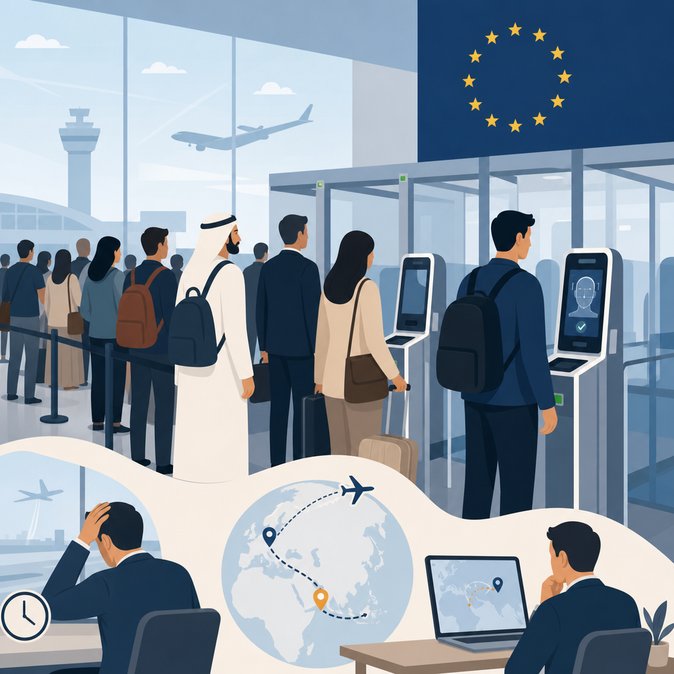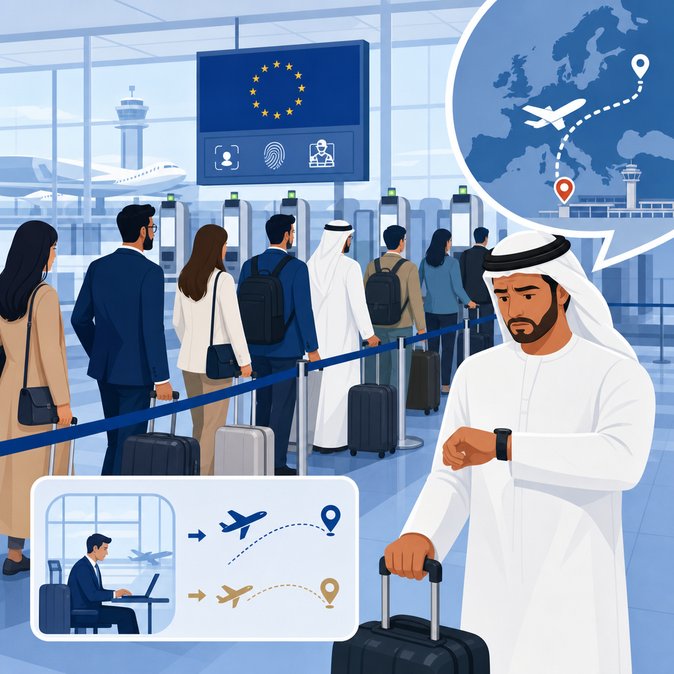
Barely 48 hours after the European Union switched on its biometric Entry/Exit System (EES) for all Schengen external borders, UAE holiday-makers and business passengers are feeling the pain. Gulf News reporters documented five- to six-hour immigration waits at Amsterdam Schiphol, Lisbon, Milan Malpensa and Warsaw Chopin over the weekend of 31 May–1 June 2026. Travel agents in Dubai say missed onward flights are now a daily occurrence.
![EU’s New Entry/Exit System Creates Hours-Long Queues for UAE Travellers]()
To help travellers navigate these new hurdles, UAE residents can consult VisaHQ, whose UAE portal (https://www.visahq.com/united-arab-emirates/) aggregates the latest Schengen entry rules, offers step-by-step visa filing tools and provides live support—giving both tourists and corporate travel managers a one-stop resource for pre-clearing documents and adjusting routes before departure.
EES replaces passport stamping with fingerprint and facial scans for non-EU visitors. While the technology promises stronger border security in the long term, the learning curve is steep: each first-time enrolment takes up to two minutes, multiplying queue times during the busy summer season. Airlines such as Wizz Air and Emirates have begun advising passengers to arrive at least four hours before departure when transiting Europe. For UAE-based corporates the disruption is more than an inconvenience. Many project teams route via European hubs to reach North and South America because of competitive fares and wide connectivity. HR and travel managers are now scrambling to re-issue itineraries with longer layovers or to re-route high-value staff through Istanbul, Doha or direct US services out of Abu Dhabi. Missed connections also raise duty-of-care questions, as employees stranded in transit may face visa-overstay penalties if onward segments are re-ticketed late. EU authorities insist the roll-out is still in a “transition phase” until 9 April 2027 and that processing times will fall as more travellers are enrolled. In the meantime, experts recommend that UAE passengers download the “Travel to Europe” mobile app, pre-register biometric data where possible, and carry printed proof of long-stay visas to avoid being funnelled into first-time lines by mistake.

To help travellers navigate these new hurdles, UAE residents can consult VisaHQ, whose UAE portal (https://www.visahq.com/united-arab-emirates/) aggregates the latest Schengen entry rules, offers step-by-step visa filing tools and provides live support—giving both tourists and corporate travel managers a one-stop resource for pre-clearing documents and adjusting routes before departure.
EES replaces passport stamping with fingerprint and facial scans for non-EU visitors. While the technology promises stronger border security in the long term, the learning curve is steep: each first-time enrolment takes up to two minutes, multiplying queue times during the busy summer season. Airlines such as Wizz Air and Emirates have begun advising passengers to arrive at least four hours before departure when transiting Europe. For UAE-based corporates the disruption is more than an inconvenience. Many project teams route via European hubs to reach North and South America because of competitive fares and wide connectivity. HR and travel managers are now scrambling to re-issue itineraries with longer layovers or to re-route high-value staff through Istanbul, Doha or direct US services out of Abu Dhabi. Missed connections also raise duty-of-care questions, as employees stranded in transit may face visa-overstay penalties if onward segments are re-ticketed late. EU authorities insist the roll-out is still in a “transition phase” until 9 April 2027 and that processing times will fall as more travellers are enrolled. In the meantime, experts recommend that UAE passengers download the “Travel to Europe” mobile app, pre-register biometric data where possible, and carry printed proof of long-stay visas to avoid being funnelled into first-time lines by mistake.