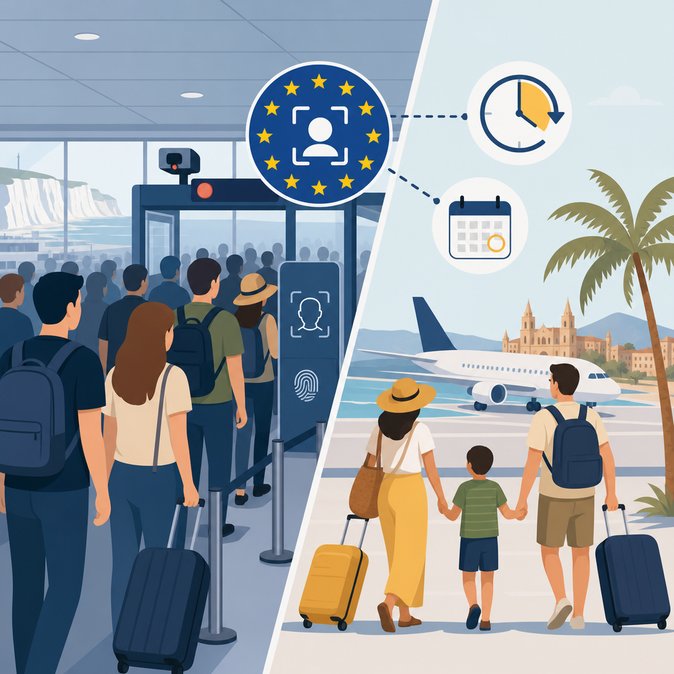
British holidaymakers queuing up to six hours at the Port of Dover on 31 May provided a stark preview of what Spanish airports could face in July and August. French frontier police – responsible for Schengen exit checks on British soil – twice invoked emergency clauses that let Member States pause biometric data capture when lines become unmanageable. The same derogation is available at Spain’s airports, but so far has only been used for short intervals at Madrid-Barajas and Palma de Mallorca. The European Commission recently confirmed that these six-hour “switch-offs” can be repeated back-to-back and that a wider 90-day seasonal suspension window is also possible. For Spanish tourism officials, the Dover episode is fresh evidence that the technology behind the Entry/Exit System still struggles under peak volumes – a concern given that Spain expects close to 4 million UK visitors between mid-July and mid-September. Industry bodies such as Exceltur argue that proactively scheduling partial suspensions – for example during early-morning and late-evening arrival banks when multiple UK flights land – would give operators certainty and prevent social-media images of snaking queues that deter last-minute bookings.
![Six-hour Dover bottleneck raises alarms for Spain’s summer arrivals as EU allows rolling EES suspensions]()
If you need help deciphering these shifting border formalities, VisaHQ keeps an updated feed of Spain’s Schengen policies and can process any required documents online, saving valuable time before departure; check their dedicated Spain page at https://www.visahq.com/spain/
Airlines, meanwhile, warn that manually checking passports extends boarding-gate deadlines and risks missing take-off slots, adding cost for carriers and passengers alike. Corporate mobility managers should monitor AENA and Ministry of Interior communiqués for advance notice of any Spanish EES derogations. Travellers holding Global Entry or Privium cards should note that fast-track biometrics provide no advantage when EES is offline – manual stamping applies to everyone. Companies running just-in-time supply chains via Dover-Spain road routes should also build extra transit time into schedules until Eurotunnel and Eurostar have fully integrated biometric capability later this year.

If you need help deciphering these shifting border formalities, VisaHQ keeps an updated feed of Spain’s Schengen policies and can process any required documents online, saving valuable time before departure; check their dedicated Spain page at https://www.visahq.com/spain/
Airlines, meanwhile, warn that manually checking passports extends boarding-gate deadlines and risks missing take-off slots, adding cost for carriers and passengers alike. Corporate mobility managers should monitor AENA and Ministry of Interior communiqués for advance notice of any Spanish EES derogations. Travellers holding Global Entry or Privium cards should note that fast-track biometrics provide no advantage when EES is offline – manual stamping applies to everyone. Companies running just-in-time supply chains via Dover-Spain road routes should also build extra transit time into schedules until Eurotunnel and Eurostar have fully integrated biometric capability later this year.