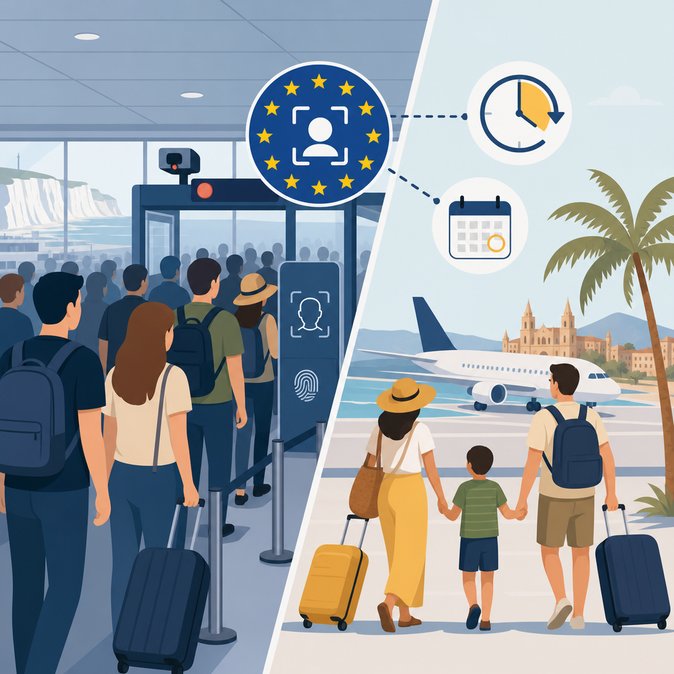
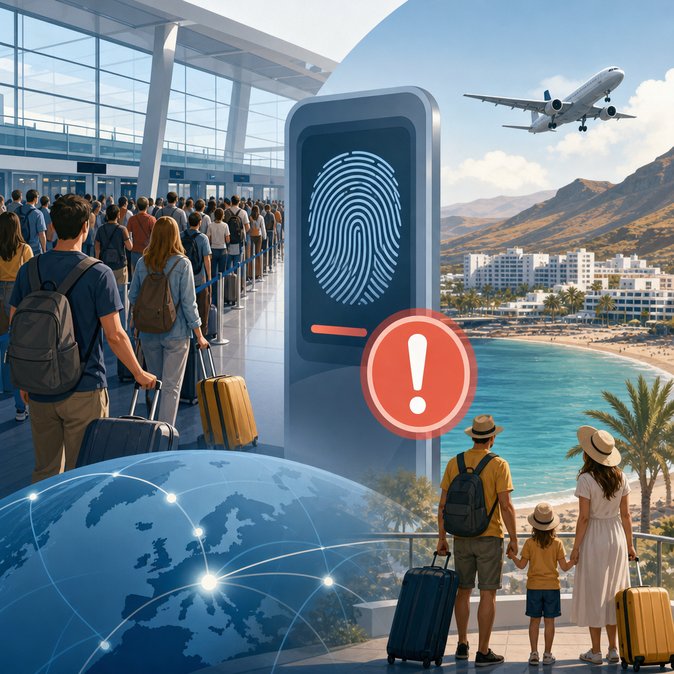
Just six weeks after the EU’s Entry/Exit System (EES) went live, Gran Canaria Airport has become the latest flash-point for the new biometric controls. Travellers reported queues of up to three hours at passport control over the weekend – peak holiday-change-over days for the Canary Islands – as malfunctioning kiosks forced officers to switch repeatedly between manual stamping and fingerprint/face scans. Photos posted on social media show lines snaking the length of the arrivals hall. EES, fully operational since 10 April 2026, records the entry and exit of every non-EU national and replaces the physical passport stamps on which the 90/180-day Schengen rule was previously enforced. The €395 million deployment at Spain’s external airports was supposed to speed traffic; instead, airlines and ground-handlers say that even brief outages add five minutes per passenger, rapidly snowballing when several wide-body flights land simultaneously. British visitors – who make up 38 % of the Canary Islands’ tourism market – have been hardest hit. Industry association Ashotel and the Canarian regional government are urging Madrid and Brussels to copy Greece’s decision to suspend mandatory biometrics during the summer peak. They warn that reputational damage could jeopardise the archipelago’s recovery: tourism accounts for 35 % of local GDP and supports one in three jobs. Opposition MPs from the Partido Popular argue the islands should obtain a “special regime” allowing selective relaxation when queues exceed one hour. AENA, the Spanish airport operator, has deployed additional staff, opened overflow lanes and says it is working with the National Police to authorise short “switch-off” windows permitted under EU rules when waiting times exceed 45 minutes.
![Biometric ‘EES’ glitches create three-hour passport queues at Gran Canaria Airport, sparking calls for Spain to ease checks]()
For travellers who want to minimise the impact of these changing border procedures, VisaHQ can help by monitoring Spain’s EES status in real time, advising on upcoming ETIAS requirements, and handling any visa or travel-authorisation paperwork through its streamlined portal: https://www.visahq.com/spain/
Corporate travel managers should alert staff that fast-track lanes (including Fast Lane and Gold Passport services) are currently suspended when EES machines are offline, and connections under two hours at hub airports in Spain may no longer be safe. Looking ahead, the queues foreshadow wider challenges once the EU brings in ETIAS travel authorisation at the end of 2026. Unless reliability improves, Spain risks losing high-spend visitors to competitor destinations that have already paused biometric collection. Companies running incentive trips or conferences in Spain’s island regions this summer should build larger schedule buffers and consider charter arrivals at quieter airports such as Fuerteventura or La Palma.
For travellers who want to minimise the impact of these changing border procedures, VisaHQ can help by monitoring Spain’s EES status in real time, advising on upcoming ETIAS requirements, and handling any visa or travel-authorisation paperwork through its streamlined portal: https://www.visahq.com/spain/
Corporate travel managers should alert staff that fast-track lanes (including Fast Lane and Gold Passport services) are currently suspended when EES machines are offline, and connections under two hours at hub airports in Spain may no longer be safe. Looking ahead, the queues foreshadow wider challenges once the EU brings in ETIAS travel authorisation at the end of 2026. Unless reliability improves, Spain risks losing high-spend visitors to competitor destinations that have already paused biometric collection. Companies running incentive trips or conferences in Spain’s island regions this summer should build larger schedule buffers and consider charter arrivals at quieter airports such as Fuerteventura or La Palma.