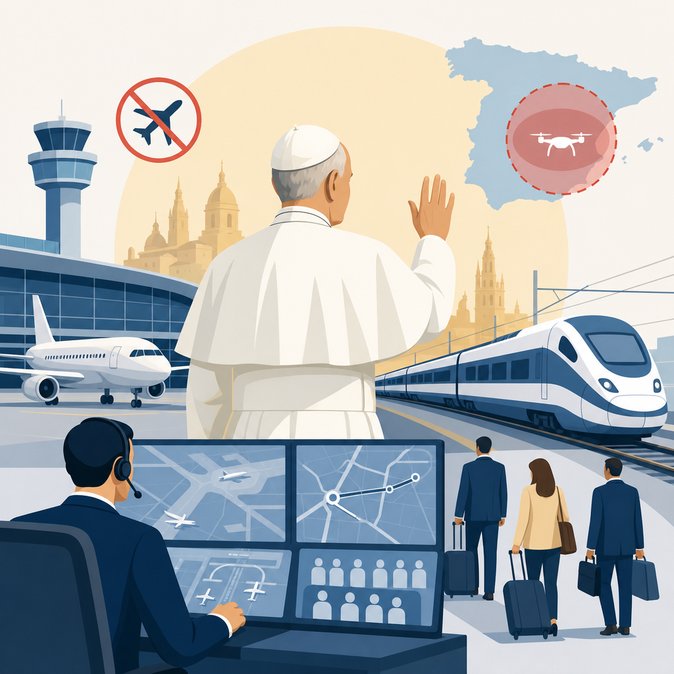
With less than two weeks to go before Pope Leo XIV’s first trip to Spain, the Ministry of Transport and Sustainable Mobility unveiled a nationwide operations plan on 29 May 2026 aimed at keeping air, rail, and road traffic flowing during what officials predict will be the country’s largest religious event since World Youth Day 2011. Between 6 and 12 June, the pontiff will preside over masses and meetings in Madrid, Barcelona, Tenerife, and Gran Canaria—destinations that together handle more than 60 percent of Spain’s daily passenger volume.
The plan, drafted after 80 inter-agency meetings, hinges on three pillars: reinforced airport capacity, dedicated railway slots, and temporary air-space restrictions. Airport operator Aena has coordinated with airlines and ground-handling agents to pre-approve slots for charter flights carrying foreign pilgrims, while reserving apron positions and fueling services for the papal aircraft. The Spanish Slot Coordination Association (AECFA) has frozen ad-hoc general-aviation requests for the busiest hours and will vet any additional flights linked to the event.
![Spain Deploys Nationwide Mobility Plan for Upcoming Papal Visit]()
For international visitors who still need entry clearance, VisaHQ can streamline the Spanish visa process with quick online applications, document reviews, and door-to-door passport return services. The company’s Spain portal (https://www.visahq.com/spain/) centralizes the latest consular requirements—an especially useful resource for pilgrim groups coordinating last-minute travel around the Pope’s itinerary.
On the ground, state rail manager Renfe will add 90,000 seats on Cercanías Madrid, Rodalies Barcelona, Avant, and selected Media Distancia services. Security perimeters and crowd-flow corridors are being mapped with the National Police and regional forces to segregate pilgrim movement from ordinary commuter traffic. Air-navigation provider ENAIRE will establish Temporary Reserved Airspace (TRA) around mass venues; only security, medical, and accredited flights will be allowed to overfly these zones.
For business travellers the key takeaway is to expect tighter slot availability and possible schedule tweaks—particularly at Madrid-Barajas (MAD) and Barcelona-El Prat (BCN)—between 5 and 13 June. Travel-managers are advised to confirm meeting times, allow extra connection buffers, and monitor NOTAMs and Renfe schedule updates. Larger corporates with mobility programmes have begun issuing internal alerts reminding assignees to carry passports even for domestic legs if their itineraries include security-filtered shuttle buses to papal venues. Tourism boards, meanwhile, view the visit as a dress rehearsal for Spain’s high-season peak. If the multimodal coordination succeeds, officials say it will strengthen the case for Spain to host other mega-events and will showcase the resilience of the country’s upgraded rail-air intermodality.
The plan, drafted after 80 inter-agency meetings, hinges on three pillars: reinforced airport capacity, dedicated railway slots, and temporary air-space restrictions. Airport operator Aena has coordinated with airlines and ground-handling agents to pre-approve slots for charter flights carrying foreign pilgrims, while reserving apron positions and fueling services for the papal aircraft. The Spanish Slot Coordination Association (AECFA) has frozen ad-hoc general-aviation requests for the busiest hours and will vet any additional flights linked to the event.

For international visitors who still need entry clearance, VisaHQ can streamline the Spanish visa process with quick online applications, document reviews, and door-to-door passport return services. The company’s Spain portal (https://www.visahq.com/spain/) centralizes the latest consular requirements—an especially useful resource for pilgrim groups coordinating last-minute travel around the Pope’s itinerary.
On the ground, state rail manager Renfe will add 90,000 seats on Cercanías Madrid, Rodalies Barcelona, Avant, and selected Media Distancia services. Security perimeters and crowd-flow corridors are being mapped with the National Police and regional forces to segregate pilgrim movement from ordinary commuter traffic. Air-navigation provider ENAIRE will establish Temporary Reserved Airspace (TRA) around mass venues; only security, medical, and accredited flights will be allowed to overfly these zones.
For business travellers the key takeaway is to expect tighter slot availability and possible schedule tweaks—particularly at Madrid-Barajas (MAD) and Barcelona-El Prat (BCN)—between 5 and 13 June. Travel-managers are advised to confirm meeting times, allow extra connection buffers, and monitor NOTAMs and Renfe schedule updates. Larger corporates with mobility programmes have begun issuing internal alerts reminding assignees to carry passports even for domestic legs if their itineraries include security-filtered shuttle buses to papal venues. Tourism boards, meanwhile, view the visit as a dress rehearsal for Spain’s high-season peak. If the multimodal coordination succeeds, officials say it will strengthen the case for Spain to host other mega-events and will showcase the resilience of the country’s upgraded rail-air intermodality.