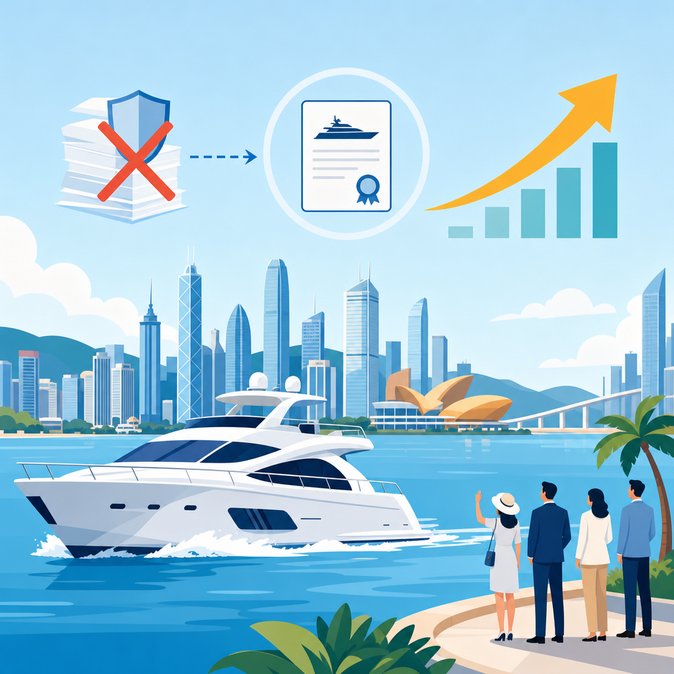
Cross-border leisure boating in the Guangdong–Hong Kong–Macao Greater Bay Area (GBA) is about to get dramatically easier. On 30 May 2026 the Hong Kong SAR Government announced that China’s State Council has approved two long-awaited facilitation measures for Hong Kong- and Macao-registered pleasure craft: (1) the complete exemption of the financial “guarantee” previously demanded when a yacht applied to sail into Mainland waters; and (2) a new system of temporary ship-nationality registration that removes the need to re-flag the vessel. The exemption and the simplified paperwork apply when yachts sail between Hong Kong, Macao and nine designated Mainland cities—Shenzhen, Guangzhou, Zhuhai, Foshan, Zhongshan, Dongguan, Huizhou, Jiangmen and Zhaoqing—using specified ports. Industry groups have campaigned for years for a rules overhaul, arguing that the guarantee—effectively a bond to ensure compliance with customs and immigration rules—added tens of thousands of Hong Kong dollars to every voyage. Eliminating it slashes upfront costs and aligns yacht procedures with those already enjoyed by cross-border drivers on the Hong Kong–Zhuhai–Macao Bridge (HZMB).
![Beijing lifts guarantee requirement for Hong Kong and Macao yachts entering Mainland ports]()
For skippers and crew still unsure about individual visa or passport requirements when docking in different GBA ports, VisaHQ’s Hong Kong team (https://www.visahq.com/hong-kong/) offers up-to-the-minute guidance, expedited visa processing and even emergency passport renewals, ensuring that both leisure and corporate voyages stay on course without documentation hiccups.
The temporary nationality certificate, meanwhile, lets owners keep their Hong Kong or Macao Registration Book while meeting Mainland legal requirements—a move expected to cut processing time from weeks to a single business day. Officials say the change is core to the GBA’s “Individual Yacht Travel Scheme”, a policy blueprint that aims to create a fully liberalised cruising market with unified safety, quarantine and immigration standards by 2030. According to the Marine Department, only 132 Hong Kong yachts sailed northbound in 2025, but the new rules could boost annual traffic five-fold within three years, generating spill-over demand for marina berths, fuel bunkering, maintenance and high-value nautical tourism services. For business mobility managers the implications go beyond leisure boating. Corporate jet-ski product launches, floating board-meetings and luxury incentive programmes can now be staged seamlessly across multiple GBA cities without the regulatory friction that used to require crew visas, local agents and hefty bank guarantees. Logistics teams should, however, note that southbound policy details for Mainland-flagged yachts entering Hong Kong are still being negotiated; full reciprocity is expected later in 2026. The Transport and Logistics Bureau is working with Guangdong’s Maritime Safety Administration to publish an operational circular in June setting out port lists, application forms and e-clearance procedures. Yacht owners are advised to check insurance clauses, ensure AIS transponders are GBA-compliant, and pre-register crew manifests through Hong Kong’s e-SeaGo portal once it goes live.

For skippers and crew still unsure about individual visa or passport requirements when docking in different GBA ports, VisaHQ’s Hong Kong team (https://www.visahq.com/hong-kong/) offers up-to-the-minute guidance, expedited visa processing and even emergency passport renewals, ensuring that both leisure and corporate voyages stay on course without documentation hiccups.
The temporary nationality certificate, meanwhile, lets owners keep their Hong Kong or Macao Registration Book while meeting Mainland legal requirements—a move expected to cut processing time from weeks to a single business day. Officials say the change is core to the GBA’s “Individual Yacht Travel Scheme”, a policy blueprint that aims to create a fully liberalised cruising market with unified safety, quarantine and immigration standards by 2030. According to the Marine Department, only 132 Hong Kong yachts sailed northbound in 2025, but the new rules could boost annual traffic five-fold within three years, generating spill-over demand for marina berths, fuel bunkering, maintenance and high-value nautical tourism services. For business mobility managers the implications go beyond leisure boating. Corporate jet-ski product launches, floating board-meetings and luxury incentive programmes can now be staged seamlessly across multiple GBA cities without the regulatory friction that used to require crew visas, local agents and hefty bank guarantees. Logistics teams should, however, note that southbound policy details for Mainland-flagged yachts entering Hong Kong are still being negotiated; full reciprocity is expected later in 2026. The Transport and Logistics Bureau is working with Guangdong’s Maritime Safety Administration to publish an operational circular in June setting out port lists, application forms and e-clearance procedures. Yacht owners are advised to check insurance clauses, ensure AIS transponders are GBA-compliant, and pre-register crew manifests through Hong Kong’s e-SeaGo portal once it goes live.