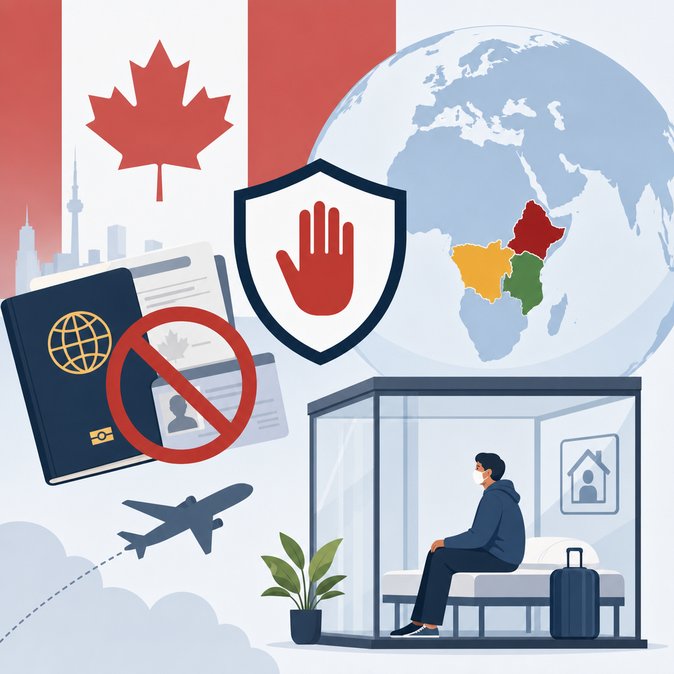
The Public Health Agency of Canada (PHAC) has invoked the Quarantine Act to introduce sweeping border restrictions aimed at preventing the spread of Ebola virus disease. In a May 26 news release, PHAC said immigration documents for residents of the Democratic Republic of the Congo, Uganda and South Sudan will be suspended for 90 days starting 27 May at 23:59 EDT. That suspension covers temporary resident visas, electronic travel authorisations (eTAs) and even already-approved permanent resident visas. Canadian citizens, permanent residents and other exempt travellers who have been in the affected countries within the previous 21 days must undertake a mandatory three-week self-isolation on arrival. Travellers without a suitable place to quarantine will be housed in government-designated facilities. Anyone showing symptoms will be transferred directly to hospital for assessment.
![Ottawa suspends visas and imposes 21-day quarantine for travellers from Ebola-affected African nations]()
To help individuals and employers stay ahead of these sudden policy shifts, VisaHQ offers up-to-the-minute travel advisories, document pre-screening and application management for Canadian visas and authorisations. Visit https://www.visahq.com/canada/ to see how the service can monitor evolving requirements, flag potential issues and streamline submissions once the temporary suspension is lifted.
The measures, which run until at least 29 August 2026, arrive amid a fast-growing outbreak in northeastern Congo that the World Health Organization warns could last for months. Although Canada has never recorded an imported Ebola case, officials said the policy reflects an “abundance of caution,” particularly with large-scale events such as the 2026 FIFA World Cup expected to drive visitor volumes. For global mobility teams, the immediate impact is two-fold. First, assignments or business trips involving employees from the three countries will face significant delays; even previously issued visas are invalid for the duration of the suspension. Second, Canadian nationals working in or transiting through those regions must factor in a 21-day quarantine before they can re-enter the workplace, complicating project timelines. Companies should audit travel plans, communicate the new requirements to affected staff and consider contingency or remote-work arrangements. PHAC advises travellers to monitor travel.gc.ca for rapid updates as the epidemiological situation evolves.

To help individuals and employers stay ahead of these sudden policy shifts, VisaHQ offers up-to-the-minute travel advisories, document pre-screening and application management for Canadian visas and authorisations. Visit https://www.visahq.com/canada/ to see how the service can monitor evolving requirements, flag potential issues and streamline submissions once the temporary suspension is lifted.
The measures, which run until at least 29 August 2026, arrive amid a fast-growing outbreak in northeastern Congo that the World Health Organization warns could last for months. Although Canada has never recorded an imported Ebola case, officials said the policy reflects an “abundance of caution,” particularly with large-scale events such as the 2026 FIFA World Cup expected to drive visitor volumes. For global mobility teams, the immediate impact is two-fold. First, assignments or business trips involving employees from the three countries will face significant delays; even previously issued visas are invalid for the duration of the suspension. Second, Canadian nationals working in or transiting through those regions must factor in a 21-day quarantine before they can re-enter the workplace, complicating project timelines. Companies should audit travel plans, communicate the new requirements to affected staff and consider contingency or remote-work arrangements. PHAC advises travellers to monitor travel.gc.ca for rapid updates as the epidemiological situation evolves.