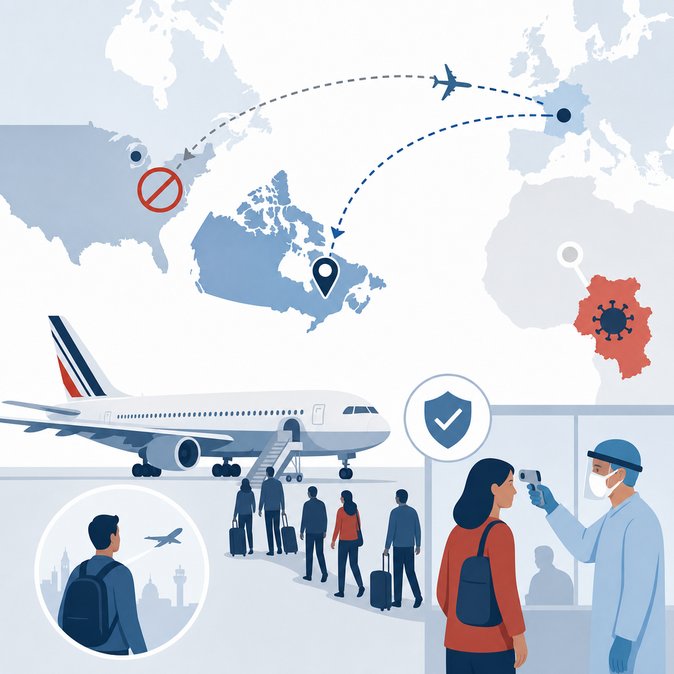
A routine Paris-to-Detroit flight turned into an unscheduled stop in Canada on May 21 when U.S. Customs and Border Protection (CBP) ordered Air France flight AFR 378 to divert to Montréal–Pierre Elliott Trudeau International Airport. According to CBP, one passenger had recently been in the Democratic Republic of Congo and therefore fell under emergency restrictions the United States imposed this week to contain a fast-spreading outbreak of Bundibugyo-strain Ebola in Central Africa. Under the rules, travellers who have been in the DRC, Uganda or South Sudan within the previous 21 days may enter the United States only through Washington Dulles International Airport, where enhanced medical screening is in place. Because Detroit Metropolitan Airport is not on the designated-entry list, CBP “took decisive action” and refused landing clearance, redirecting the aircraft to Montreal. Canadian quarantine officers boarded the plane, determined the traveller was asymptomatic and arranged for their immediate return to Paris; the remaining passengers later continued to Detroit. The incident highlights how quickly health-related border measures can disrupt flight operations and corporate travel itineraries.
Carriers serving transatlantic routes with large connecting flows to the U.S. Midwest should review passenger-origin data and be prepared for last-minute operational changes.
![Ebola travel rules force Air France jet to land in Montreal instead of Detroit]()
At times like these, VisaHQ’s travel document specialists can be an invaluable back-stop. Through its Canada portal (https://www.visahq.com/canada/), the company offers real-time updates on health advisories, visa requirements and airport-specific entry rules, helping airlines, corporate travel teams and individual passengers verify that every leg of a multi-country itinerary satisfies the latest government mandates.
Employers moving staff between Europe, Canada and the United States, meanwhile, should confirm whether travellers have recently been in outbreak-affected regions and, if so, route them through the approved U.S. airport or via Canada with onward travel after screening. For Canada, the diversion re-emphasises the importance of inter-agency coordination: Transport Canada, the Public Health Agency of Canada and CBSA must be ready to manage unexpected arrivals created by another country’s public-health rules. Although no Canadian entry ban exists for the affected African countries, mobility managers should monitor federal advisories, as Ottawa could mirror or tighten measures if the outbreak worsens. The episode also serves as a cautionary tale for the business-aviation sector. A single traveller’s itinerary error—or an automated airline misconnection—can trigger costly diversions, crew-duty complications and itinerary knock-ons for dozens of passengers. Companies should review duty-of-care protocols to ensure that travel approval workflows capture the latest health entry restrictions not just at destination but at all transit points.
Carriers serving transatlantic routes with large connecting flows to the U.S. Midwest should review passenger-origin data and be prepared for last-minute operational changes.

At times like these, VisaHQ’s travel document specialists can be an invaluable back-stop. Through its Canada portal (https://www.visahq.com/canada/), the company offers real-time updates on health advisories, visa requirements and airport-specific entry rules, helping airlines, corporate travel teams and individual passengers verify that every leg of a multi-country itinerary satisfies the latest government mandates.
Employers moving staff between Europe, Canada and the United States, meanwhile, should confirm whether travellers have recently been in outbreak-affected regions and, if so, route them through the approved U.S. airport or via Canada with onward travel after screening. For Canada, the diversion re-emphasises the importance of inter-agency coordination: Transport Canada, the Public Health Agency of Canada and CBSA must be ready to manage unexpected arrivals created by another country’s public-health rules. Although no Canadian entry ban exists for the affected African countries, mobility managers should monitor federal advisories, as Ottawa could mirror or tighten measures if the outbreak worsens. The episode also serves as a cautionary tale for the business-aviation sector. A single traveller’s itinerary error—or an automated airline misconnection—can trigger costly diversions, crew-duty complications and itinerary knock-ons for dozens of passengers. Companies should review duty-of-care protocols to ensure that travel approval workflows capture the latest health entry restrictions not just at destination but at all transit points.