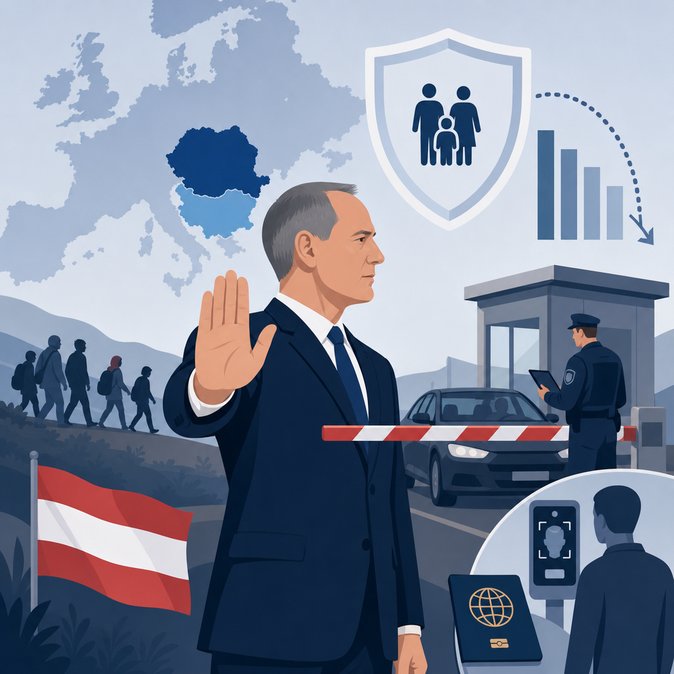
Speaking in Constanţa, Romania, on 27 May 2026, Austria’s interior minister Gerhard Karner reiterated that Vienna’s December 2022 decision to block the full Schengen accession of Romania and Bulgaria was “a heavy but absolutely necessary step.” Karner was in the Black-Sea port for two days of border-security talks with his Romanian counterpart Cătălin Predoiu and EU officials. According to Karner, the veto had a catalytic effect: it triggered a €220 million EU support package that paid for thermal cameras, drones, mobile fingerprint scanners and joint patrols along the Bulgarian-Turkish frontier.
![Interior Minister Karner says Austria’s 2022 Schengen veto “proved its worth” as illegal crossings plunge 95 %]()
To navigate the chain reaction of new checks and documentation requirements this has set off, travellers and corporate mobility teams can tap VisaHQ’s dedicated Austria portal (https://www.visahq.com/austria/). The platform monitors Schengen policy updates in real time, guides users through ETIAS pre-registration, and provides fast, professional visa and residence-permit processing—helping organisations keep staff moving smoothly even when border rules tighten overnight.
Since those measures went live, detected illegal entries there have fallen roughly 60 % while interceptions in Austria’s Burgenland province have collapsed from about 3,500 in October 2022 to only 20 during the week of 11–17 May 2026. The price charged by smuggling networks for a land crossing from Turkey into Bulgaria has reportedly risen to €10,000 per person, further dampening flows. Karner emphasised that Austria remains committed to Schengen enlargement “once the external border is truly secure,” but said Vienna would maintain its own internal checks with Hungary, Slovenia, Slovakia and the Czech Republic until at least June 2026. He credited the so-called “three-wall” concept—mobile patrols beyond the immediate frontier, intensified cooperation with neighbours, and targeted police checks deep inside the country—for keeping asylum claims at their lowest April total since 2014. For multinationals moving staff through Vienna International Airport, the minister’s remarks signal that spot controls and biometric Entry/Exit-System procedures will remain part of the travel experience for the foreseeable future. Mobility managers should continue to warn travelers to carry proof of onward travel and be prepared for random passport scans even on Schengen-internal flights. Employers placing assignees in Austria must also monitor the new family-reunification quota legislation passed earlier in May, as it could interact with the tightened border regime. Karner’s visit comes as the EU finalises implementation rules for the bloc-wide Asylum & Migration Pact and prepares for the late-2026 launch of ETIAS. Austria is positioning itself as a hard-line voice in those negotiations—an approach that plays well with domestic voters but keeps mobility teams on constant alert for new compliance hurdles.

To navigate the chain reaction of new checks and documentation requirements this has set off, travellers and corporate mobility teams can tap VisaHQ’s dedicated Austria portal (https://www.visahq.com/austria/). The platform monitors Schengen policy updates in real time, guides users through ETIAS pre-registration, and provides fast, professional visa and residence-permit processing—helping organisations keep staff moving smoothly even when border rules tighten overnight.
Since those measures went live, detected illegal entries there have fallen roughly 60 % while interceptions in Austria’s Burgenland province have collapsed from about 3,500 in October 2022 to only 20 during the week of 11–17 May 2026. The price charged by smuggling networks for a land crossing from Turkey into Bulgaria has reportedly risen to €10,000 per person, further dampening flows. Karner emphasised that Austria remains committed to Schengen enlargement “once the external border is truly secure,” but said Vienna would maintain its own internal checks with Hungary, Slovenia, Slovakia and the Czech Republic until at least June 2026. He credited the so-called “three-wall” concept—mobile patrols beyond the immediate frontier, intensified cooperation with neighbours, and targeted police checks deep inside the country—for keeping asylum claims at their lowest April total since 2014. For multinationals moving staff through Vienna International Airport, the minister’s remarks signal that spot controls and biometric Entry/Exit-System procedures will remain part of the travel experience for the foreseeable future. Mobility managers should continue to warn travelers to carry proof of onward travel and be prepared for random passport scans even on Schengen-internal flights. Employers placing assignees in Austria must also monitor the new family-reunification quota legislation passed earlier in May, as it could interact with the tightened border regime. Karner’s visit comes as the EU finalises implementation rules for the bloc-wide Asylum & Migration Pact and prepares for the late-2026 launch of ETIAS. Austria is positioning itself as a hard-line voice in those negotiations—an approach that plays well with domestic voters but keeps mobility teams on constant alert for new compliance hurdles.