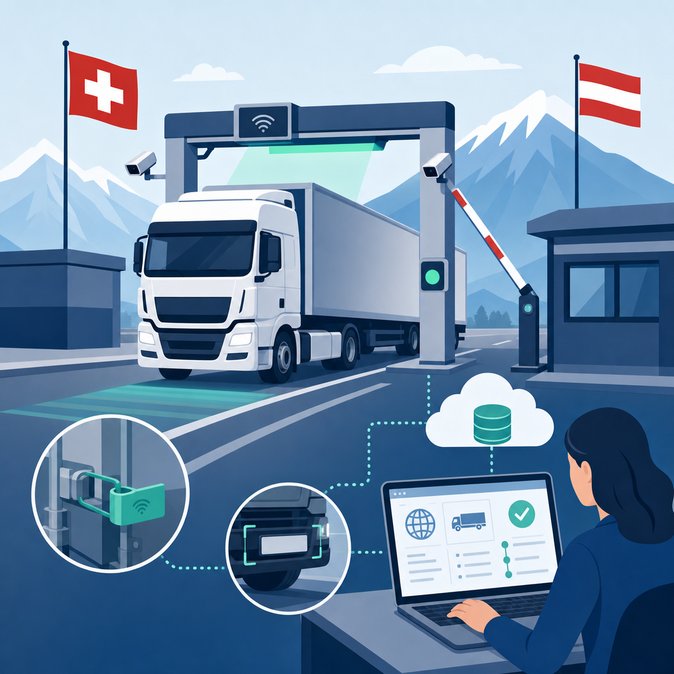
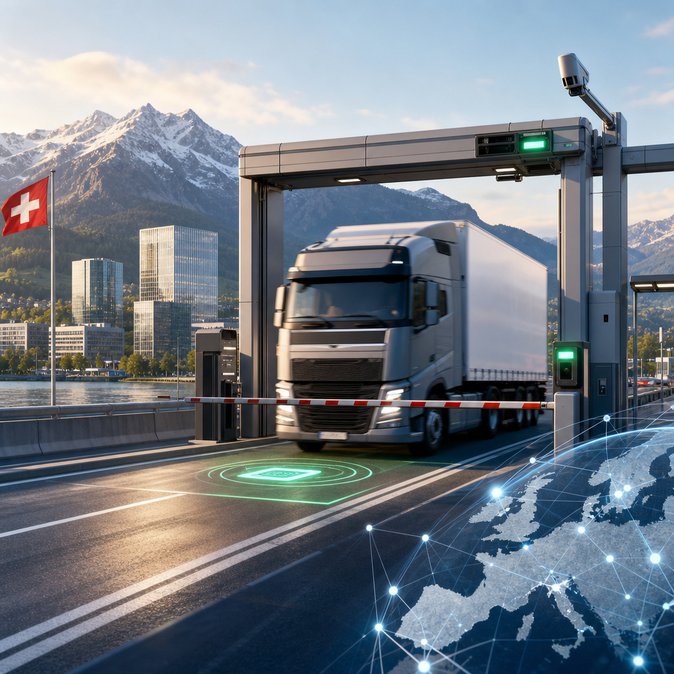
The Vorarlberg branch of the Austrian Federal Economic Chamber (WKO) hosted more than 150 exporters, freight forwarders and logistics-technology firms in Dornbirn on 27 May 2026 for an update on “Smart Border Austria,” the government-backed project to automate customs formalities on the busy A13/A14 corridor to Switzerland. Zollamt Österreich’s regional head Wolfgang Hämmerle told participants that phase-one infrastructure—camera gantries, licence-plate readers and passive RFID portals—has been installed at the Lustenau, Hohenems and Höchst crossings and will enter pilot operation in July. Under the scheme, trucks pre-declare consignments via a single-window platform that interfaces with the EU Customs Data Hub, Swiss e-dec and Austria’s Fin-Customs Risk Engine. As a vehicle approaches the border, sensors retrieve the declaration, weigh the load and compare licence plates and seal numbers against the manifest. If no red flags are triggered, the driver receives a green signal on an in-cab app and may proceed at reduced speed without stopping—cutting average clearance times from eight minutes to under 30 seconds. Hämmerle stressed that Smart Border Austria is not only about speed but also about compliance. “We will have real-time risk scoring, so a lorry carrying dual-use goods or flagged for under-invoicing can still be pulled into a secure inspection bay,” he said. The system uses the same EU “shared services” that will underpin the new Entry/Exit System for people, laying the groundwork for a fully integrated passenger-and-cargo border by the end of the decade.
![‘Smart Border Austria’ event details digital customs corridor with Switzerland, promises 30-second truck clearance]()
Whether you’re a fleet manager scheduling cross-border driver rotations or an executive planning factory visits on both sides of the Rhine Valley, VisaHQ can simplify the human side of the journey. Through its Austria portal (https://www.visahq.com/austria/) the company lets users check current visa and travel-document rules, submit digital applications and monitor approvals in one dashboard—an administrative shortcut that pairs neatly with the physical time savings Smart Border Austria aims to deliver.
For multinationals with just-in-time supply chains between Austria and Switzerland, the project could unlock substantial savings in detention fees and driver hours—provided they invest in back-office integration now. Several big automotive suppliers in Tirol and Vorarlberg said they plan to link their SAP Global Trade Compliance modules to the new API this summer. Smaller freight forwarders expressed concern about upfront IT costs, but WKO announced a €2 million grant programme to subsidise onboarding. Once the pilot proves stable, the Finance Ministry aims to extend Smart Border Austria to rail cargos on the Buchs–Feldkirch line and to roll out comparable “green lanes” on the Czech and Hungarian frontiers, giving Austria a head start on the EU’s 2030 Customs Reform agenda.
Whether you’re a fleet manager scheduling cross-border driver rotations or an executive planning factory visits on both sides of the Rhine Valley, VisaHQ can simplify the human side of the journey. Through its Austria portal (https://www.visahq.com/austria/) the company lets users check current visa and travel-document rules, submit digital applications and monitor approvals in one dashboard—an administrative shortcut that pairs neatly with the physical time savings Smart Border Austria aims to deliver.
For multinationals with just-in-time supply chains between Austria and Switzerland, the project could unlock substantial savings in detention fees and driver hours—provided they invest in back-office integration now. Several big automotive suppliers in Tirol and Vorarlberg said they plan to link their SAP Global Trade Compliance modules to the new API this summer. Smaller freight forwarders expressed concern about upfront IT costs, but WKO announced a €2 million grant programme to subsidise onboarding. Once the pilot proves stable, the Finance Ministry aims to extend Smart Border Austria to rail cargos on the Buchs–Feldkirch line and to roll out comparable “green lanes” on the Czech and Hungarian frontiers, giving Austria a head start on the EU’s 2030 Customs Reform agenda.