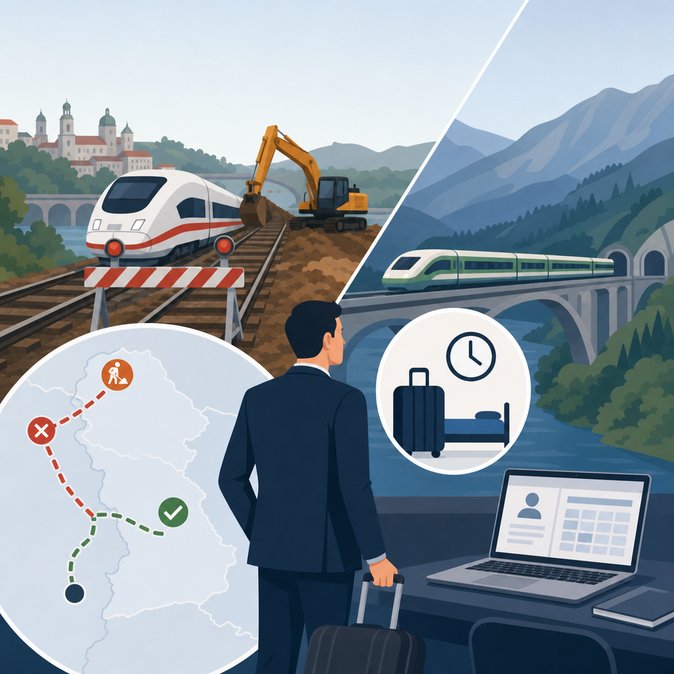
International rail passengers have just two weeks to prepare for the largest set of engineering works on the Vienna-Germany corridor in more than a decade. In a service update published on 26 May 2026, the Austrian news portal The Local warned that Deutsche Bahn’s complete closure of the Passau–Obertraubling line from 14 June to 12 December will force long-distance ICE trains between Vienna and Nuremberg off the rails entirely. ÖBB says travellers should route via Munich or expect longer journey times on alternative Railjet services that deviate through Bavaria’s busy “German Eck”.
ÖBB says travellers should route via Munich or expect longer journey times on alternative Railjet services that deviate through Bavaria’s busy “German Eck”.
The knock-on effects go well beyond Bavaria. Westbahn’s half-year timetable, which also begins on 14 June, shows extended journey times of up to 30 minutes on its Vienna–Munich–Stuttgart trains and delays of 40 minutes on Innsbruck-Zurich services because the Feldkirch–Buchs cross-border track is simultaneously closed for renewal.
Local Vorarlberg-to-Switzerland connections will be replaced by buses—bicycles are banned on those coaches, a detail corporate mobility policies should flag to touring technicians and project staff.
For assignment managers the summer works create three concrete challenges: (1) greater buffer times in door-to-door travel calculations, (2) tighter seat availability on the remaining Munich corridor trains, and (3) higher demand for overnight accommodation in Salzburg and Innsbruck when missed connections strand staff.
![Major Deutsche Bahn track works to disrupt Austria–Germany rail links from mid-June]()
ÖBB recommends booking seats as early as possible; Railjets permit mandatory seat reservations up to 90 days ahead on international legs. Companies that rely on flex passes will need to balance the cost of compulsory reservations against productivity losses caused by standing-room-only coaches.
If itinerary changes escalate to the point that staff need new entry visas or transit permits, VisaHQ’s Austria portal can expedite the paperwork online, steering companies through Schengen, German transit, or Swiss requirements with step-by-step checklists and real-time status updates: https://www.visahq.com/austria/ That service can be a lifeline when last-minute rail detours suddenly send employees through unexpected border crossings.
Although the engineering window lasts six months, the busiest weeks are expected at the very start (mid-June holiday get-aways) and in late September when trade-fair traffic resumes.
Mobility teams should therefore pre-warn travellers about potential re-routing via Linz–Regensburg buses or Vienna-Munich flights, which may offer faster end-to-end times despite airport transfers.
In extreme disruption scenarios, ÖBB is advising business customers to consider overnight sleepers from Vienna to Berlin or Hamburg, which avoid the Passau bottleneck completely.
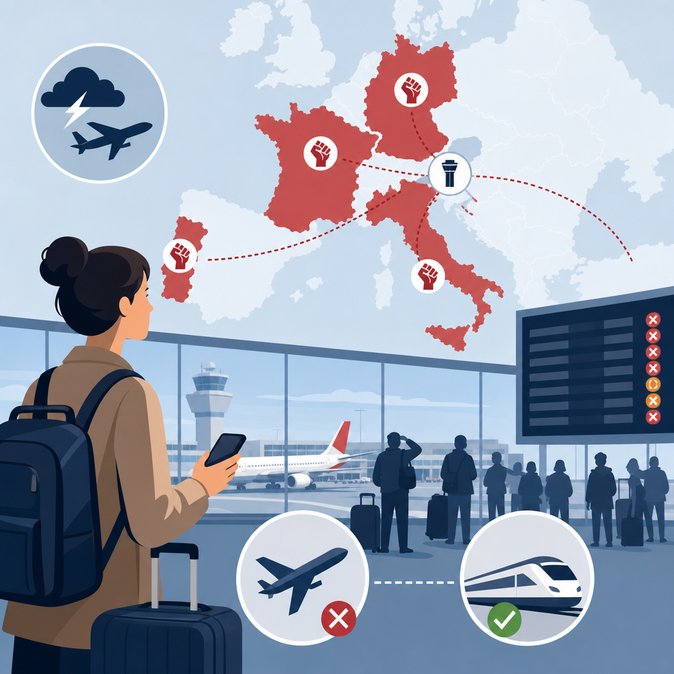
The episode underlines a broader truth for global mobility planners: Central Europe’s push to modernise ageing rail infrastructure is accelerating, and the resulting block closures can be just as disruptive to cross-border assignments as airline strikes. Building rail-contingency playbooks—complete with alternative airports, coach charters and remote-work triggers—has become an essential part of Austrian mobility risk management.
ÖBB says travellers should route via Munich or expect longer journey times on alternative Railjet services that deviate through Bavaria’s busy “German Eck”.
The knock-on effects go well beyond Bavaria. Westbahn’s half-year timetable, which also begins on 14 June, shows extended journey times of up to 30 minutes on its Vienna–Munich–Stuttgart trains and delays of 40 minutes on Innsbruck-Zurich services because the Feldkirch–Buchs cross-border track is simultaneously closed for renewal.
Local Vorarlberg-to-Switzerland connections will be replaced by buses—bicycles are banned on those coaches, a detail corporate mobility policies should flag to touring technicians and project staff.
For assignment managers the summer works create three concrete challenges: (1) greater buffer times in door-to-door travel calculations, (2) tighter seat availability on the remaining Munich corridor trains, and (3) higher demand for overnight accommodation in Salzburg and Innsbruck when missed connections strand staff.

ÖBB recommends booking seats as early as possible; Railjets permit mandatory seat reservations up to 90 days ahead on international legs. Companies that rely on flex passes will need to balance the cost of compulsory reservations against productivity losses caused by standing-room-only coaches.
If itinerary changes escalate to the point that staff need new entry visas or transit permits, VisaHQ’s Austria portal can expedite the paperwork online, steering companies through Schengen, German transit, or Swiss requirements with step-by-step checklists and real-time status updates: https://www.visahq.com/austria/ That service can be a lifeline when last-minute rail detours suddenly send employees through unexpected border crossings.
Although the engineering window lasts six months, the busiest weeks are expected at the very start (mid-June holiday get-aways) and in late September when trade-fair traffic resumes.
Mobility teams should therefore pre-warn travellers about potential re-routing via Linz–Regensburg buses or Vienna-Munich flights, which may offer faster end-to-end times despite airport transfers.
In extreme disruption scenarios, ÖBB is advising business customers to consider overnight sleepers from Vienna to Berlin or Hamburg, which avoid the Passau bottleneck completely.
The episode underlines a broader truth for global mobility planners: Central Europe’s push to modernise ageing rail infrastructure is accelerating, and the resulting block closures can be just as disruptive to cross-border assignments as airline strikes. Building rail-contingency playbooks—complete with alternative airports, coach charters and remote-work triggers—has become an essential part of Austrian mobility risk management.