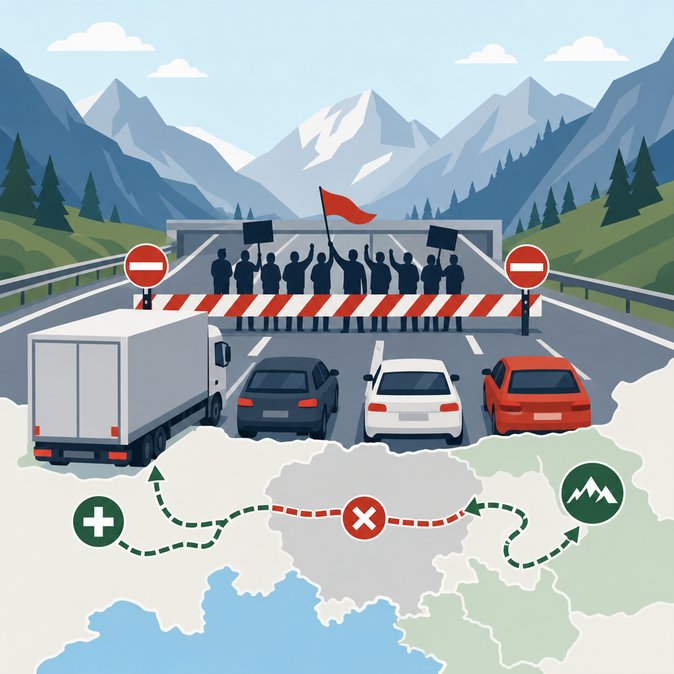
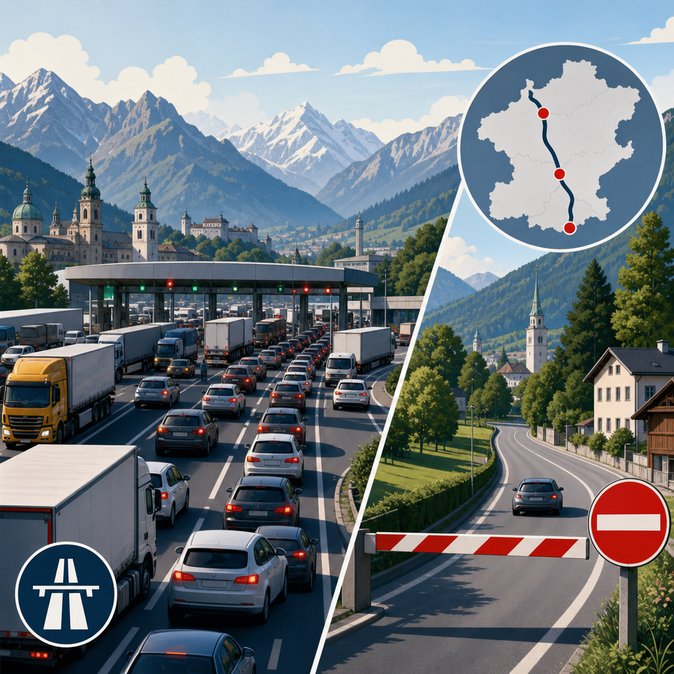
Austria’s first big holiday weekend of the year is under way – and so are the traffic jams. From the early hours of 23 May long queues formed on the German A8 towards the Walserberg crossing and spilled onto Austria’s West (A1) and Tauern (A10) motorways. The Austrian automobile club ÖAMTC reported delays of more than an hour before noon, while ORF correspondents observed stop-and-go traffic stretching almost 30 km on the Inntal and Brenner corridors in Tyrol. Salzburg and Tyrol have deployed a controversial tool to keep transit cars out of local communities: ‘Abfahrtssperren’, temporary exit bans that force through-traffic to remain on the motorway. The measure, trialled after last year’s record-breaking 50-km tailback on the Tauern, was activated between Puch-Urstein and Zederhaus on the A10 and on several secondary roads south of Salzburg city. Police checkpoints also monitored German side-roads to discourage navigation-app-prompted rat-running.
![Pentecost getaway starts with heavy jams at Austrian borders despite new ‘exit bans’]()
For travellers planning to extend their journeys beyond Austria’s borders, having the right paperwork is just as crucial as choosing the fastest lane. VisaHQ can streamline the process of securing visas, residence permits and other travel documents online through its Austrian portal (https://www.visahq.com/austria/), saving holiday-makers, assignees and logistics teams valuable time that might otherwise be lost to administrative queues.
While the strategy appears to have prevented gridlock in village centres, it has implications for coach operators and relocation companies that normally schedule rest stops off the motorway. Businesses moving assignees southwards are advised to pre-book service-area parking and to brief drivers on the exact boundaries of the ban: fines can reach €300 for unauthorised exits. Further south, the Brenner corridor saw early congestion that is expected to worsen as Italian schools begin half-term. Combined with next week’s planned Brenner blockade, mobility managers face a double-hit: weekend leisure peaks followed by a weekday standstill. Air and rail alternatives from Munich and Vienna are already reporting higher load factors. Authorities predict the jam peak will pass by late afternoon, but remind travellers that the A11 Karawanken tunnel (towards Slovenia) and Spielfeld crossing (towards Croatia) are also prone to 45-minute waits. Companies with time-critical deliveries should consider overnight slots or alternative corridors via Hungary.
For travellers planning to extend their journeys beyond Austria’s borders, having the right paperwork is just as crucial as choosing the fastest lane. VisaHQ can streamline the process of securing visas, residence permits and other travel documents online through its Austrian portal (https://www.visahq.com/austria/), saving holiday-makers, assignees and logistics teams valuable time that might otherwise be lost to administrative queues.
While the strategy appears to have prevented gridlock in village centres, it has implications for coach operators and relocation companies that normally schedule rest stops off the motorway. Businesses moving assignees southwards are advised to pre-book service-area parking and to brief drivers on the exact boundaries of the ban: fines can reach €300 for unauthorised exits. Further south, the Brenner corridor saw early congestion that is expected to worsen as Italian schools begin half-term. Combined with next week’s planned Brenner blockade, mobility managers face a double-hit: weekend leisure peaks followed by a weekday standstill. Air and rail alternatives from Munich and Vienna are already reporting higher load factors. Authorities predict the jam peak will pass by late afternoon, but remind travellers that the A11 Karawanken tunnel (towards Slovenia) and Spielfeld crossing (towards Croatia) are also prone to 45-minute waits. Companies with time-critical deliveries should consider overnight slots or alternative corridors via Hungary.