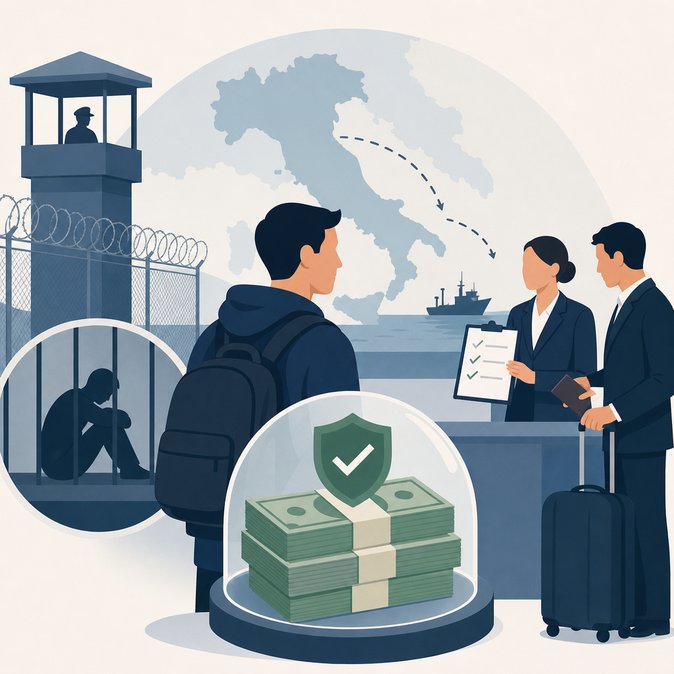
Italy has set the price of liberty for asylum seekers subjected to accelerated border procedures: €4,938. A decree signed by Interior Minister Matteo Piantedosi, Justice Minister Carlo Nordio and Economy Minister Giancarlo Giorgetti was published in the Gazzetta Ufficiale on 26 May, fleshing out Article 6-bis of the so-called Cutro Law passed in March. Under the law, non-EU nationals arriving from countries deemed “safe” who lack valid travel documents can be routed into a four-week border-zone procedure. They are normally detained in hotspot or CPR (repatriation) centres while their claim is examined. The new decree allows them to avoid detention by posting an individual bank or insurance guarantee covering accommodation, subsistence and—critically—the cost of removal should their claim fail. The guarantee must be presented in full, cannot be paid by third parties and is forfeited if the migrant absconds.
![€4,938 bank guarantee required for asylum seekers to avoid border-zone detention under Italy’s new fast-track procedure]()
For individuals, employers or academic sponsors trying to make sense of these shifting rules, VisaHQ can be a practical ally. Through its dedicated Italy page (https://www.visahq.com/italy/), the platform monitors real-time regulatory changes and helps clients assemble the correct visas, insurance certificates and financial guarantees—minimising the risk of detention or costly compliance mistakes at the border.
Opposition parties and NGOs reacted with fury, calling the measure “classist” and “inhumane”—a pay-to-be-free scheme that penalises the poorest refugees. The government counters that the sum is calibrated on average removal costs and will accelerate returns, deterring unfounded claims. For employers and universities that sometimes assist high-skill applicants caught in documentation gaps, the decree raises practical questions: can companies lawfully advance the funds? The Interior Ministry says no; the guarantee must come from the individual, although nothing prevents an employer from later reimbursing legitimate expenses after release. Legal advisers urge multinational clients with interns or secondees arriving from ‘safe-list’ countries (for example Tunisia or Côte d’Ivoire) to ensure they carry complete visa documentation and proof of means to avoid being swept into the fast-track channel. Airlines and shipping agents should also update check-in protocols to reduce carrier-liability fines triggered by improperly documented travellers. Whether the €4,938 figure withstands future court scrutiny remains to be seen; the EU Court of Justice struck down a similar Hungarian bond in 2020. For now, however, the financial-guarantee regime is the price tag attached to freedom of movement at Italy’s external borders.

For individuals, employers or academic sponsors trying to make sense of these shifting rules, VisaHQ can be a practical ally. Through its dedicated Italy page (https://www.visahq.com/italy/), the platform monitors real-time regulatory changes and helps clients assemble the correct visas, insurance certificates and financial guarantees—minimising the risk of detention or costly compliance mistakes at the border.
Opposition parties and NGOs reacted with fury, calling the measure “classist” and “inhumane”—a pay-to-be-free scheme that penalises the poorest refugees. The government counters that the sum is calibrated on average removal costs and will accelerate returns, deterring unfounded claims. For employers and universities that sometimes assist high-skill applicants caught in documentation gaps, the decree raises practical questions: can companies lawfully advance the funds? The Interior Ministry says no; the guarantee must come from the individual, although nothing prevents an employer from later reimbursing legitimate expenses after release. Legal advisers urge multinational clients with interns or secondees arriving from ‘safe-list’ countries (for example Tunisia or Côte d’Ivoire) to ensure they carry complete visa documentation and proof of means to avoid being swept into the fast-track channel. Airlines and shipping agents should also update check-in protocols to reduce carrier-liability fines triggered by improperly documented travellers. Whether the €4,938 figure withstands future court scrutiny remains to be seen; the EU Court of Justice struck down a similar Hungarian bond in 2020. For now, however, the financial-guarantee regime is the price tag attached to freedom of movement at Italy’s external borders.