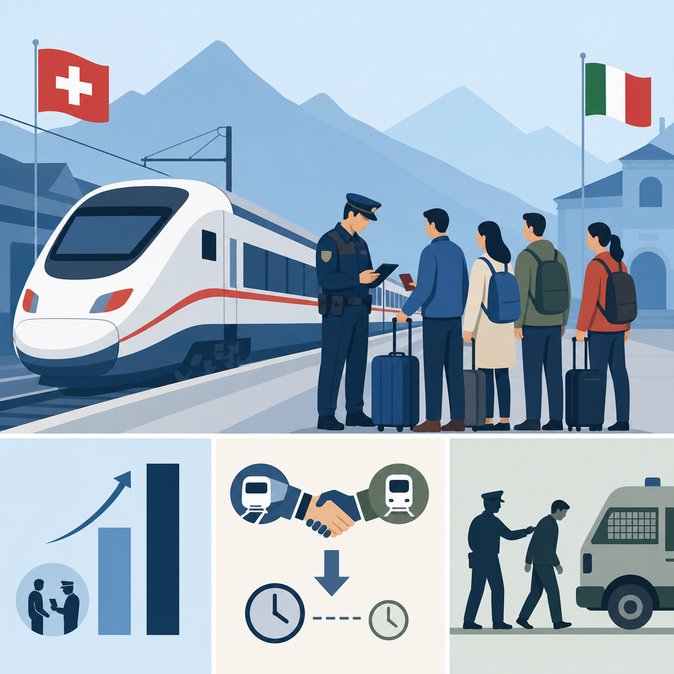
The Frontier Police of Domodossola, the main rail-border station between northern Italy and Switzerland, has released its operational results for the first four months of 2026. More than 15,000 travellers on international trains were identified from January to April, a jump of over 50 % compared with the same period in 2025. Officers attribute the surge in inspections to sustained migration pressure along the Simplon corridor, a route favoured by asylum-seekers who board Swiss trains in the hope of reaching Italy’s industrial north. 94 “active readmissions”—migrants turned back to Switzerland immediately after being found without the right to enter— were carried out, up 27 %. By contrast, “passive readmissions” of migrants returned to Italy by Swiss authorities halved to 60, and the Questura executed 23 expulsions (none were recorded a year earlier). Security measures have been coordinated with Swiss Federal Railways (SBB). Teams of Italian police and Swiss rail staff now board most cross-border services before they enter Italian territory, allowing ID checks to be completed en route and reducing unscheduled stops. The tighter control regime appears to be paying operational dividends: long-distance train delays into Domodossola shrank from more than 4,300 minutes in early-2025 to 1,083 minutes this year, a four-fold improvement.
![Domodossola intensifies border checks with Switzerland, boosts rail punctuality]()
For individual travellers and corporate mobility planners keen to avoid being delayed by ad-hoc checks, VisaHQ offers a fast way to verify and secure the exact documents needed for entry into Italy. Its platform—https://www.visahq.com/italy/—provides real-time visa requirements, digital application tools and concierge support that help ensure travellers arrive with the correct paperwork, easing passage through increasingly scrutinised Schengen borders.
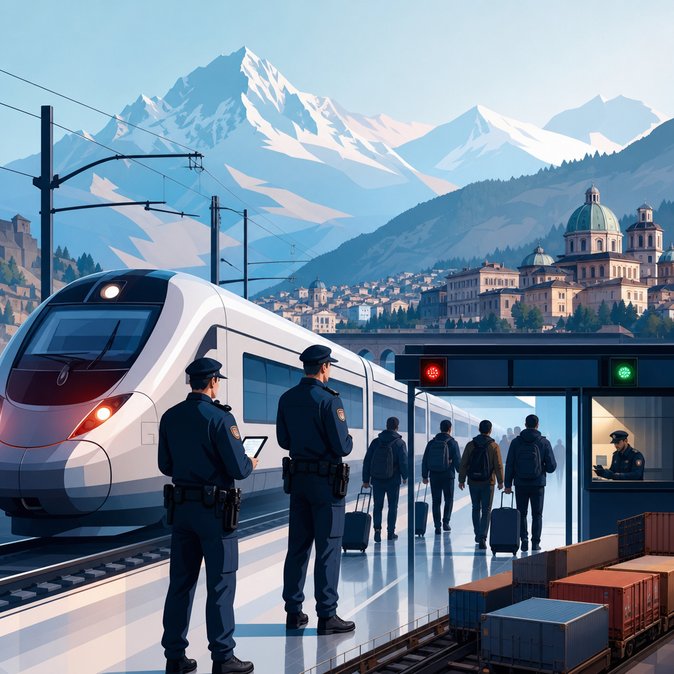
Local freight forwarders welcome the change, noting that predictable arrival slots are essential for just-in-time supply chains serving Lombardy’s manufacturing belt. For mobility managers the figures underscore a broader trend: Schengen’s internal borders are increasingly subject to ad-hoc police checks, even when formal border posts remain dismantled. Companies routing talent or goods through northern Italy should build extra time into itineraries and monitor any escalation of bilateral controls, especially if asylum flows intensify over the summer.
For individual travellers and corporate mobility planners keen to avoid being delayed by ad-hoc checks, VisaHQ offers a fast way to verify and secure the exact documents needed for entry into Italy. Its platform—https://www.visahq.com/italy/—provides real-time visa requirements, digital application tools and concierge support that help ensure travellers arrive with the correct paperwork, easing passage through increasingly scrutinised Schengen borders.
Local freight forwarders welcome the change, noting that predictable arrival slots are essential for just-in-time supply chains serving Lombardy’s manufacturing belt. For mobility managers the figures underscore a broader trend: Schengen’s internal borders are increasingly subject to ad-hoc police checks, even when formal border posts remain dismantled. Companies routing talent or goods through northern Italy should build extra time into itineraries and monitor any escalation of bilateral controls, especially if asylum flows intensify over the summer.