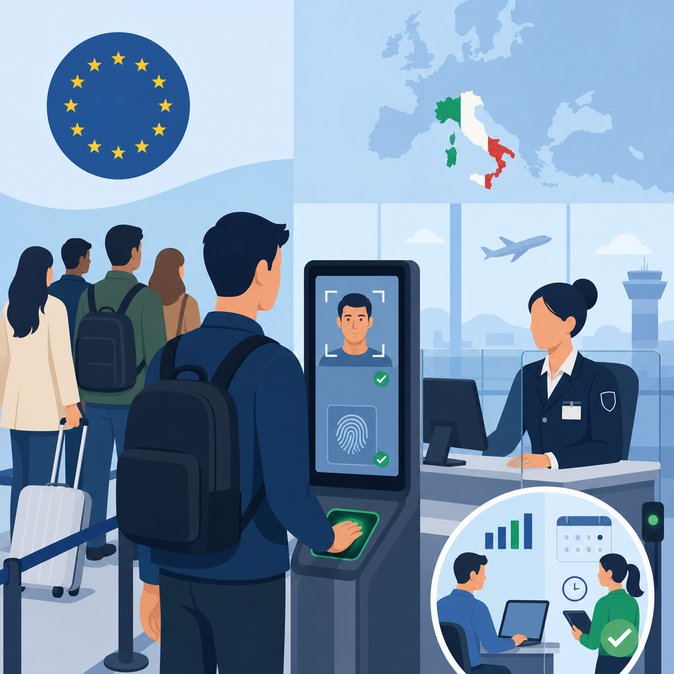
Italy switched on the EU-wide Entry/Exit System (EES) at airports, ports and land crossings on 21 May 2026, replacing passport stamps with a biometric register for non-EU travellers.
![EU Entry/Exit System Goes Live at All Italian Borders—Expect Longer Queues (for Now)]()
For travellers and mobility coordinators looking for practical support amid these changes, VisaHQ offers up-to-date guidance on Schengen visa policies, real-time tracking of remaining days and streamlined application services. Their Italy country page (https://www.visahq.com/italy/) aggregates the latest entry rules and can help arrange any required visas or residence permits, providing a single dashboard for staff movements and compliance.
The roll-out completes Italy’s physical infrastructure upgrade ahead of the wider Schengen launch later this year. Under EES, border officers capture fingerprints and a facial image and log the exact date and location of each entry or exit. The system automatically calculates remaining Schengen-area days for visa-exempt visitors, tightening enforcement of the 90/180-day rule that governs trips by UK, US and many other nationals. During the bedding-in phase, authorities warn of possible slow-downs—especially at Rome Fiumicino, Milan Malpensa and busy Brenner rail checkpoints—while new kiosks and e-gates reach full throughput. Airlines have been instructed to add pre-boarding notices urging travellers to arrive earlier and to ensure passports have at least two blank pages for contingency manual stamping. For global mobility and travel-risk managers, the immediate tasks are to brief staff on longer dwell times, update arrival instructions and double-check that contractors’ Schengen day counts remain in tolerance—overstays will now surface instantly at exit. In the medium term, the digital trail should simplify posted-worker audits and automate calculation of days present for tax-residency checks, potentially easing compliance headaches once the learning curve flattens.

For travellers and mobility coordinators looking for practical support amid these changes, VisaHQ offers up-to-date guidance on Schengen visa policies, real-time tracking of remaining days and streamlined application services. Their Italy country page (https://www.visahq.com/italy/) aggregates the latest entry rules and can help arrange any required visas or residence permits, providing a single dashboard for staff movements and compliance.
The roll-out completes Italy’s physical infrastructure upgrade ahead of the wider Schengen launch later this year. Under EES, border officers capture fingerprints and a facial image and log the exact date and location of each entry or exit. The system automatically calculates remaining Schengen-area days for visa-exempt visitors, tightening enforcement of the 90/180-day rule that governs trips by UK, US and many other nationals. During the bedding-in phase, authorities warn of possible slow-downs—especially at Rome Fiumicino, Milan Malpensa and busy Brenner rail checkpoints—while new kiosks and e-gates reach full throughput. Airlines have been instructed to add pre-boarding notices urging travellers to arrive earlier and to ensure passports have at least two blank pages for contingency manual stamping. For global mobility and travel-risk managers, the immediate tasks are to brief staff on longer dwell times, update arrival instructions and double-check that contractors’ Schengen day counts remain in tolerance—overstays will now surface instantly at exit. In the medium term, the digital trail should simplify posted-worker audits and automate calculation of days present for tax-residency checks, potentially easing compliance headaches once the learning curve flattens.