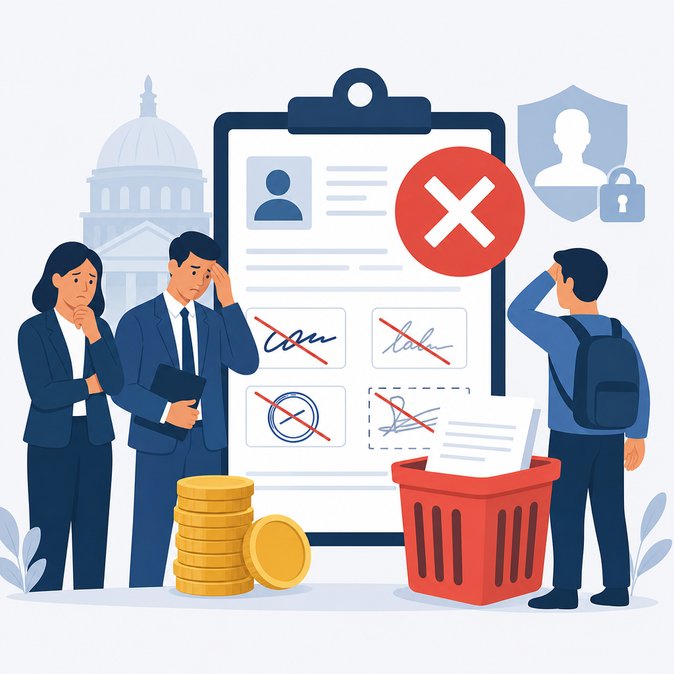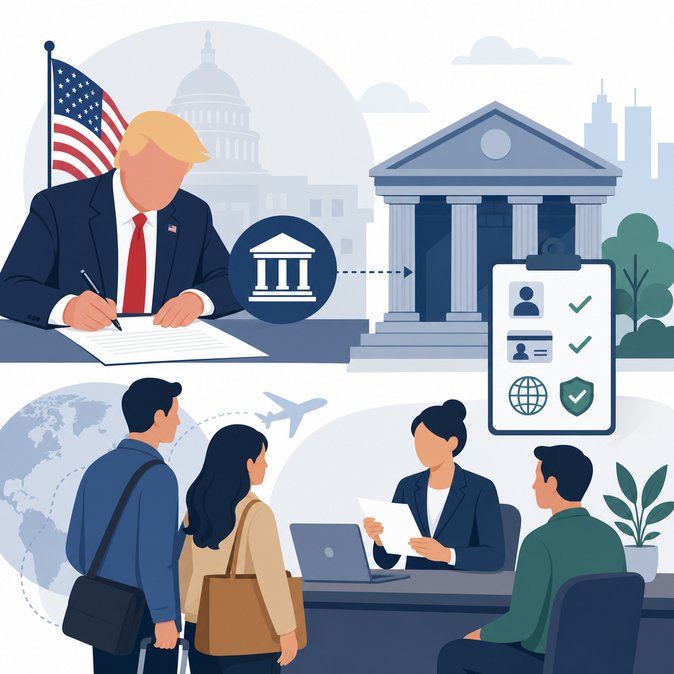
In a late-night move on May 19, President Donald Trump signed an executive order instructing federal banking regulators to “evaluate and mitigate immigration-related credit risk.” The order tells the Treasury Department, the Federal Reserve, the FDIC and the OCC to issue supervisory guidance urging banks to determine whether borrowers and account holders could be subject to deportation. According to White House officials, the policy is framed as a safety-and-soundness measure: regulators are to consider the possibility that an undocumented borrower might suddenly be removed from the United States, leaving loans in default. While the text stops short of mandating that banks collect proof of citizenship or lawful status, industry lawyers say the practical effect will be new ‘know-your-customer’ questionnaires asking whether applicants are U.S. citizens, permanent residents or in a lawful non-immigrant category. Financial institutions had lobbied vigorously against an earlier draft that would have required them to gather citizenship documents from all customers; the final version makes the practice voluntary but warns that institutions could face enforcement action if they ignore “material immigration risk.”
Immigrant-rights advocates and consumer groups swiftly condemned the order. They warn that undocumented customers—many of whom already rely on alternative financial services—could retreat further into an unregulated cash economy, increasing their vulnerability to predatory lenders and wage theft. The National Immigration Law Center said the order echoes Operation Choke Point by pressuring banks to deny services to a disfavored group. Community-development banks are also worried: roughly 10 percent of their small-business lending in agricultural regions goes to mixed-status households.
![Trump Executive Order Tells U.S. Banks to Scrutinize Customers’ Citizenship]()
Amid this uncertainty, VisaHQ can offer practical assistance. Through its digital portal (https://www.visahq.com/united-states/), the service enables individuals, HR teams, and global mobility managers to obtain real-time visa status updates, generate evidence letters, and track renewal deadlines—tools that can prove invaluable when banks begin requesting additional immigration documentation under the new supervisory guidance.
From an employer-mobility perspective, international assignees on temporary visas could encounter higher documentation hurdles when opening U.S. accounts or securing mortgages. Global mobility managers may need to provide visa evidence letters more routinely and coach relocating employees on acceptable proof of lawful status. Multinational companies that offer home-purchase assistance may find closings delayed while banks conduct additional immigration checks. Human-resources departments should review relocation timelines and be prepared to liaise with corporate banking partners.
The executive order takes effect immediately, but regulators have 45 days to publish guidance. Until those details emerge, banks are expected to follow existing anti-money-laundering (AML) rules while beginning internal risk assessments focused on immigration status. Mobility stakeholders should monitor forthcoming bulletins from the OCC and Fed to understand exactly what documentation will be requested and whether temporary visa holders could face higher interest rates or loan-to-value restrictions.
Immigrant-rights advocates and consumer groups swiftly condemned the order. They warn that undocumented customers—many of whom already rely on alternative financial services—could retreat further into an unregulated cash economy, increasing their vulnerability to predatory lenders and wage theft. The National Immigration Law Center said the order echoes Operation Choke Point by pressuring banks to deny services to a disfavored group. Community-development banks are also worried: roughly 10 percent of their small-business lending in agricultural regions goes to mixed-status households.

Amid this uncertainty, VisaHQ can offer practical assistance. Through its digital portal (https://www.visahq.com/united-states/), the service enables individuals, HR teams, and global mobility managers to obtain real-time visa status updates, generate evidence letters, and track renewal deadlines—tools that can prove invaluable when banks begin requesting additional immigration documentation under the new supervisory guidance.
From an employer-mobility perspective, international assignees on temporary visas could encounter higher documentation hurdles when opening U.S. accounts or securing mortgages. Global mobility managers may need to provide visa evidence letters more routinely and coach relocating employees on acceptable proof of lawful status. Multinational companies that offer home-purchase assistance may find closings delayed while banks conduct additional immigration checks. Human-resources departments should review relocation timelines and be prepared to liaise with corporate banking partners.
The executive order takes effect immediately, but regulators have 45 days to publish guidance. Until those details emerge, banks are expected to follow existing anti-money-laundering (AML) rules while beginning internal risk assessments focused on immigration status. Mobility stakeholders should monitor forthcoming bulletins from the OCC and Fed to understand exactly what documentation will be requested and whether temporary visa holders could face higher interest rates or loan-to-value restrictions.