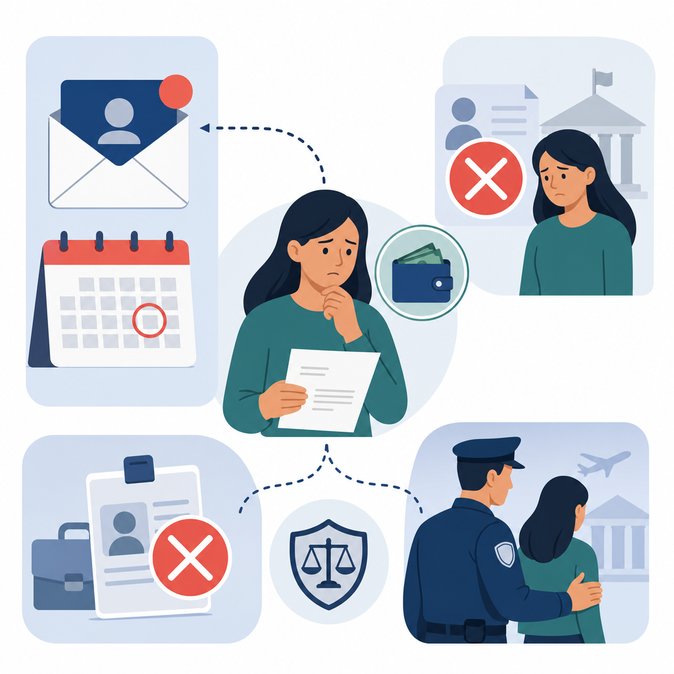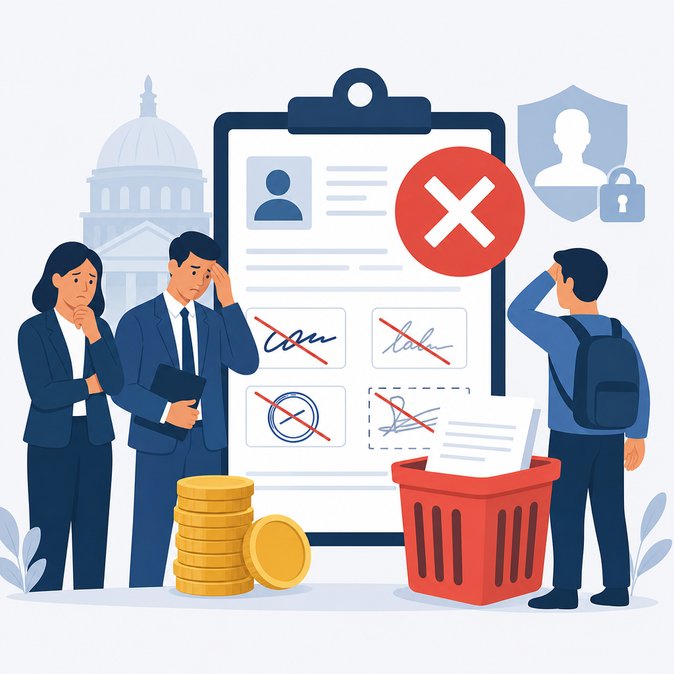
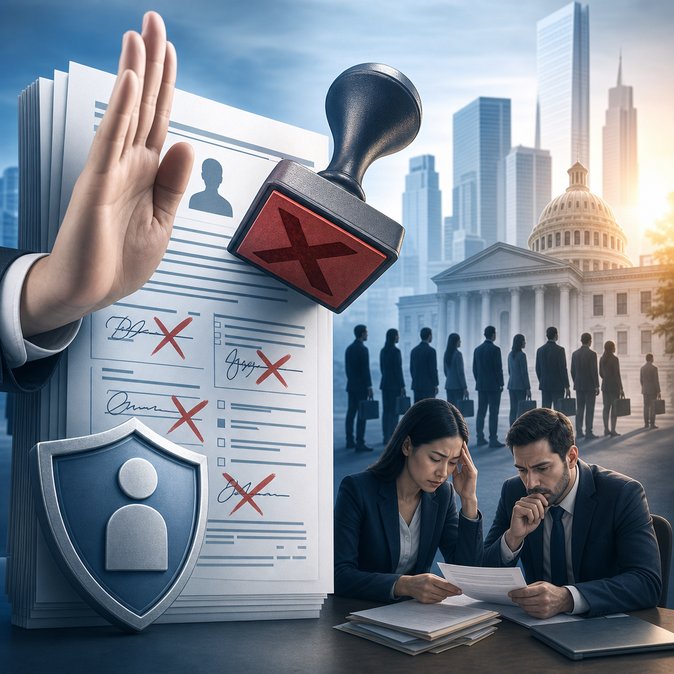
U.S. Citizenship and Immigration Services (USCIS) has published an interim final rule, “Signatures on Immigration Benefit Requests,” that fundamentally changes how the agency treats signature defects. Beginning 10 July 2026, any immigration form filed without a valid signature can be *rejected at intake* or *denied during adjudication*—and USCIS now reserves the right to **retain filing fees** in either scenario. Why the crackdown? Agency officials say they have seen a surge in copy-and-paste images, software-generated signatures, and filings signed by people with no legal authority to represent the petitioner. Under the new rule, traditional handwritten (“wet-ink”) signatures remain the gold standard, and clear photocopies or scans of a wet signature are still acceptable. But the rule explicitly bans typed names, reused digital signature images, signature stamps, and any signature supplied by an unauthorized employee or family member. Employers that rely on fully electronic workflows—or that archive only PDFs rather than original pages—face the greatest exposure.
![USCIS Tightens Signature Requirements, Raising Rejection Risks for H-1B and Green Card Filings]()
If you’re looking for help adapting to these stricter requirements, VisaHQ offers an online portal that walks applicants through current U.S. immigration filing rules, flags signature issues before submission, and even coordinates courier pickup for wet-ink pages—saving you time and avoiding costly rejections. Learn more at https://www.visahq.com/united-states/
Practically, the rule expands officers’ discretion. Even after USCIS issues a receipt notice, an officer who later spots a questionable signature can deny the case outright. That denial is treated as a full adjudication, meaning filing fees (often several thousand dollars for an H-1B or employment-based green card) are forfeited, and the underlying immigration status—work authorization, priority date, or maintenance of legal stay—may unravel. Immigration attorneys are already urging HR teams to audit signature procedures. Best practices include: (1) making sure every signer has proper company authority, (2) keeping original, wet-signed pages in a secure file for at least six years, and (3) avoiding shortcuts such as image “cut-and-paste” workflows. Petitioners that depend on high-volume digital filing processes may need to revert to hybrid paper workflows—at least for signature pages—to stay compliant. Public comments are being accepted through 10 July 2026, but because the rule becomes effective on that same date, foreign nationals and employers have only a brief window to adapt. Missing that window could mean lost cap-season chances, forfeited premium-processing fees, and unexpected gaps in work authorization—all triggered by something as small as the wrong kind of signature.
If you’re looking for help adapting to these stricter requirements, VisaHQ offers an online portal that walks applicants through current U.S. immigration filing rules, flags signature issues before submission, and even coordinates courier pickup for wet-ink pages—saving you time and avoiding costly rejections. Learn more at https://www.visahq.com/united-states/
Practically, the rule expands officers’ discretion. Even after USCIS issues a receipt notice, an officer who later spots a questionable signature can deny the case outright. That denial is treated as a full adjudication, meaning filing fees (often several thousand dollars for an H-1B or employment-based green card) are forfeited, and the underlying immigration status—work authorization, priority date, or maintenance of legal stay—may unravel. Immigration attorneys are already urging HR teams to audit signature procedures. Best practices include: (1) making sure every signer has proper company authority, (2) keeping original, wet-signed pages in a secure file for at least six years, and (3) avoiding shortcuts such as image “cut-and-paste” workflows. Petitioners that depend on high-volume digital filing processes may need to revert to hybrid paper workflows—at least for signature pages—to stay compliant. Public comments are being accepted through 10 July 2026, but because the rule becomes effective on that same date, foreign nationals and employers have only a brief window to adapt. Missing that window could mean lost cap-season chances, forfeited premium-processing fees, and unexpected gaps in work authorization—all triggered by something as small as the wrong kind of signature.