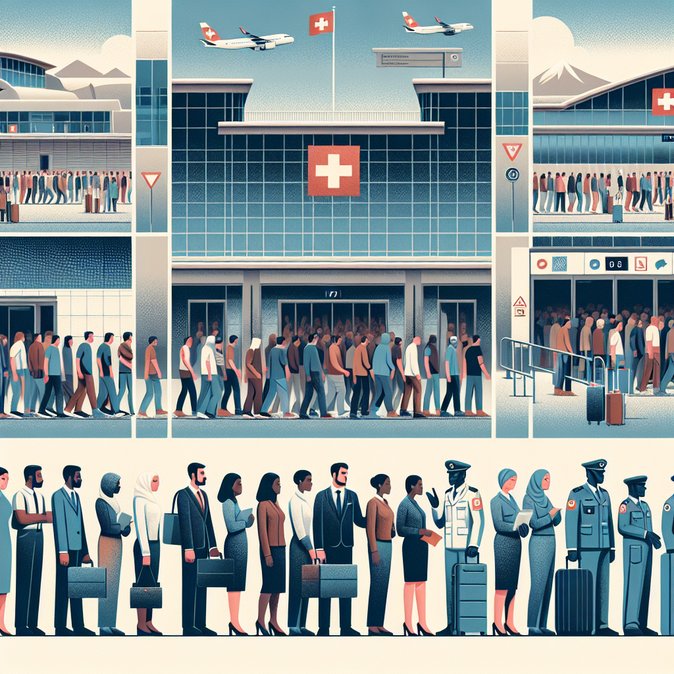
Responding to mounting complaints of multi-hour queues, the European Commission announced on 2 May that Schengen member states—including associate member Switzerland—may temporarily scale back certain functions of the newly launched Entry/Exit System (EES). The digital register, fully activated on 10 April, captures the biometric data of every non-EU traveller and automatically calculates remaining days under the 90/180 rule. Under the Commission’s guidance, border authorities can now suspend fingerprint or facial-image enrolment during peak waves, revert to passport stamping if kiosks fail, and redeploy staff across lanes.
The move is particularly welcome at Zurich and Geneva airports, where processing times for some long-haul arrivals had spiked to 90 minutes in mid-April, according to operators. Zurich’s Dock E has since added 25 mobile enrolment units and is trialling a dedicated "corporate crew" channel for high-volume company shuttles. Geneva, meanwhile, has postponed the closure of three manual booths that were due to be converted into automated gates.
The Federal Office for Customs and Border Security (BAZG) says that with the new flexibility it expects to keep average wait times below 30 minutes over the Ascension-Day travel surge.
For Swiss-based multinationals the partial reprieve buys time to fine-tune travel policies. Mobility teams are updating traveller briefings with step-by-step kiosk instructions, advising staff to allow an extra hour for first post-10-April re-entry into Schengen and encouraging enrolment during off-peak slots.
![Brussels grants ‘flex mode’ for new biometric Entry/Exit System – relief for Swiss airports]()
Firms running commuter buses from non-Schengen offices have begun staggering departure times to avoid the morning tsunami at Basel EuroAirport.
To help passengers and corporate mobility managers stay ahead of these fast-moving rules, VisaHQ’s Switzerland portal (https://www.visahq.com/switzerland/) offers real-time Schengen updates, pre-screens itineraries against the 90/180 rule and the forthcoming ETIAS requirement, and can even arrange expedited passport or visa processing via courier—an extra safety net when biometric bottlenecks threaten to upend travel plans.
Industry groups caution that the underlying obligation to record biometrics remains. Once systems are stable, the Commission expects full compliance and has signalled that the "flex mode" could be withdrawn after the summer season.
Airlines and travel-management companies therefore continue to lobby for an "on-off switch" enshrined in EU regulation. Swiss authorities support the idea, noting that missed connections cost carriers and passengers an estimated CHF 2 million per day during the initial rollout.
The episode underscores the operational shock that digital border projects can deliver. Mobility leaders should map which staff still need their first EES enrolment, budget for longer layovers this summer and monitor further EU guidance—especially as the next layer, the ETIAS travel authorisation, is slated for late-2026.
The move is particularly welcome at Zurich and Geneva airports, where processing times for some long-haul arrivals had spiked to 90 minutes in mid-April, according to operators. Zurich’s Dock E has since added 25 mobile enrolment units and is trialling a dedicated "corporate crew" channel for high-volume company shuttles. Geneva, meanwhile, has postponed the closure of three manual booths that were due to be converted into automated gates.
The Federal Office for Customs and Border Security (BAZG) says that with the new flexibility it expects to keep average wait times below 30 minutes over the Ascension-Day travel surge.
For Swiss-based multinationals the partial reprieve buys time to fine-tune travel policies. Mobility teams are updating traveller briefings with step-by-step kiosk instructions, advising staff to allow an extra hour for first post-10-April re-entry into Schengen and encouraging enrolment during off-peak slots.

Firms running commuter buses from non-Schengen offices have begun staggering departure times to avoid the morning tsunami at Basel EuroAirport.
To help passengers and corporate mobility managers stay ahead of these fast-moving rules, VisaHQ’s Switzerland portal (https://www.visahq.com/switzerland/) offers real-time Schengen updates, pre-screens itineraries against the 90/180 rule and the forthcoming ETIAS requirement, and can even arrange expedited passport or visa processing via courier—an extra safety net when biometric bottlenecks threaten to upend travel plans.
Industry groups caution that the underlying obligation to record biometrics remains. Once systems are stable, the Commission expects full compliance and has signalled that the "flex mode" could be withdrawn after the summer season.
Airlines and travel-management companies therefore continue to lobby for an "on-off switch" enshrined in EU regulation. Swiss authorities support the idea, noting that missed connections cost carriers and passengers an estimated CHF 2 million per day during the initial rollout.
The episode underscores the operational shock that digital border projects can deliver. Mobility leaders should map which staff still need their first EES enrolment, budget for longer layovers this summer and monitor further EU guidance—especially as the next layer, the ETIAS travel authorisation, is slated for late-2026.