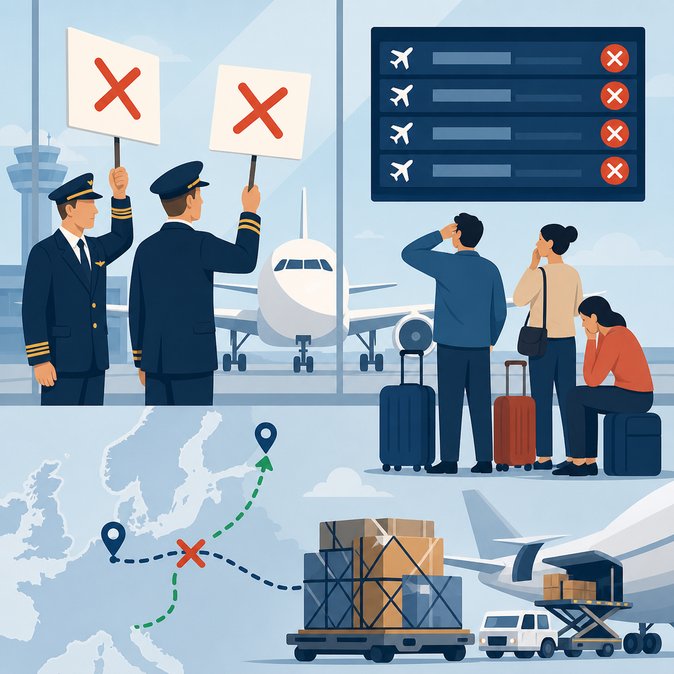
Travellers leaving Finland for Germany or onward long-haul connections faced disruption on Tuesday after pilots at Lufthansa, Lufthansa Cargo and CityLine launched a 48-hour walk-out over pay and pension provisions. According to Finnish travel portal Daily Finland, more than 800 flights were axed during the first strike day, including the morning and early-afternoon rotations between Helsinki-Vantaa (HEL) and the carrier’s hubs in Frankfurt (FRA) and Munich (MUC). Evening services were still listed as ‘subject to change’ when Helsinki Airport published its 17:00 schedule update.
![Lufthansa Pilots’ Strike Ripples into Finland, Cancels Frankfurt–Helsinki Services]()
Because many passengers are now rerouting through third-country hubs, up-to-date visa or transit documentation can suddenly become critical. VisaHQ’s Finland portal (https://www.visahq.com/finland/) lets travellers and corporate mobility teams check entry rules in minutes and arrange any required visas online, reducing last-minute stress while itineraries are being rebuilt.
The cancellations have a knock-on effect that extends well beyond point-to-point traffic. Lufthansa feeds a sizeable share of Finland’s trans-Atlantic and Latin American passenger flow, so missed connections are forcing business travellers to re-route via Amsterdam, Copenhagen or London. Freight forwarders shipping high-value electronics from Finnish factories to North America have also had to scramble for belly-hold capacity on Finnair and KLM flights. Corporate travel managers report that rebooking costs are being compounded by a seasonal spike in airfares: many Nordic companies had already blocked seats for summer-holiday traffic, leaving little slack in premium cabins. EU Regulation 261/2004 obliges Lufthansa to provide duty-of-care services, but in practice passengers arriving at HEL this morning were handed QR-coded vouchers directing them to an online re-booking tool rather than staffed counters. Finnair told media it had no spare aircraft to operate rescue flights on the German routes. Unions have warned of further industrial action if salary negotiations do not progress by mid-June. Mobility teams with staff movements routed through Lufthansa hubs should therefore build contingency into June travel plans, approve flexible tickets, and remind travellers that strike-related travel insurance claims usually require written confirmation of the disruption from the carrier. For now, rail alternatives offer only partial relief: the popular night train via Stockholm is fully booked for 3–4 June, and ferry crossings from Turku to Travemünde cannot substitute time-critical air cargo. The situation underlines the importance of having multi-carrier agreements in place and of monitoring European labour relations as closely as traditional security threats when planning mobility.
Because many passengers are now rerouting through third-country hubs, up-to-date visa or transit documentation can suddenly become critical. VisaHQ’s Finland portal (https://www.visahq.com/finland/) lets travellers and corporate mobility teams check entry rules in minutes and arrange any required visas online, reducing last-minute stress while itineraries are being rebuilt.
The cancellations have a knock-on effect that extends well beyond point-to-point traffic. Lufthansa feeds a sizeable share of Finland’s trans-Atlantic and Latin American passenger flow, so missed connections are forcing business travellers to re-route via Amsterdam, Copenhagen or London. Freight forwarders shipping high-value electronics from Finnish factories to North America have also had to scramble for belly-hold capacity on Finnair and KLM flights. Corporate travel managers report that rebooking costs are being compounded by a seasonal spike in airfares: many Nordic companies had already blocked seats for summer-holiday traffic, leaving little slack in premium cabins. EU Regulation 261/2004 obliges Lufthansa to provide duty-of-care services, but in practice passengers arriving at HEL this morning were handed QR-coded vouchers directing them to an online re-booking tool rather than staffed counters. Finnair told media it had no spare aircraft to operate rescue flights on the German routes. Unions have warned of further industrial action if salary negotiations do not progress by mid-June. Mobility teams with staff movements routed through Lufthansa hubs should therefore build contingency into June travel plans, approve flexible tickets, and remind travellers that strike-related travel insurance claims usually require written confirmation of the disruption from the carrier. For now, rail alternatives offer only partial relief: the popular night train via Stockholm is fully booked for 3–4 June, and ferry crossings from Turku to Travemünde cannot substitute time-critical air cargo. The situation underlines the importance of having multi-carrier agreements in place and of monitoring European labour relations as closely as traditional security threats when planning mobility.