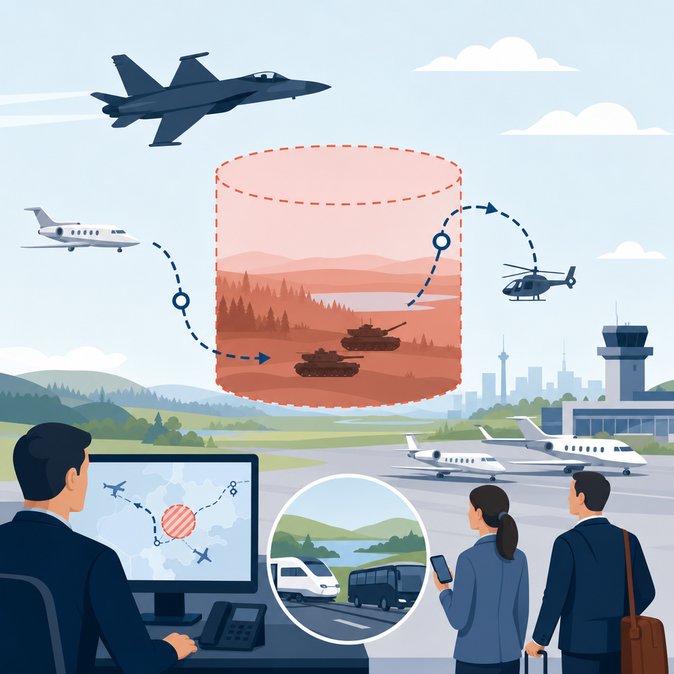
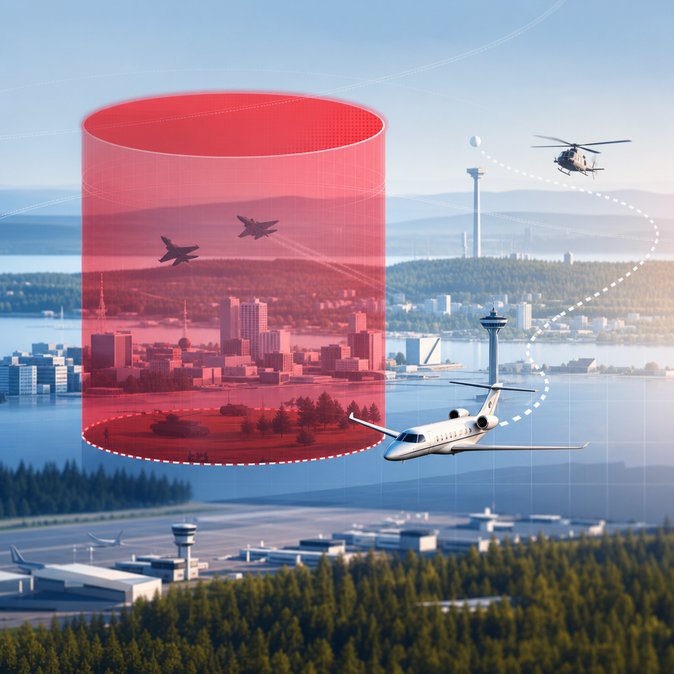
Fintraffic Aeronautical Information Service has issued AIP Supplement 098/2026 establishing a new Temporary Reserved Area (TRA) labelled EFTRTP100 in the Helsinki Flight Information Region (FIR). The airspace, roughly centred west of Tampere, is effective from 21:00 UTC on 31 May until 21:00 UTC on 18 June 2026 and extends from the surface to flight-level 95. Activation will occur tactically "for safeguarding military operations", with real-time status available from Tampere-Pirkkala (EFTP) air-traffic services. The TRA’s lateral limits trace a polygon that brackets busy general-aviation corridors north-west of Helsinki. While commercial airline routes at higher altitudes should remain unaffected, business-jet operators that routinely fly IFR below FL100—especially corporate shuttles between Helsinki, Seinäjoki and Jyväskylä—will see mandatory re-routes or altitude restrictions whenever the zone is active. Visual-flight-rules (VFR) traffic, including helicopter transfers to industrial sites and renewable-energy projects, must obtain updated NOTAM information before departure.
![Temporary restricted airspace EFTRTP100 activated over Tampere region, 31 May–18 June]()
While travel visas are not usually top of mind when dealing with temporary airspace restrictions, crews repositioning from abroad and corporate teams shuttling specialists into Finland can simplify entry formalities through VisaHQ’s Finland page (https://www.visahq.com/finland/). The platform aggregates current Schengen and third-country requirements, offers courier or digital filing options, and provides alert services that sync neatly with flight-dispatch timelines—helpful when operational changes such as EFTRTP100 already add extra layers of coordination.
The Finnish Defence Forces have not publicly disclosed the nature of the drills, but the activation window overlaps with NATO’s Arctic Shield command-post exercise taking place across Northern Europe. Since Finland joined NATO in April 2024, such temporary air-space reservations have become more frequent, and coordination between Fintraffic, Traficom and neighbouring ANSPs has tightened in order to minimise disruption to civil aviation. Operators that file flight plans through integrated scheduling tools should ensure that automated routing engines import the AIXM 5.1 file attached to the supplement, as failure to do so could yield rejected flight plans or last-minute changes. For mobility planners the practical impact is three-fold. First, expect short-notice slot constraints at Tampere-Pirkkala and Seinäjoki during peak exercise periods, which could cascade to Helsinki Airport’s regional feeder banks. Second, air-ambulance and drone-logistics services must coordinate with ATS to avoid conflict with military traffic. Third, travel-insurance policies that exclude war-risk areas may require notification if flights enter an active military TRA, so corporate travel desks should verify cover. Fintraffic advises pilots to monitor the nationwide VOLMET broadcast and the Fintraffic AIS website for dynamic activation times. The supplement highlights that the upper limit "may be lower when operation permits," offering some flexibility for late-evening medevac or cargo missions. Nonetheless, the safest assumption is that EFTRTP100 will be live throughout the first half of June, making early flight-plan filing and contingency ground-transport options essential for time-critical movements.
While travel visas are not usually top of mind when dealing with temporary airspace restrictions, crews repositioning from abroad and corporate teams shuttling specialists into Finland can simplify entry formalities through VisaHQ’s Finland page (https://www.visahq.com/finland/). The platform aggregates current Schengen and third-country requirements, offers courier or digital filing options, and provides alert services that sync neatly with flight-dispatch timelines—helpful when operational changes such as EFTRTP100 already add extra layers of coordination.
The Finnish Defence Forces have not publicly disclosed the nature of the drills, but the activation window overlaps with NATO’s Arctic Shield command-post exercise taking place across Northern Europe. Since Finland joined NATO in April 2024, such temporary air-space reservations have become more frequent, and coordination between Fintraffic, Traficom and neighbouring ANSPs has tightened in order to minimise disruption to civil aviation. Operators that file flight plans through integrated scheduling tools should ensure that automated routing engines import the AIXM 5.1 file attached to the supplement, as failure to do so could yield rejected flight plans or last-minute changes. For mobility planners the practical impact is three-fold. First, expect short-notice slot constraints at Tampere-Pirkkala and Seinäjoki during peak exercise periods, which could cascade to Helsinki Airport’s regional feeder banks. Second, air-ambulance and drone-logistics services must coordinate with ATS to avoid conflict with military traffic. Third, travel-insurance policies that exclude war-risk areas may require notification if flights enter an active military TRA, so corporate travel desks should verify cover. Fintraffic advises pilots to monitor the nationwide VOLMET broadcast and the Fintraffic AIS website for dynamic activation times. The supplement highlights that the upper limit "may be lower when operation permits," offering some flexibility for late-evening medevac or cargo missions. Nonetheless, the safest assumption is that EFTRTP100 will be live throughout the first half of June, making early flight-plan filing and contingency ground-transport options essential for time-critical movements.