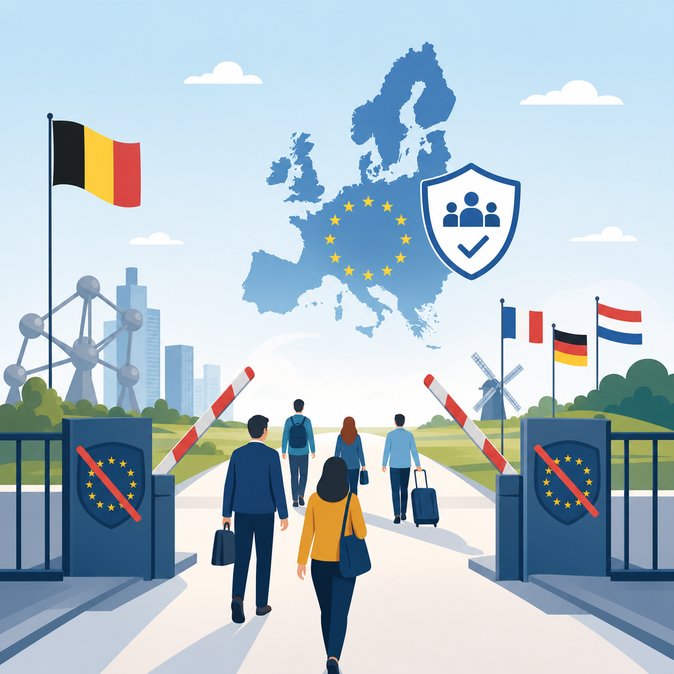
In a set of opinions released on 2 June 2026, the European Commission called on nine Schengen countries—including Belgium’s neighbours France, Germany and the Netherlands—to phase out long-running internal border controls introduced for security and migration reasons. The Commission concluded that alternative measures such as mobile police patrols and biometric technologies can manage risks with less disruption to cross-border commuters and the single market. Although Belgium itself has kept its borders open, tens of thousands of Belgian residents who work in Lille, Aachen or Eindhoven face daily checkpoints imposed by neighbouring states. Flemish employers’ federation VOKA estimates that the controls add €12 million a year in lost productivity. Removing them would restore pre-pandemic fluidity vital for companies managing cross-border postings and temporary projects.
![European Commission Urges End to Internal Schengen Border Checks, Nudging Belgium’s Neighbours]()
For travellers, assignees and HR teams who still need clarity on evolving entry rules, VisaHQ’s Belgium portal (https://www.visahq.com/belgium/) provides quick, reliable updates on visas, work permits and other documentation. The platform’s step-by-step tools and expert support can smooth the paperwork for anyone moving between Belgium and its neighbours while internal checks are being wound down.
The Commission’s push is politically sensitive. The Netherlands has already notified Brussels of a further extension of its Belgium land-border checks until 30 September 2026, citing organised-crime threats. Germany points to continued pressure from irregular migration along the so-called Balkan route. EU Migration Commissioner Magnus Brunner argued that the new Pact on Migration and Asylum—fully applicable from 12 June—strengthens external-border management and makes internal checks less justified. For global-mobility managers, the potential lifting of checks would simplify logistics for short-term assignments and service calls carried out under the EU’s Posted Workers Directive. However, companies are advised to continue carrying A1 certificates and identity documents until formal withdrawal dates are confirmed. The Commission will review member-state responses in September and could launch infringement proceedings against those keeping controls “without sufficient justification.” Belgium’s Foreign Ministry welcomed the opinions, saying it is ready to work with neighbours on police co-operation and real-time data sharing. If adopted, the phase-out would mark the biggest restoration of Schengen free movement since the 2015 migration crisis.

For travellers, assignees and HR teams who still need clarity on evolving entry rules, VisaHQ’s Belgium portal (https://www.visahq.com/belgium/) provides quick, reliable updates on visas, work permits and other documentation. The platform’s step-by-step tools and expert support can smooth the paperwork for anyone moving between Belgium and its neighbours while internal checks are being wound down.
The Commission’s push is politically sensitive. The Netherlands has already notified Brussels of a further extension of its Belgium land-border checks until 30 September 2026, citing organised-crime threats. Germany points to continued pressure from irregular migration along the so-called Balkan route. EU Migration Commissioner Magnus Brunner argued that the new Pact on Migration and Asylum—fully applicable from 12 June—strengthens external-border management and makes internal checks less justified. For global-mobility managers, the potential lifting of checks would simplify logistics for short-term assignments and service calls carried out under the EU’s Posted Workers Directive. However, companies are advised to continue carrying A1 certificates and identity documents until formal withdrawal dates are confirmed. The Commission will review member-state responses in September and could launch infringement proceedings against those keeping controls “without sufficient justification.” Belgium’s Foreign Ministry welcomed the opinions, saying it is ready to work with neighbours on police co-operation and real-time data sharing. If adopted, the phase-out would mark the biggest restoration of Schengen free movement since the 2015 migration crisis.