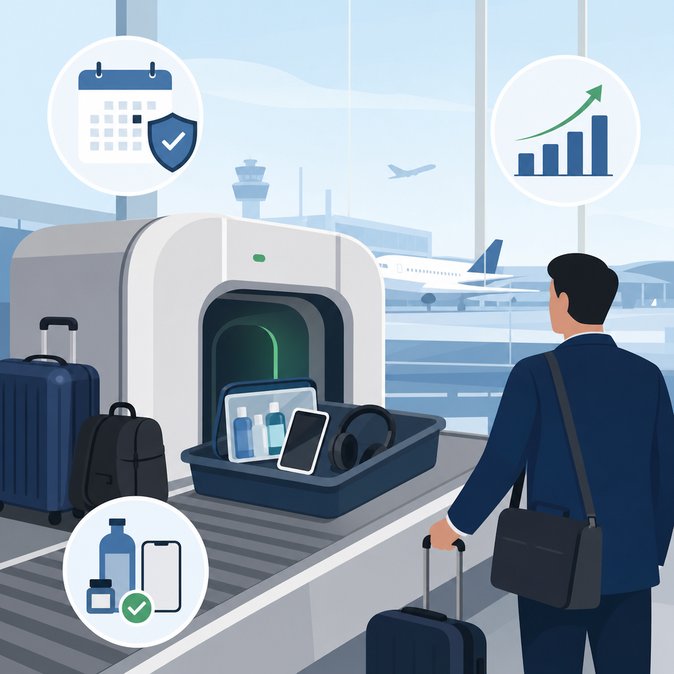
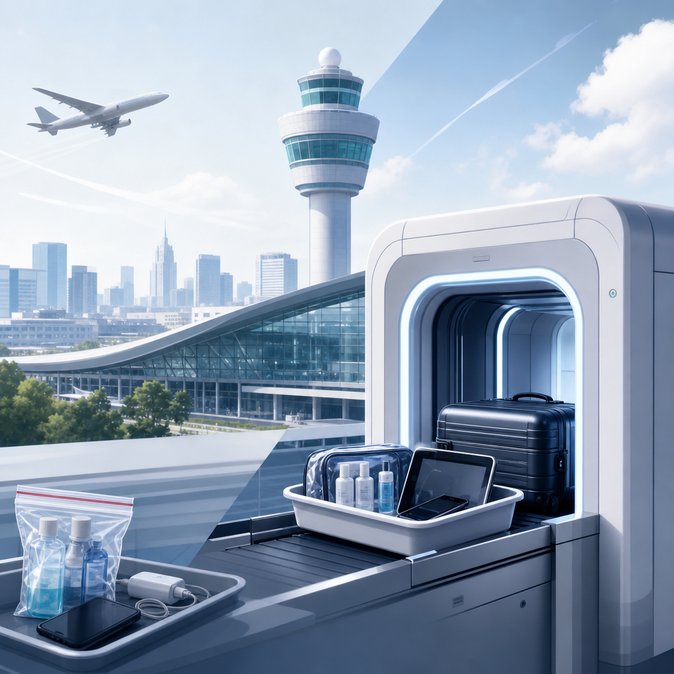
Business travellers who dread the stop-start ritual of unpacking laptops and plastic bags of mini-bottles at Brussels Airport security will soon be able to breathe a little easier. On 29 May 2026 the airport operator announced a €70 million investment programme to replace all conventional X-ray lanes with Computed Tomography (CT) scanners and new body-scanners. The project will be phased in between 2027 and 2028 so that, once fully operational, passengers will be able to keep electronics and liquids inside their cabin baggage – in line with revised EU aviation-security rules that come into force in 2027. CT scanners generate a three-dimensional image of the contents of a bag and use advanced algorithms to detect explosives. That means the current 100 ml liquid limit can be relaxed to two-litre containers, and the process of removing laptops, tablets and cameras – a key source of bottlenecks at peak times – disappears altogether. According to Brussels Airport CEO Arnaud Feist, the modernised lanes will “increase throughput capacity by at least 25 % while maintaining the highest security standards”.
![Brussels Airport rolls out next-generation CT scanners – liquids and laptops can stay in bags from 2028]()
Meanwhile, companies arranging last-minute hops or multi-country itineraries may also want to streamline the visa side of the equation. VisaHQ’s online platform (https://www.visahq.com/belgium/) lets travellers and travel managers check entry requirements, generate digital invitation letters and submit visa applications for Belgium and dozens of other destinations in a single dashboard—avoiding embassy queues and cutting admin time.
For mobility managers the change is more than a passenger-experience upgrade. Faster lanes reduce the minimum connection time for short-haul‐to-long-haul transfers at Europe’s 12th-busiest hub, something airlines have lobbied for as they rebuild post-pandemic schedules. Companies with large commuter flows between Belgium and neighbouring capitals could shave 10–15 minutes off end-to-end journey times, making same-day meetings in London or Milan viable again. The airport is also re-configuring queuing areas and installing biometric e-gates that will ultimately dovetail with the EU’s Entry/Exit System (EES) and ETIAS travel-authorisation scheme. That future-proofing is critical: management expects passenger volumes to top 30 million by 2030, driven by pharma exports, the NATO enlargement wave and the 2028 Antwerp World Expo. Practical take-away: frequent-flier programmes and TMCs should update traveller communications. The first six lanes in Pier A will switch to CT in Q2 2027, with the entire airport converted by the 2028 summer peak. Until then, the existing 100 ml rule still applies and travellers should continue to arrive two hours (Schengen) or three hours (non-Schengen) before departure.
Meanwhile, companies arranging last-minute hops or multi-country itineraries may also want to streamline the visa side of the equation. VisaHQ’s online platform (https://www.visahq.com/belgium/) lets travellers and travel managers check entry requirements, generate digital invitation letters and submit visa applications for Belgium and dozens of other destinations in a single dashboard—avoiding embassy queues and cutting admin time.
For mobility managers the change is more than a passenger-experience upgrade. Faster lanes reduce the minimum connection time for short-haul‐to-long-haul transfers at Europe’s 12th-busiest hub, something airlines have lobbied for as they rebuild post-pandemic schedules. Companies with large commuter flows between Belgium and neighbouring capitals could shave 10–15 minutes off end-to-end journey times, making same-day meetings in London or Milan viable again. The airport is also re-configuring queuing areas and installing biometric e-gates that will ultimately dovetail with the EU’s Entry/Exit System (EES) and ETIAS travel-authorisation scheme. That future-proofing is critical: management expects passenger volumes to top 30 million by 2030, driven by pharma exports, the NATO enlargement wave and the 2028 Antwerp World Expo. Practical take-away: frequent-flier programmes and TMCs should update traveller communications. The first six lanes in Pier A will switch to CT in Q2 2027, with the entire airport converted by the 2028 summer peak. Until then, the existing 100 ml rule still applies and travellers should continue to arrive two hours (Schengen) or three hours (non-Schengen) before departure.