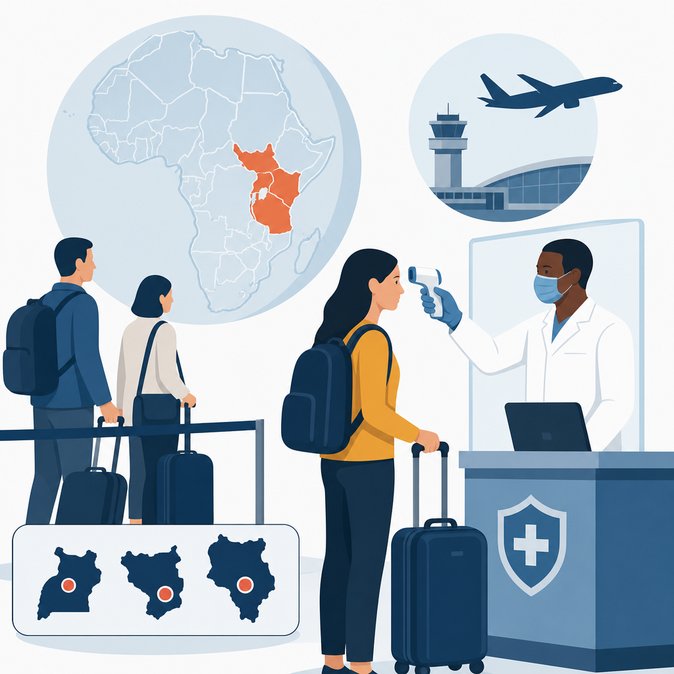
The U.S. Department of State and the Centers for Disease Control and Prevention issued a joint Public Health Alert on May 23 imposing new entry restrictions on anyone—including U.S. citizens and permanent residents—who has been in the Democratic Republic of the Congo (DRC), Uganda or South Sudan within 21 days of arrival. Beginning immediately, such passengers may enter the United States only through three airports equipped for enhanced Ebola screening: Washington Dulles (IAD) for flights after 23:59 ET on May 21, Atlanta Hartsfield-Jackson (ATL) after 23:59 ET on May 22, and Houston George Bush Intercontinental (IAH) after 23:59 CT on May 26. Customs and Border Protection officers, working with CDC medical staff, will conduct temperature checks, health questionnaires and possible isolation for symptomatic travelers. Airlines have been instructed to re-route affected passengers, and the alert warns of potential flight cancellations or last-minute schedule changes. The measure follows the World Health Organization’s May 22 declaration that the Ebola outbreak in eastern DRC poses a “very high” national risk.
![Enhanced Ebola Screening: U.S. Restricts Entry Points for Travelers From DRC, Uganda and South Sudan]()
For travelers unsure how these entry funnels affect their itineraries, VisaHQ can streamline the planning. The service (https://www.visahq.com/united-states/) monitors real-time U.S. health advisories, helps verify documentation, and works with corporate mobility teams to confirm that bookings comply with the designated-airport requirement—reducing the risk of costly re-routing at the last minute.
Although no Ebola cases have been detected in the United States, officials say the restrictions are a precaution to prevent importation during the busy summer travel season. Multinational companies with operations in Central and East Africa must now update travel protocols, ensuring assignees and business travelers schedule connections through the designated airports and build extra transit time into itineraries. Employers should also confirm that travel-insurance policies cover medical evacuation in the event of exposure and remind staff to enroll in the State Department’s STEP alert system. For global mobility managers, the move revives memories of the COVID-19 era, when country-specific entry funnels created significant logistical hurdles. Employees who inadvertently transit a non-designated U.S. gateway could be denied boarding at origin or forced to re-book at their own expense. Companies are encouraged to distribute clear guidance, maintain traveler-tracking dashboards, and coordinate with travel management companies to flag bookings originating in the three affected countries. Public-health experts say the limited, airport-funnel approach is less disruptive than blanket travel bans but stress that screening must be paired with robust contact-tracing to be effective. The CDC has not indicated how long the measures will remain in place; updates will depend on the trajectory of the Ebola outbreak in Africa.

For travelers unsure how these entry funnels affect their itineraries, VisaHQ can streamline the planning. The service (https://www.visahq.com/united-states/) monitors real-time U.S. health advisories, helps verify documentation, and works with corporate mobility teams to confirm that bookings comply with the designated-airport requirement—reducing the risk of costly re-routing at the last minute.
Although no Ebola cases have been detected in the United States, officials say the restrictions are a precaution to prevent importation during the busy summer travel season. Multinational companies with operations in Central and East Africa must now update travel protocols, ensuring assignees and business travelers schedule connections through the designated airports and build extra transit time into itineraries. Employers should also confirm that travel-insurance policies cover medical evacuation in the event of exposure and remind staff to enroll in the State Department’s STEP alert system. For global mobility managers, the move revives memories of the COVID-19 era, when country-specific entry funnels created significant logistical hurdles. Employees who inadvertently transit a non-designated U.S. gateway could be denied boarding at origin or forced to re-book at their own expense. Companies are encouraged to distribute clear guidance, maintain traveler-tracking dashboards, and coordinate with travel management companies to flag bookings originating in the three affected countries. Public-health experts say the limited, airport-funnel approach is less disruptive than blanket travel bans but stress that screening must be paired with robust contact-tracing to be effective. The CDC has not indicated how long the measures will remain in place; updates will depend on the trajectory of the Ebola outbreak in Africa.