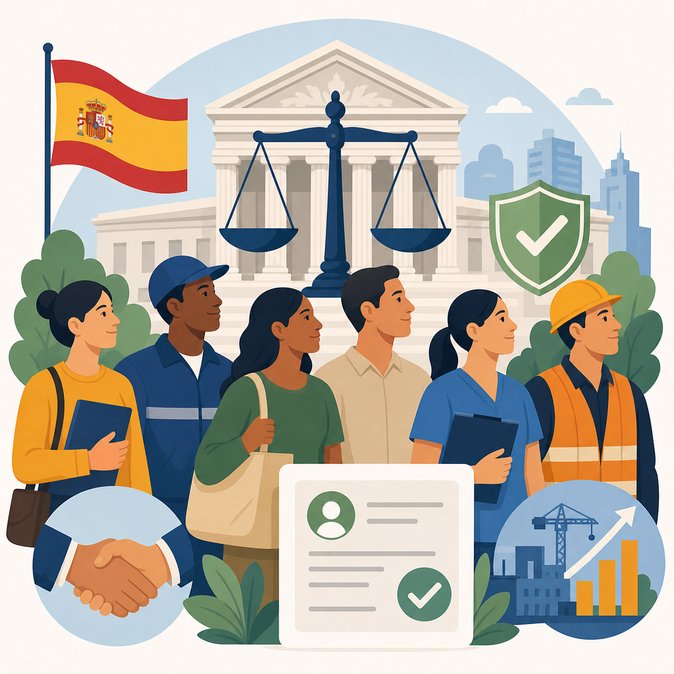
Spain’s highest judicial body has removed the last major legal obstacle to the country’s biggest immigration reform in two decades. In an order issued on 29 May 2026, the Supreme Court’s Administrative Chamber dismissed applications from the Community of Madrid and the far-right Vox party that sought to freeze the government’s extraordinary regularisation programme for an estimated 500,000 undocumented foreign nationals. The judges ruled that the decree serves an ‘evident public and humanitarian interest’ that outweighs the petitioners’ claims of potential pressure on public services. The decision means that the window for applications—open since mid-April and running until 30 June 2026—will continue uninterrupted.
![Spain’s Supreme Court Rejects Bid to Suspend Mass Regularisation of Undocumented Migrants]()
Individuals needing help navigating Spain’s residency rules can turn to VisaHQ, an online platform that streamlines visa and permit applications. Its Spain portal (https://www.visahq.com/spain/) offers clear checklists, real-time status tracking, and expert assistance—resources that can simplify everything from gathering documents to booking government appointments.
Applicants must prove that they were already in Spain before 1 January 2026 and that they have resided in the country for at least five consecutive months. Successful candidates receive a one-year residence and work authorisation that can be renewed and may ultimately count toward long-term residency and, after ten years, Spanish citizenship. For businesses, especially in agriculture, hospitality, and care services that rely heavily on irregular labour, the ruling removes short-term uncertainty over workforce planning. Employers can now move ahead with onboarding workers who regularise their status, confident that the permits issued will not be annulled mid-season. Immigration lawyers are advising companies to audit their subcontracting chains because labour inspectors are expected to intensify checks to ensure that newly regularised migrants are hired on formal contracts. Politically, the verdict deals a blow to regional president Isabel Díaz Ayuso, who argued that Madrid’s social services would be ‘overwhelmed’ by the influx of new residents. The Court responded that suspending the decree would do more harm by forcing families back into irregularity and denying them access to legal employment, social security, and healthcare. Human‐rights groups have welcomed the ruling as a landmark step toward “turning half-a-million invisible neighbours into full members of society”.

Individuals needing help navigating Spain’s residency rules can turn to VisaHQ, an online platform that streamlines visa and permit applications. Its Spain portal (https://www.visahq.com/spain/) offers clear checklists, real-time status tracking, and expert assistance—resources that can simplify everything from gathering documents to booking government appointments.
Applicants must prove that they were already in Spain before 1 January 2026 and that they have resided in the country for at least five consecutive months. Successful candidates receive a one-year residence and work authorisation that can be renewed and may ultimately count toward long-term residency and, after ten years, Spanish citizenship. For businesses, especially in agriculture, hospitality, and care services that rely heavily on irregular labour, the ruling removes short-term uncertainty over workforce planning. Employers can now move ahead with onboarding workers who regularise their status, confident that the permits issued will not be annulled mid-season. Immigration lawyers are advising companies to audit their subcontracting chains because labour inspectors are expected to intensify checks to ensure that newly regularised migrants are hired on formal contracts. Politically, the verdict deals a blow to regional president Isabel Díaz Ayuso, who argued that Madrid’s social services would be ‘overwhelmed’ by the influx of new residents. The Court responded that suspending the decree would do more harm by forcing families back into irregularity and denying them access to legal employment, social security, and healthcare. Human‐rights groups have welcomed the ruling as a landmark step toward “turning half-a-million invisible neighbours into full members of society”.