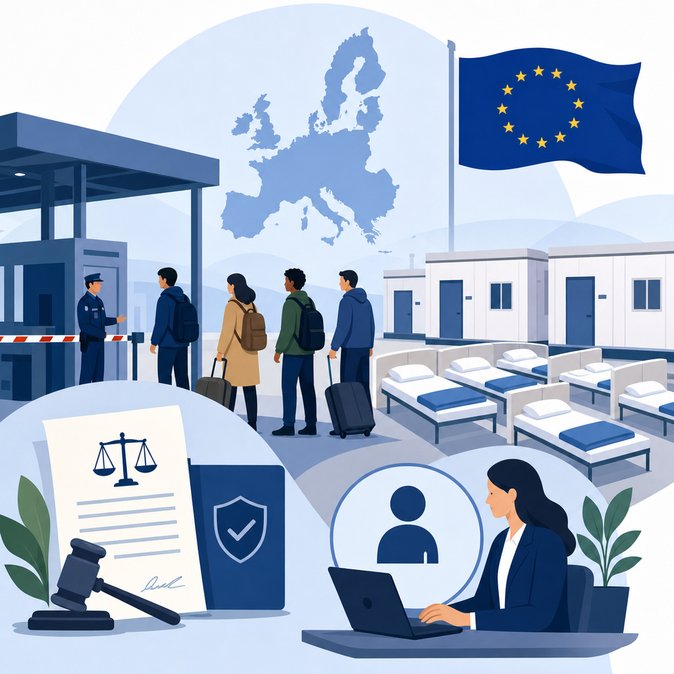
Spain has entered the final stretch toward implementing the European Union’s new border asylum regime. Speaking in the Senate on 26 May, Minister of Inclusion, Social Security and Migration Elma Saiz confirmed that the country will have 3,301 reception places fully operational on 12 June, the date on which the EU’s re-engineered ‘border procedure’ becomes mandatory. The new framework, adopted under the 2024-2025 Pact on Migration and Asylum, obliges Member States to carry out accelerated screenings for certain asylum seekers immediately at the external frontier and to accommodate them in dedicated facilities while their claims are assessed. According to Saiz, Spain has already notified Brussels of the exact centres that will host applicants. Most are existing, publicly-owned sites run by the Ministry of Inclusion, upgraded over the past year to meet EU standards for case processing, biometric registration and independent monitoring.
The Ombudsperson (Defensor del Pueblo) will act as the national fundamental-rights watchdog for the new procedure, mirroring models in Germany and the Netherlands.
![Spain readies 3,301 reception places to launch EU border-asylum procedure on 12 June]()
Meanwhile, travellers and HR teams navigating these shifts can turn to VisaHQ for practical assistance. Via its dedicated Spain page (https://www.visahq.com/spain/), the service provides real-time visa requirements, document checks and application support, helping applicants stay compliant as the new border procedures take effect.
Three inter-ministerial task-forces—covering triage, protection procedure and IT—have been working since late 2025 to integrate police, migration and judicial databases so that decisions can be taken within the 12-week maximum foreseen by the Regulation. The minister also revealed that the Interior Ministry has drafted amendments to the Asylum Law and the Aliens Act to transpose the pact, while a public consultation opened this week on changes to Spain’s reception-system rules. Regional governments, especially those bearing the brunt of arrivals in Andalusia, the Canaries and the Basque Country, have complained of “limited information”. Saiz promised a sectorial conference in June to clarify burden-sharing and the treatment of unaccompanied minors. For multinational employers the message is two-fold. First, staff whose protection claims have been pending for months may see decisions speed up—but negative decisions and accelerated returns could also rise. Second, assignees posted to high-arrival regions should expect more visible security and NGO presence at airports and ferry ports as the new screening zones go live. Companies relying on humanitarian access programmes should review contingency plans before the summer peak. Ultimately, Spain’s swift rollout strengthens its position in Brussels as a ‘front-runner’ on the pact, potentially giving it leverage in forthcoming talks on the EU Talent Pool and Schengen visa digitalisation—two dossiers watched closely by global-mobility managers.
The Ombudsperson (Defensor del Pueblo) will act as the national fundamental-rights watchdog for the new procedure, mirroring models in Germany and the Netherlands.

Meanwhile, travellers and HR teams navigating these shifts can turn to VisaHQ for practical assistance. Via its dedicated Spain page (https://www.visahq.com/spain/), the service provides real-time visa requirements, document checks and application support, helping applicants stay compliant as the new border procedures take effect.
Three inter-ministerial task-forces—covering triage, protection procedure and IT—have been working since late 2025 to integrate police, migration and judicial databases so that decisions can be taken within the 12-week maximum foreseen by the Regulation. The minister also revealed that the Interior Ministry has drafted amendments to the Asylum Law and the Aliens Act to transpose the pact, while a public consultation opened this week on changes to Spain’s reception-system rules. Regional governments, especially those bearing the brunt of arrivals in Andalusia, the Canaries and the Basque Country, have complained of “limited information”. Saiz promised a sectorial conference in June to clarify burden-sharing and the treatment of unaccompanied minors. For multinational employers the message is two-fold. First, staff whose protection claims have been pending for months may see decisions speed up—but negative decisions and accelerated returns could also rise. Second, assignees posted to high-arrival regions should expect more visible security and NGO presence at airports and ferry ports as the new screening zones go live. Companies relying on humanitarian access programmes should review contingency plans before the summer peak. Ultimately, Spain’s swift rollout strengthens its position in Brussels as a ‘front-runner’ on the pact, potentially giving it leverage in forthcoming talks on the EU Talent Pool and Schengen visa digitalisation—two dossiers watched closely by global-mobility managers.