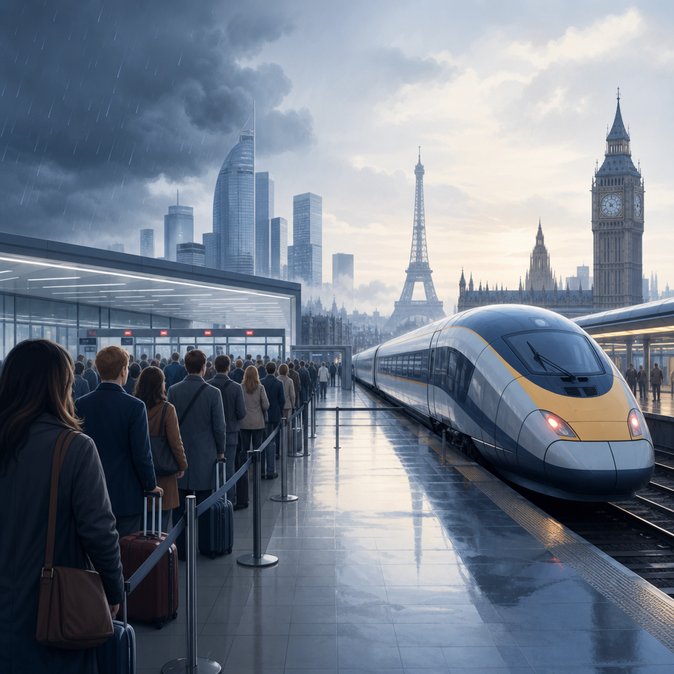
Eurostar’s live service board showed a cascade of delays and cancellations on 25 May 2026, with Paris-bound and London-bound trains hit by a combination of infrastructure problems and extended EU border-control procedures linked to the new Entry/Exit System (EES). At 15:26 the operator listed disruptions at London St Pancras, Paris Gare du Nord and Amsterdam Centraal, explicitly citing “EU border control procedures” for hold-ups on the Dutch leg. EES, fully rolled out across the Schengen Area in April, requires non-EU passengers to provide biometrics on first entry and generates automatic overstay alerts.
![Eurostar warns of same-day delays as EU border checks snarl 25 May services]()
For travellers uncertain about the new EES workflow—or the upcoming ETIAS requirements—VisaHQ can streamline the paperwork, offer real-time guidance, and even book the necessary appointments through its France portal (https://www.visahq.com/france/), helping passengers avoid last-minute snags at St Pancras and Gare du Nord.
While most French airport e-gates now capture data quickly, rail terminals still rely on staffed booths, creating bottlenecks when trains arrive in quick succession. Eurostar says it is collaborating with French border police (PAF) to expand biometric kiosks at St Pancras before the late-2026 launch of ETIAS, but retro-fitting historic stations is technically complex. For 25 May the operator reported delayed departures at Paris, cancellations of train 9061, and ‘limited service’ notices running into the evening. Cross-border commuters experienced knock-on effects on local Transilien and RER services as platform occupancy at Gare du Nord over-ran. Corporate mobility teams should alert travellers that: (1) same-day meetings in London or Paris risk overruns; (2) tickets remain changeable without fee under Eurostar’s disruption policy; and (3) passengers returning to the UK need to allow extra dwell time for exit biometrics until throughput stabilises. Firms can mitigate by scheduling early-morning trains, using videoconferencing back-up options, and keeping proof of attendance to claim EU rail delay compensation (25 % refund after 60 minutes, 50 % after 120 minutes). Looking ahead, Eurostar projects full biometric self-service at St Pancras by October and at Gare du Nord by December. However, engineering works and strike threats on continental networks could still trigger rolling timetable changes throughout the summer peak.
For travellers uncertain about the new EES workflow—or the upcoming ETIAS requirements—VisaHQ can streamline the paperwork, offer real-time guidance, and even book the necessary appointments through its France portal (https://www.visahq.com/france/), helping passengers avoid last-minute snags at St Pancras and Gare du Nord.
While most French airport e-gates now capture data quickly, rail terminals still rely on staffed booths, creating bottlenecks when trains arrive in quick succession. Eurostar says it is collaborating with French border police (PAF) to expand biometric kiosks at St Pancras before the late-2026 launch of ETIAS, but retro-fitting historic stations is technically complex. For 25 May the operator reported delayed departures at Paris, cancellations of train 9061, and ‘limited service’ notices running into the evening. Cross-border commuters experienced knock-on effects on local Transilien and RER services as platform occupancy at Gare du Nord over-ran. Corporate mobility teams should alert travellers that: (1) same-day meetings in London or Paris risk overruns; (2) tickets remain changeable without fee under Eurostar’s disruption policy; and (3) passengers returning to the UK need to allow extra dwell time for exit biometrics until throughput stabilises. Firms can mitigate by scheduling early-morning trains, using videoconferencing back-up options, and keeping proof of attendance to claim EU rail delay compensation (25 % refund after 60 minutes, 50 % after 120 minutes). Looking ahead, Eurostar projects full biometric self-service at St Pancras by October and at Gare du Nord by December. However, engineering works and strike threats on continental networks could still trigger rolling timetable changes throughout the summer peak.