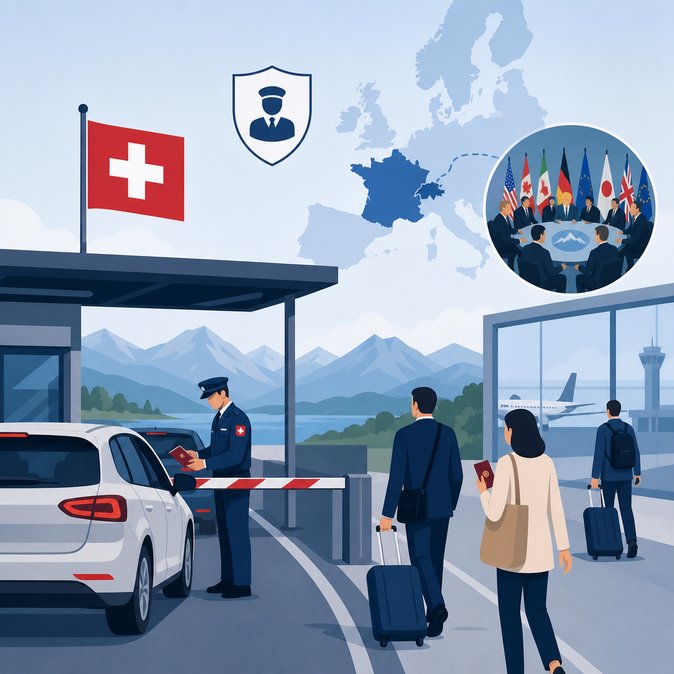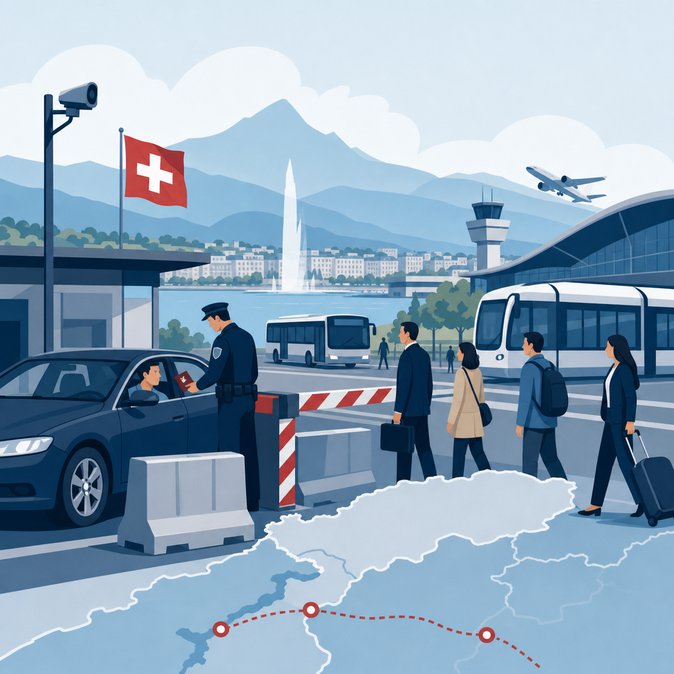
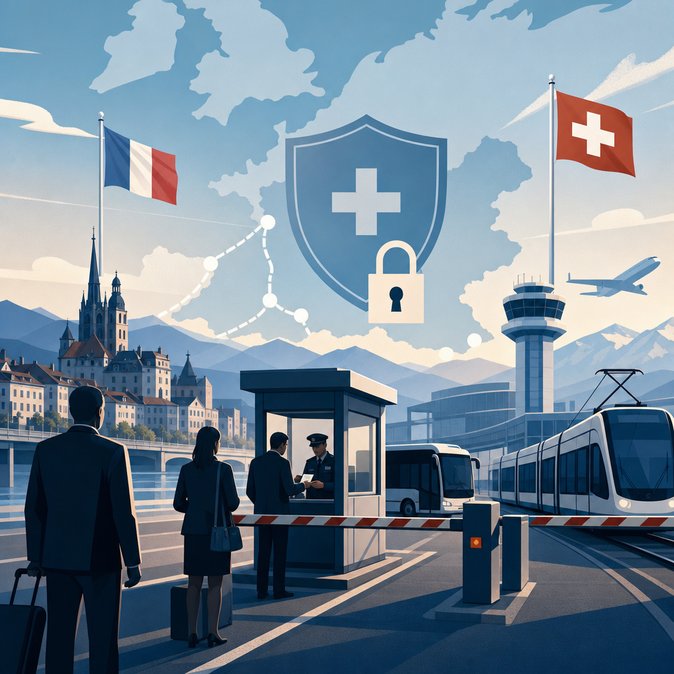
Geneva and the wider Lake Geneva region are preparing for an extraordinary security operation ahead of the G7 leaders’ meeting in nearby Évian-les-Bains on 15–17 June. Although the summit takes place on French soil, the Swiss Federal Council has authorised the temporary suspension of Schengen free-movement rules between 10 and 19 June, closing around 30 minor crossings and re-introducing systematic checks at the seven main road and rail posts linking Switzerland and France. Travellers should expect ‘significant delays’ as every vehicle is inspected; a priority-lane pass will be issued only to essential cross-border workers in critical sectors. Geneva Airport has launched a dedicated G7 information portal and will shift to an “adapted organisation” from 13 June.
![Geneva Braces for G7 Summit: Switzerland Re-imposes French Border Checks & Tweaks Airport, Public Transport Operations]()
Whether you’re flying in for a high-level bilateral or a routine site visit, it may be worth double-checking your entry paperwork now. VisaHQ’s Swiss portal (https://www.visahq.com/switzerland/) offers quick visa assessments, document checklists and expedited courier handling, giving travellers and corporate travel managers a single dashboard to track any additional permits or letters of invitation that local police might request during the G7 security window.
While flight schedules remain largely intact, passengers face parking closures, heavier police presence and longer landside queues; the airport urges check-in three hours before departure. Air-freight forwarders have also been warned that customs clearance could slow down time-critical consignments of pharmaceuticals and luxury goods. Public-transport operator TPG will run a holiday timetable during the summit week, cutting frequencies on several cross-border bus and tram routes. Business travellers headed to Geneva’s banking district or the UN campus should plan for earlier departures, possible modal swaps to commuter rail, and remote-working contingencies for staff who live in Haute-Savoie. The Canton has published real-time disruption maps and recommends that firms issue written confirmations of duty travel for employees to show at roadblocks. The decision mirrors wider Schengen-area security tightening: Italy, the Netherlands and Germany have prolonged internal checks through 2026, citing terrorism and migration concerns. For multinationals with regional headquarters in Geneva, the episode is a live stress-test of business-continuity plans, especially for supply-chain managers who rely on just-in-time deliveries via the A40 motorway and CEVA cross-border rail. The Federal Council insists the measure is ‘strictly temporary’, but critics fear it normalises ad-hoc border closures that erode the predictability on which cross-border labour markets depend. Corporate mobility teams should: 1) brief travellers to carry passports or Swiss residence cards even for routine commutes; 2) reserve airport fast-track services early; 3) anticipate overtime costs for logistics providers; and 4) monitor cantonal websites for late-breaking route closures. Once the summit ends, controls are expected to lift at 00:01 on 20 June, restoring Switzerland’s full participation in the passport-free zone.
Whether you’re flying in for a high-level bilateral or a routine site visit, it may be worth double-checking your entry paperwork now. VisaHQ’s Swiss portal (https://www.visahq.com/switzerland/) offers quick visa assessments, document checklists and expedited courier handling, giving travellers and corporate travel managers a single dashboard to track any additional permits or letters of invitation that local police might request during the G7 security window.
While flight schedules remain largely intact, passengers face parking closures, heavier police presence and longer landside queues; the airport urges check-in three hours before departure. Air-freight forwarders have also been warned that customs clearance could slow down time-critical consignments of pharmaceuticals and luxury goods. Public-transport operator TPG will run a holiday timetable during the summit week, cutting frequencies on several cross-border bus and tram routes. Business travellers headed to Geneva’s banking district or the UN campus should plan for earlier departures, possible modal swaps to commuter rail, and remote-working contingencies for staff who live in Haute-Savoie. The Canton has published real-time disruption maps and recommends that firms issue written confirmations of duty travel for employees to show at roadblocks. The decision mirrors wider Schengen-area security tightening: Italy, the Netherlands and Germany have prolonged internal checks through 2026, citing terrorism and migration concerns. For multinationals with regional headquarters in Geneva, the episode is a live stress-test of business-continuity plans, especially for supply-chain managers who rely on just-in-time deliveries via the A40 motorway and CEVA cross-border rail. The Federal Council insists the measure is ‘strictly temporary’, but critics fear it normalises ad-hoc border closures that erode the predictability on which cross-border labour markets depend. Corporate mobility teams should: 1) brief travellers to carry passports or Swiss residence cards even for routine commutes; 2) reserve airport fast-track services early; 3) anticipate overtime costs for logistics providers; and 4) monitor cantonal websites for late-breaking route closures. Once the summit ends, controls are expected to lift at 00:01 on 20 June, restoring Switzerland’s full participation in the passport-free zone.