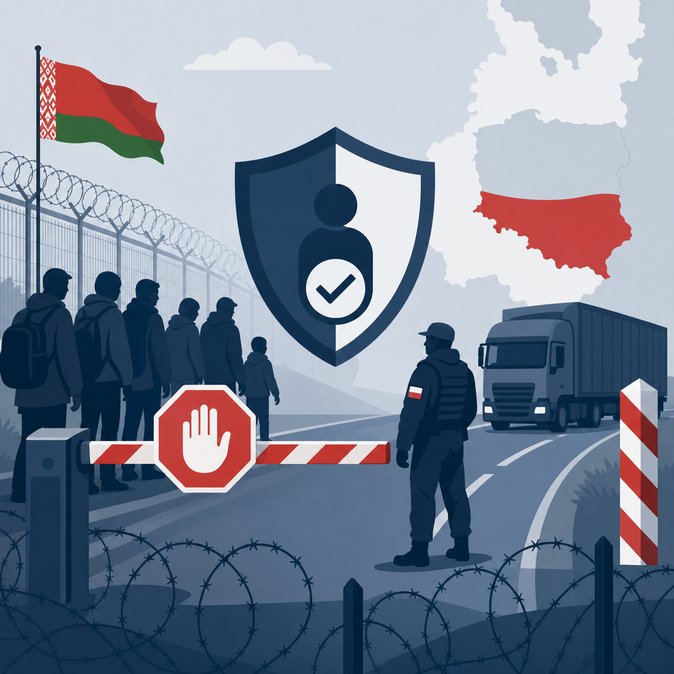
The Polish Sejm has approved yet another 60-day extension of the extraordinary measure that blocks most migrants from lodging applications for international protection at official crossing points on the Belarusian frontier. The renewed restriction, which took effect at 00:00 on 21 May 2026, is the seventh consecutive prolongation since the rule was first imposed in March 2025. Government ministers told MPs that the underlying security rationale has not changed: Warsaw continues to accuse the regime of Aleksandr Lukashenko of “instrumentalising migration” by funnelling people from the Middle East and Africa toward EU territory.
![Poland Extends Ban on Asylum Applications at the Belarus Border for a Seventh Time]()
For anyone who still needs to travel to or work in Poland despite the heightened controls, VisaHQ can help demystify the evolving requirements. The service’s dedicated Poland portal (https://www.visahq.com/poland/) provides live updates on entry rules, visa options and supporting documents, allowing travellers, HR teams and mobility managers to prepare compliant applications without delay.
According to the Ministry of the Interior, Polish border guards turned away 475 would-be applicants between the start of the ban and 21 April 2026, a stark contrast with the same period a year earlier, when more than 3,100 requests were accepted. Only narrowly defined “vulnerable groups” – unaccompanied minors, pregnant women, the elderly and the seriously ill – are still allowed to file claims, and 127 such cases have been processed in the past thirteen months. From a global-mobility perspective, the decision tightens an already restrictive corridor at the EU’s eastern edge. Transport operators moving staff or goods through the Kuźnica, Bobrowniki or Terespol crossings must factor in longer inspection times and the possibility of ad-hoc detours if pedestrian lanes are temporarily closed. Companies relocating third-country nationals to Poland should also anticipate heightened document checks at airports: officials confirmed that the same risk-profiling algorithms used on the land border are now being trialled at Warsaw Chopin Airport’s non-Schengen arrivals. Legal practitioners note that the rolling extensions sit in a grey zone of EU law. While Article 6 of the Schengen Borders Code allows member states to reintroduce controls in emergencies, human-rights NGOs argue that a 14-month blanket refusal violates the bloc’s Asylum Procedures Regulation. Poland counters that each prolongation is individually authorised by parliament and therefore meets the “time-limited” requirement. A challenge brought by the Helsinki Foundation for Human Rights is pending before the Supreme Administrative Court, but a judgment is unlikely before late summer. In practical terms, multinational employers should update crisis-response playbooks for staff whose nationalities may expose them to questioning on arrival. HR teams are advised to flag the policy in pre-departure briefings and, where possible, route short-term assignees through alternative airports such as Kraków or Gdańsk to minimise exposure. Mobility managers should also monitor freight forwarders’ surcharges: industry bodies warn that container drivers face queue surcharges of up to €180 per trip if congestion at Bobrowniki worsens during the harvest season. Although the extension formally expires on 19 July 2026, interior-ministry sources have already signalled that another request for prolongation is “probable”. With the EU’s new Entry/Exit System bedding in and the bloc’s migration pact still stalled, few observers expect the Polish-Belarusian crossing to return to normal asylum processing before 2027.

For anyone who still needs to travel to or work in Poland despite the heightened controls, VisaHQ can help demystify the evolving requirements. The service’s dedicated Poland portal (https://www.visahq.com/poland/) provides live updates on entry rules, visa options and supporting documents, allowing travellers, HR teams and mobility managers to prepare compliant applications without delay.
According to the Ministry of the Interior, Polish border guards turned away 475 would-be applicants between the start of the ban and 21 April 2026, a stark contrast with the same period a year earlier, when more than 3,100 requests were accepted. Only narrowly defined “vulnerable groups” – unaccompanied minors, pregnant women, the elderly and the seriously ill – are still allowed to file claims, and 127 such cases have been processed in the past thirteen months. From a global-mobility perspective, the decision tightens an already restrictive corridor at the EU’s eastern edge. Transport operators moving staff or goods through the Kuźnica, Bobrowniki or Terespol crossings must factor in longer inspection times and the possibility of ad-hoc detours if pedestrian lanes are temporarily closed. Companies relocating third-country nationals to Poland should also anticipate heightened document checks at airports: officials confirmed that the same risk-profiling algorithms used on the land border are now being trialled at Warsaw Chopin Airport’s non-Schengen arrivals. Legal practitioners note that the rolling extensions sit in a grey zone of EU law. While Article 6 of the Schengen Borders Code allows member states to reintroduce controls in emergencies, human-rights NGOs argue that a 14-month blanket refusal violates the bloc’s Asylum Procedures Regulation. Poland counters that each prolongation is individually authorised by parliament and therefore meets the “time-limited” requirement. A challenge brought by the Helsinki Foundation for Human Rights is pending before the Supreme Administrative Court, but a judgment is unlikely before late summer. In practical terms, multinational employers should update crisis-response playbooks for staff whose nationalities may expose them to questioning on arrival. HR teams are advised to flag the policy in pre-departure briefings and, where possible, route short-term assignees through alternative airports such as Kraków or Gdańsk to minimise exposure. Mobility managers should also monitor freight forwarders’ surcharges: industry bodies warn that container drivers face queue surcharges of up to €180 per trip if congestion at Bobrowniki worsens during the harvest season. Although the extension formally expires on 19 July 2026, interior-ministry sources have already signalled that another request for prolongation is “probable”. With the EU’s new Entry/Exit System bedding in and the bloc’s migration pact still stalled, few observers expect the Polish-Belarusian crossing to return to normal asylum processing before 2027.