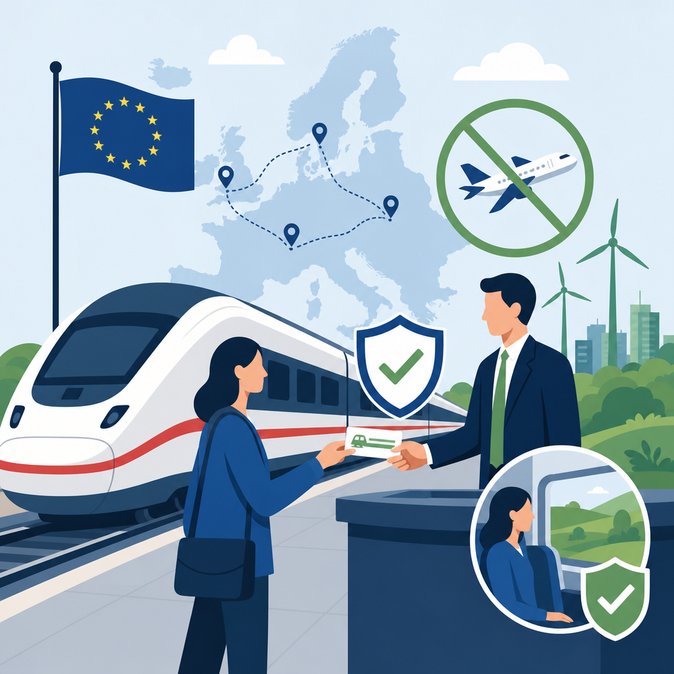
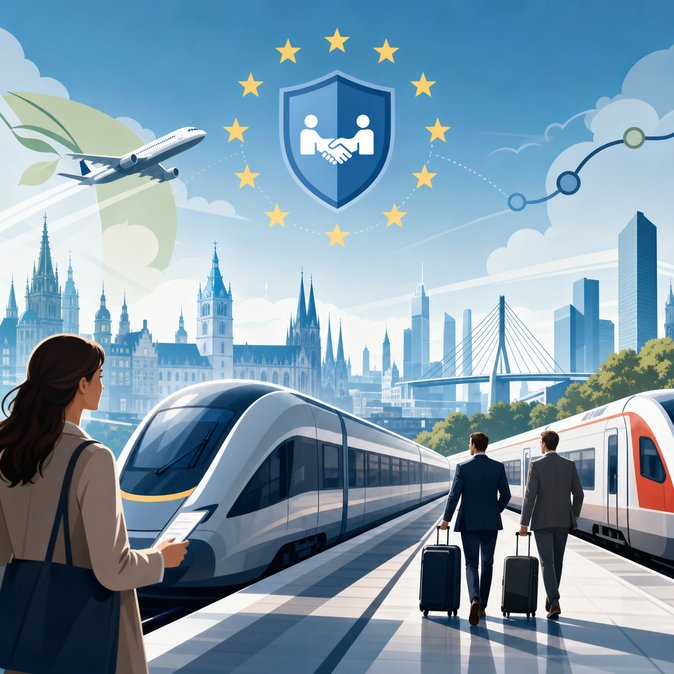
Late on the evening of 16 May 2026 the Council of the European Union adopted a landmark regulation that will force Europe’s rail operators—Deutsche Bahn included—to sell each other’s tickets on their own websites and apps. The law, years in the making, aims to make cross-border train travel as simple as booking a flight and is being hailed by German business-travel managers as a potential game-changer. Under the new rules, rail carriers must provide real-time fares and seat inventory to accredited platforms and honour through-ticket rights similar to airline interlining. If a delayed ICE from Frankfurt causes a passenger to miss a Thalys connection in Brussels, the second carrier must rebook the traveller or refund the unused leg and cover reasonable meals and, where necessary, overnight accommodation. The regulation also caps re-routing fees and obliges operators to automate EU-wide compensation claims. For German corporates with pan-European footprints, the change promises lower booking fees, richer data for CO₂ accounting, and a credible alternative to short-haul air—particularly as surcharges linked to the Iran-war oil spike keep airfares volatile. Travel-management company BCD Germany estimates that firms could shift up to 18 percent of intra-Schengen trips from air to rail within two years if connectivity and punctuality targets are met, saving both money and emissions.
![One Ticket, Any Train: EU Adopts Seamless Rail-Booking Law Benefiting German Travellers]()
Whether you’re a frequent business traveler or an expat newly settled in Germany, VisaHQ can streamline the paperwork that often accompanies international mobility. Its dedicated portal (https://www.visahq.com/germany/) provides step-by-step assistance with Schengen visas, residence permits and passport services, letting you focus on snapping up those seamless cross-border train tickets while VisaHQ handles the red tape.
Rail incumbents lobbied hard against mandatory data sharing, arguing it would erode brand differentiation and expose them to "free-riding" OTAs. The European Commission countered that fragmented sales channels make trains 70 percent slower to book than flights, suppressing demand and undermining the EU Green Deal. A phased implementation schedule gives operators until mid-2027 to open their APIs; Deutsche Bahn says its "NextGen Distribution" interface will enter beta in Q4 2026. From a mobility-policy angle, the regulation dovetails with Germany’s own efforts to decarbonise domestic travel, such as the €49 Deutschland-Ticket and the rollout of hybrid ICE L sets optimised for international routes. For expatriates and assignees based in Germany, the promise is clear: one click to reach Paris, Amsterdam or Milan—plus stronger passenger-rights if things go wrong.
Whether you’re a frequent business traveler or an expat newly settled in Germany, VisaHQ can streamline the paperwork that often accompanies international mobility. Its dedicated portal (https://www.visahq.com/germany/) provides step-by-step assistance with Schengen visas, residence permits and passport services, letting you focus on snapping up those seamless cross-border train tickets while VisaHQ handles the red tape.
Rail incumbents lobbied hard against mandatory data sharing, arguing it would erode brand differentiation and expose them to "free-riding" OTAs. The European Commission countered that fragmented sales channels make trains 70 percent slower to book than flights, suppressing demand and undermining the EU Green Deal. A phased implementation schedule gives operators until mid-2027 to open their APIs; Deutsche Bahn says its "NextGen Distribution" interface will enter beta in Q4 2026. From a mobility-policy angle, the regulation dovetails with Germany’s own efforts to decarbonise domestic travel, such as the €49 Deutschland-Ticket and the rollout of hybrid ICE L sets optimised for international routes. For expatriates and assignees based in Germany, the promise is clear: one click to reach Paris, Amsterdam or Milan—plus stronger passenger-rights if things go wrong.